13 best AI email assistants

Discover how AI email assistants handle sorting, drafting, and scheduling automatically.

You're in a meeting when someone asks if anyone responded to the client yet. Three people say yes. Nobody knows which version went out. Later, you discover all three replies said slightly different things.
This happens because most professionals manage email the same way they did ten years ago: manually sorting, individually responding, and hoping nothing falls through. Your inbox doesn't care that you have better things to do. It just keeps filling up.
AI email assistants change this. They learn which messages actually matter to you. They draft replies while you sleep. They turn meeting requests into calendar events without you touching your keyboard. The shift from manual management to AI assistance means spending less time reacting to email and more time on work that matters.
This guide explores AI email assistants and how they transform inbox chaos into something manageable.
Benefits of AI email assistants
Your inbox grows faster than you can manage. Messages stack up, replies overlap, and details get lost. AI assistants step in to untangle the confusion and keep communication flowing.
Automatic sorting & prioritization
AI learns which senders and topics matter most by watching your behavior. It filters promotional emails away from client messages. Critical communications surface first. Everything else waits until you have time.
Time savings & productivity
AI email assistants handle the repetitive work that consumes your day. Faster inbox processing, automated responses to routine questions, and reduced context switching add up. Users report meaningful time savings each week.
Team collaboration
Modern AI platforms turn email into collaborative workspace. Teams discuss client communications privately through internal comments. They assign tasks directly from messages. Everyone maintains visibility across customer interactions without leaving their inbox.
Similar to how Coda enables teams to collaborate on documents and workflows, AI email assistants create shared understanding around communications. Teams coordinate around what clients actually said rather than working from fragmented memory.
Personalization & scalability
AI learns contextual information about your contacts and adapts to your writing tone. You can send one email or hundreds while maintaining a personal touch. The system scales your outreach capacity without sacrificing quality.
Workflow automation
Smart scheduling eliminates the back-and-forth of finding meeting times. Auto-reply features draft appropriate responses that you edit and send. The assistant handles repetitive tasks that traditionally consume valuable time.
Reduction of cognitive load
AI summarization provides quick overviews of lengthy email threads. Intelligent categorization groups related messages automatically. You focus on decisions that matter rather than triaging every message manually.
13 best AI email assistants
Different tools solve different problems. Some excel at team collaboration. Others prioritize inbox organization or writing assistance. We've organized these tools by their primary strengths to help you find what fits your needs.
TL;DR:
- Superhuman Mail: speed-focused AI assistant with instant replies, auto-summarize, and keyboard shortcuts
- Missive: shared inboxes with internal chat and collaborative drafting for teams
- Front: AI-powered triage and workflow automation for customer communication
- SaneBox: intelligent filtering that learns your email behavior across all providers
- Clean Email: bulk email cleanup with smart views and one-click unsubscribe
- Grammarly: real-time grammar, tone, and clarity suggestions across email platforms
- MailMaestro: AI email generation with magic templates and tone adjustment
- Lavender: real-time email coaching and scoring for sales teams
- SmartWriter: automated prospect research and hyper-personalized cold emails
- Gemini: Google's native AI assistant for Gmail composition and categorization
- Mixmax: email scheduling with AI-optimized send times and sequences
- Mailshake: cold email outreach with automated follow-ups and A/B testing
- Followup.cc: simple email-based reminder system for any provider
Best AI email assistants for team collaboration
Projects stall, threads splinter, and team updates vanish into long email chains nobody has time to untangle. These AI assistants pull everything together, clarifying conversations, aligning teams, and keeping collaboration smooth instead of chaotic.
1. Superhuman Mail
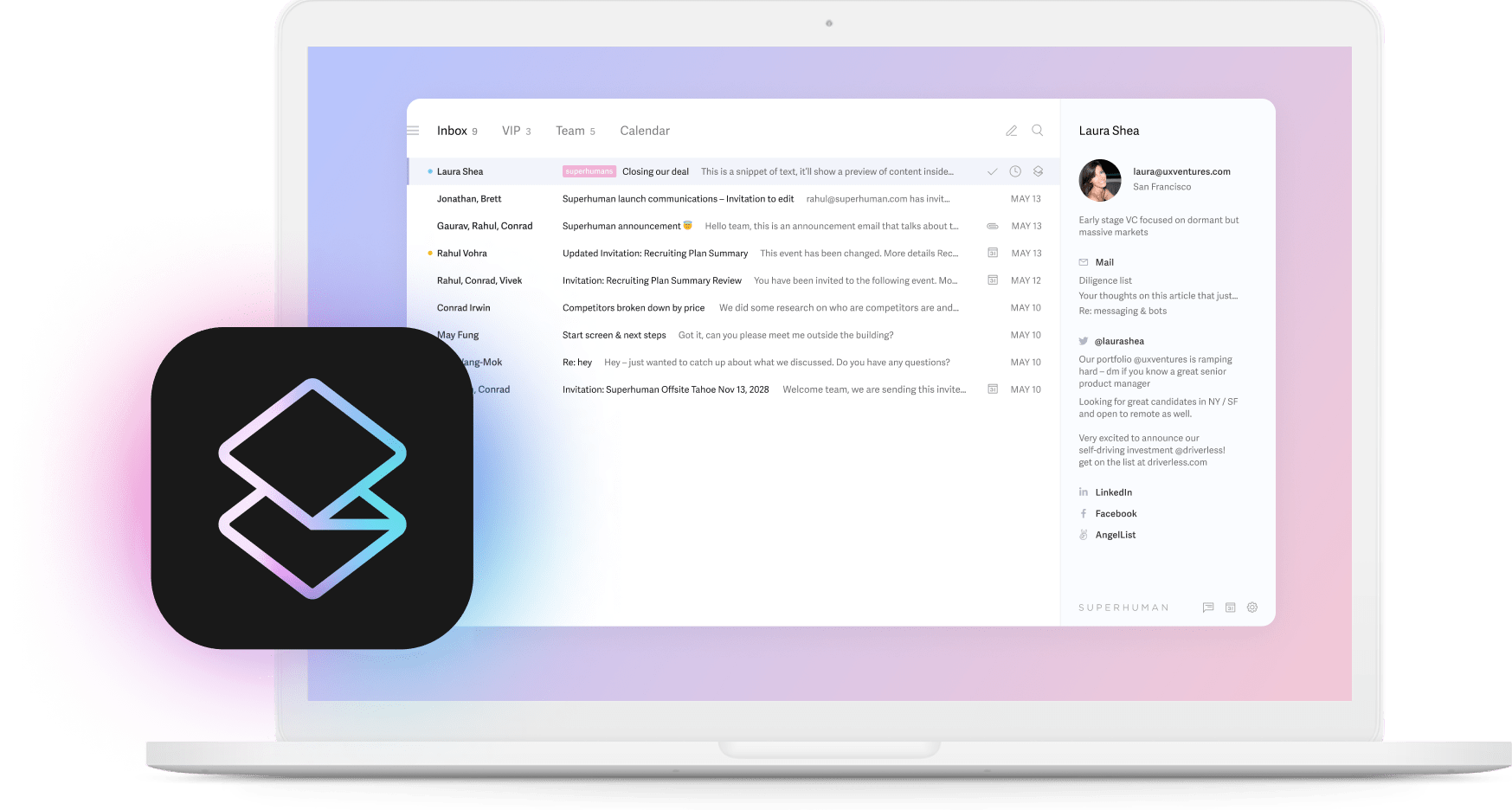
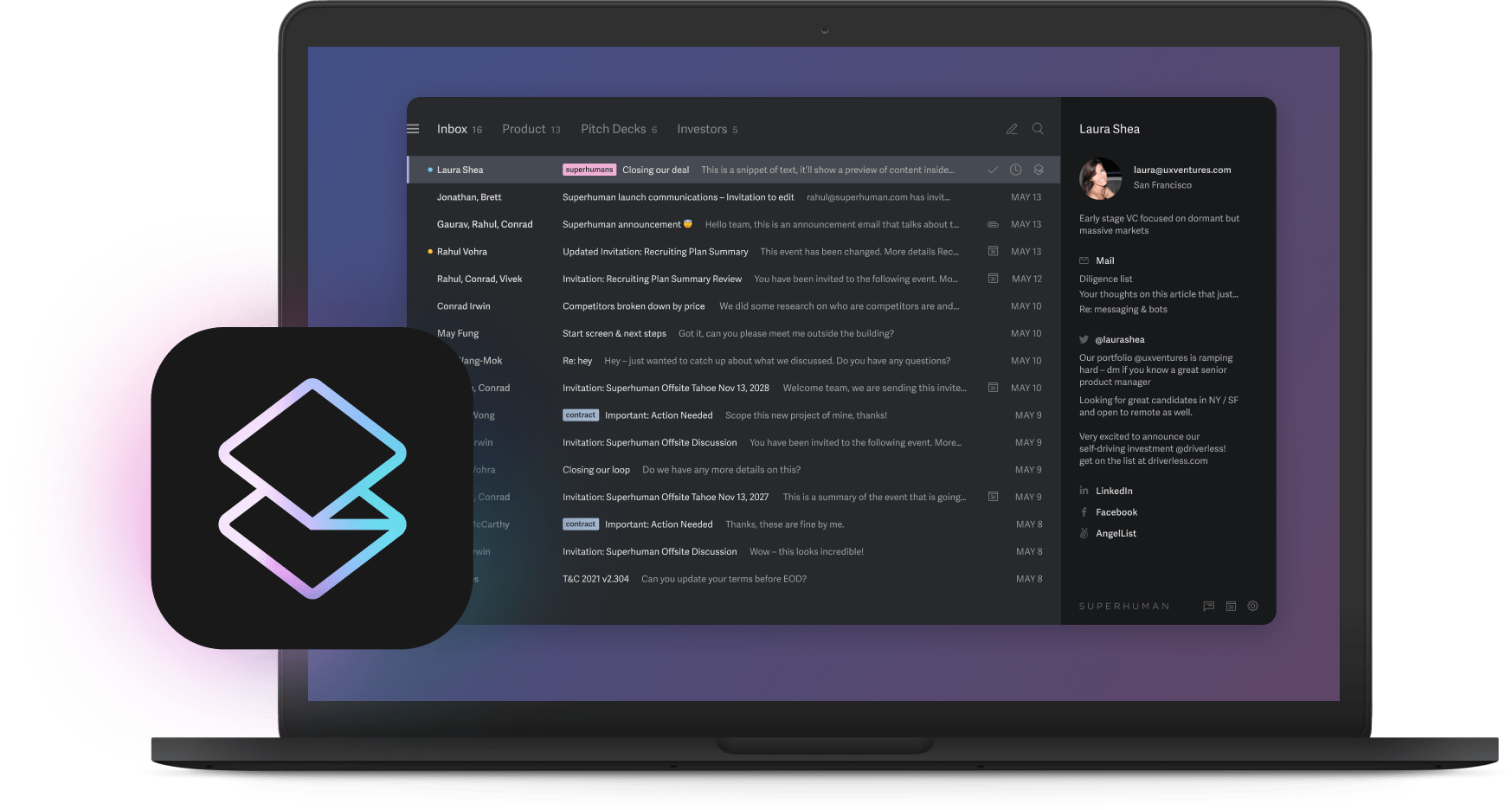
Superhuman Mail helps you process your inbox twice as fast. It integrates with Gmail and Outlook accounts while offering AI assistant features that accelerate everything you do with email. The focus on speed and keyboard shortcuts makes it ideal for professionals who want to fly through messages.
Key Features
- Instant Reply: drafts ready for every email when you wake up
- Auto Summarize: one-line summaries above every conversation that update with new messages
- Instant Event: creates calendar events with title, description, location, attendees, and optimal timing from email content
- Ask AI: rapid answers without searching through old messages
- Shared Conversations: team visibility into email threads
- Team Comments: internal collaboration on messages
- Cross-platform support: native apps for Android, iOS, Windows, and Mac
Pros: Superhuman Mail delivers exceptional speed and productivity gains. Its comprehensive AI assistant features handle writing, scheduling, and searching. Native apps work wherever you do.
Cons: The premium pricing exceeds free alternatives. The keyboard-centric workflow requires learning new habits.
2. Missive
Missive transforms email into collaborative workspace. It combines shared inboxes, internal chat, and task management into a single interface. Small to medium-sized teams that need to coordinate around email communications find it particularly useful.
Key Features
- Shared inboxes: team collaboration on customer emails
- Internal chat: private team discussions within email threads
- Collaborative drafting: real-time editing of emails
- Task management: convert emails to tasks
- AI rules: automatic email analysis and triggered actions
- Multi-channel support: SMS, WhatsApp, and social media integration
Pros: Missive offers excellent team collaboration features. The unified inbox handles all communication channels. Pricing remains affordable for small teams.
Cons: New users face a learning curve. The platform isn't Gmail-native, requiring a switch to a new interface.
3. Front
Front emphasizes team collaboration and workflow automation for customer communication. It excels at streamlining group communication and managing customer interactions with AI assistant features designed to reduce response times.
Key Features
- AI-powered triage: intelligent message routing
- Auto-generated responses: automated replies for common customer inquiries
- Workflow automation: streamlined customer communication processes
- Shared team inbox: assignment and routing capabilities
- Analytics and reporting: team performance tracking
Pros: Front provides strong automation capabilities for customer support. It handles high volumes of customer inquiries effectively. Comprehensive analytics give visibility into team performance.
Cons: The price point increases for enterprise features. Smaller teams may find it complex.
Best AI email assistants for inbox organization and prioritization
Your inbox becomes unpredictable fast. Important messages sink beneath noise, tasks blur, and priorities disappear. These AI assistants step in, sort the chaos, spotlight what matters most, and keep focus.
4. SaneBox
SaneBox automatically sorts incoming emails based on importance. Using algorithms and machine learning, it analyzes your email behavior to determine which messages deserve immediate attention and which can wait.
Key Features
- SaneLater folder: automatic filtering of less important emails
- SaneBlackHole: permanent blocking of unwanted senders
- SaneReminders: follow-up tracking on unreplied emails
- Do Not Disturb: pause incoming email delivery
- SaneAttachments: automatic cloud storage for email attachments
- Universal compatibility: works with Gmail, Outlook, and Apple Mail
Pros: The AI filtering becomes highly effective and improves over time. SaneBox works with any email client. The feature set extends beyond basic filtering.
Cons: The system requires initial training to reach optimal accuracy. No permanent free plan exists, only trial periods.
5. Clean Email
Clean Email helps users quickly delete thousands of emails, unsubscribe from unwanted newsletters, and maintain inbox organization. It uses rules and filters to segment emails into relevant groups, enabling bulk actions.
Key Features
- Smart Views: automatic email grouping by age, sender, and type
- One-click unsubscribe: newsletter and promotional email removal
- Auto Clean: automated repetitive email tasks
- Quick Clean: rapid inbox decluttering
- Privacy Guard: data breach alert monitoring
- Universal compatibility: works across all major email providers
Pros: Clean Email excels at bulk email management and unsubscribe functionality. The privacy-focused approach avoids server-side email storage. It works across multiple email accounts.
Cons: Advanced automation features require paid plans. Some users find the interface less intuitive than competitors.
Best AI email assistants for writing and composition
Your drafts pile up, rewrites drag on, and simple emails take longer than they should. These AI writing assistants jump in, sharpen your message, speed up composition, and make every send effortless.
6. Grammarly
Grammarly provides real-time writing assistance across email platforms. It catches grammar and spelling errors while offering suggestions to improve clarity, tone, and engagement. The AI adapts to your writing style and helps maintain consistency across all communications.
Key Features
- Grammar and spelling check: real-time error detection and correction
- Tone detection: analysis of how your message will be perceived
- Clarity suggestions: sentence restructuring for better readability
- Style guide: custom rules for brand and team consistency
- Browser extension: works across Gmail, Outlook web, and other platforms
- Desktop and mobile apps: native integration across devices
Pros: Grammarly catches errors that spell-check misses. The tone detector helps craft appropriate messages for different audiences. It works seamlessly across email platforms and other writing applications.
Cons: Premium features require a paid subscription. Occasional suggestions may not fit your intended voice.
7. MailMaestro
MailMaestro focuses on helping users write better emails faster using AI. It generates, improves, and personalizes email content while learning your communication preferences.
Key Features
- AI email generation: draft creation from brief descriptions
- Magic templates: reusable email frameworks
- Tone and language adjustment: message customization for different audiences
- Email summarization: condensed versions of long threads
- Platform integration: Outlook and Gmail extension
Pros: MailMaestro generates high-quality email drafts quickly. The security focus includes enterprise-grade encryption. It learns from your writing style over time.
Cons: Some users report occasional generic-sounding suggestions. The free version has limited features.
8. Lavender
Lavender helps sales teams write personalized emails that get responses. It analyzes your drafts in real-time and provides suggestions to improve reply rates.
Key Features
- Real-time email coaching: draft scoring and improvement suggestions
- Personalization assistant: relevant detail recommendations
- Mobile preview: email appearance across devices
- Team insights: performance benchmarking against colleagues
- CRM integration: connects with major email platforms and CRMs
Pros: Lavender excels at scaling personalized communication. The template system supports sophisticated outreach.
Cons: The focus on writing lacks organizational features. Pricing can be steep for individual users.
9. SmartWriter
SmartWriter automatically researches prospects across data sources and generates hyper-personalized emails. It proves particularly valuable for B2B sales, recruiting, and cold email campaigns.
Key Features
- Automated research: data source scanning for prospect information
- Hyper-personalized generation: cold emails with recipient-specific details
- LinkedIn personalization: outreach tailored to profile data
- Bulk processing: simultaneous handling of multiple URLs
- Email finding and verification: contact information confirmation
Pros: SmartWriter dramatically increases cold email reply rates. It saves hours of manual research time. The tool excels for B2B sales and recruiting.
Cons: It occasionally pulls irrelevant information. Some users report customer support issues.
10. Gemini (Google)
Gemini brings Google's AI assistant capabilities to Gmail. It offers email composition and management features with context-aware reply suggestions and smart email categorization. Integration across Google's productivity suite provides a seamless workflow.
Key Features
- AI-powered composition: automated email drafting
- Context-aware replies: intelligent response suggestions
- Smart categorization: email filtering and organization
- Google ecosystem integration: Calendar, Docs, and other Google apps connectivity
Pros: Native Gmail integration works smoothly. It leverages Google's advanced AI technology. The service is free for Google Workspace users.
Cons: Features remain limited to Gmail users. Some capabilities require Google Workspace subscription.
Best AI email assistants for scheduling and follow-ups
Deadlines slip, follow-ups get forgotten, and meetings scatter across your calendar before you even notice. These AI assistants keep everything on track, making sure nothing important goes unanswered.
11. Mixmax
Mixmax transforms Gmail into a powerful outreach tool. It excels at email scheduling, sequence automation, and meeting coordination with AI assistant features that optimize send times and automate follow-ups.
Key Features
- AI Smart Send: optimal email timing determination
- Automated sequences: conditional follow-up emails
- One-click scheduling: meeting coordination without back-and-forth
- Email tracking: open and click analytics
- CRM integration: Salesforce and HubSpot connectivity
- Task automation: workflow rules for repetitive actions
Pros: Mixmax offers powerful automation capabilities. It excels for sales teams. A free plan includes core features.
Cons: Beginners may find it complex. Advanced features require paid plans.
12. Mailshake
Mailshake focuses on cold email outreach and automated follow-ups. It simplifies sending personalized emails at scale with features designed to maximize deliverability and response rates.
Key Features
- Automated follow-up sequences: engagement maintenance
- SHAKEspeare AI: email copywriting assistance
- Data Finder: prospect discovery
- A/B testing: email performance optimization
- Deliverability tools: email domain setup and inbox placement
Pros: Mailshake excels at cold email campaigns. Strong focus on deliverability helps messages land. The interface remains easy to use and intuitive.
Cons: Customization options are limited. Customer support can be slow to respond.
13. Followup.cc
Followup.cc provides a simple email reminder system that works with any email provider. It helps users schedule email reminders, set follow-ups, and manage their inbox by sending emails back at specified times.
Key Features
- Email-based reminders: no app installation required
- Response detection: automatic reminder cancellation
- Recurring reminders: ongoing task management
- Send later: scheduled email delivery
- Universal compatibility: works with any email platform
Pros: Followup.cc is extremely simple to use. It works with any email provider. A free plan is available.
Cons: Features are limited compared to full email platforms. The Gmail extension offers more capabilities than the email-only method.
How to choose the right AI email assistant for your team
Selecting the ideal AI email assistant depends on factors specific to your workflow and organizational needs.
Platform compatibility
Ensure the tool integrates with your existing email platform. Teams using Gmail should prioritize native Gmail integration. Microsoft-centric organizations need tools that work with Outlook. Some tools like SaneBox and Clean Email work across all major platforms, making them ideal for diverse environments.
Core features and use case
Match the assistant's strengths to your primary pain points. If team collaboration challenges you most, tools like Missive or Front excel in this area. For inbox organization, SaneBox and Clean Email are top choices. Sales teams should prioritize tools like Mixmax or Mailshake with strong automation and tracking.
Integration with productivity tools
Consider how the email assistant connects with your existing tech stack. CRM integration matters for sales teams. Project management integrations help operational teams. Look for tools offering native integrations with platforms you already use.
Just as Coda connects documents, spreadsheets, and apps into unified workflows, your email assistant should integrate seamlessly with your existing systems. Disconnected tools create friction and data silos that slow teams down.
Team size and collaboration needs
Individual users have different needs than teams. Solo professionals might prioritize speed and AI-powered writing assistance. Teams require shared inboxes, internal commenting, and collaborative features. Consider whether you need centralized team management or individual productivity tools.
Try Superhuman Mail
For professionals ready to transform their email experience today, Superhuman Mail stands out. With its comprehensive suite of AI assistant features including Instant Reply, Auto Summarize, Instant Event, and Ask AI, Superhuman Mail helps users reclaim significant time every week.
Its focus on speed, intelligent automation, and seamless collaboration makes it an excellent choice for individuals and teams serious about email productivity.
The Superhuman family of products extends beyond email. Grammarly helps you write clearly across every application. Coda transforms how teams organize and share information. Together, these tools create a productivity ecosystem that helps you work faster and think clearer.
Get started with Superhuman Mail and experience the future of AI email assistance.