
Here's what most people get wrong about follow-up emails. They think the problem is being too pushy. The real problem is being too boring. When your follow-up emails disappear into the void, you're getting ignored because you sound like everyone else.
Whether you're reaching out to prospects, following up after interviews, or nudging clients about overdue invoices, the silence feels personal. But here's the good news: strategic follow-ups still work when done right. Belkins' 2025 study of 16.5 million emails found the sweet spot is one initial email plus one follow-up, which maintains the highest reply rates (around 8%).
The catch? Each additional follow-up after that sees diminishing returns, and sending four or more emails triples your spam complaint rate. Quality beats quantity.
This guide gives you 15+ ready-to-copy templates, timing strategies that work, and automation tactics that turn silent inboxes into active conversations.
What is a follow-up email?
A follow-up email is a message sent after an initial interaction, whether that's a cold outreach, job interview, networking event, or business meeting.
Follow-up emails serve several functions in professional communication. They demonstrate persistence and genuine interest. They provide additional value or context that might tip someone toward responding. And they keep you top-of-mind when recipients are juggling dozens of competing priorities.
The key distinction between effective follow-ups and annoying ones comes down to value. Every follow-up should offer something new, whether that's fresh information, a different angle on your original message, or simply a more convenient way for the recipient to respond.
15 ready-to-copy follow-up email templates
These 15 templates cover the situations you'll face most often. Each includes subject lines, personalized body copy, and explanations of what makes them work.
Sales and prospecting templates
First cold email follow-up
Subject: Quick question, [Name]
Hi [Name],
Hope your week's going well. I sent over some thoughts about [specific topic/challenge mentioned] last week and wanted to see if you had a chance to review them.
Would it make sense to hop on a quick 15-minute call this week to discuss? I've got some ideas that might help with [specific challenge].
Thanks, [Your name]
Why this works: The casual tone removes pressure while the specific reference shows genuine interest in their situation. The short time commitment makes saying yes easier.
Follow up after no response
Subject: One more thought, [Name]
Hi [Name],
I know your inbox is probably overflowing, so I'll keep this brief.
Companies similar to [their company] have been using [specific approach] to tackle [specific challenge]. Based on what I know about your work in [their industry], specifically [reference specific detail about their business], this approach could make a real difference.
If timing isn't right, no worries. Should I check back in a few weeks instead?
Best, [Your name]
Why this works: The honest, no-pressure approach breaks through email fatigue by introducing new value rather than simply repeating previous messages. Personalized follow-ups achieve roughly 18% response rates compared to 9% for generic templates.
Post-demo follow-up
Subject: Next steps from our demo
Hi [Name],
Thanks for taking the time to see the demo yesterday. It was great hearing about [specific challenge they mentioned] and how it's affecting [specific business area].
Based on our conversation, it sounds like [recap key pain point] is the main priority. Here's how we typically help companies in your situation:
- [Specific benefit tied to their challenge]
- [Specific benefit tied to their challenge]
- [Specific benefit tied to their challenge]
What questions can I answer to help you move forward?
Best, [Your name]
Why this works: Referencing specific demo moments shows active listening while positioning next steps around their needs, not your sales process.
Breakup email (final attempt)
Subject: Should I close your file?
Hi [Name],
I've reached out a few times about [topic] and haven't heard back, which tells me one of three things:
- You're swamped, and this fell through the cracks
- The timing isn't right
- You're not interested
Any of those is completely fine. If you'd like me to reach out again in a few months, just let me know. Otherwise, I'll assume this isn't a fit and won't take up any more of your time.
Thanks for considering it either way.
[Your name]
Why this works: This email gives the recipient an easy out while leaving the door open. Many prospects respond to breakup emails because the low-pressure approach removes friction.
Job search and interview templates
5. 24-48 hour post-interview thank you
Send your thank-you note within 24-48 hours of your interview. 80% of hiring managers say thank-you notes affect their decision-making, with 22% saying they have a significant impact. Yet only 24-57% of candidates actually send them.
Subject: Thank you for the conversation, [Position] role
Hi [Interviewer name],
Thank you for taking the time to meet with me yesterday about the [Position title] role. I enjoyed our conversation about [specific topic discussed] and learning more about [specific company initiative or challenge mentioned].
Our discussion about [specific challenge] really resonated with me. In my previous role at [Company], I faced a similar situation and [brief, specific example of relevant experience].
I'm excited about the opportunity to contribute to [specific team/project mentioned] and look forward to hearing about next steps.
Best regards, [Your name]
Why this works: Referencing specific details from your conversation demonstrates genuine engagement and attentiveness, setting your thank-you note apart from generic messages.
6. Application status check
Subject: Checking in on [Position] application
Hi [Hiring manager name],
I wanted to follow up on my application for the [Position title] role I submitted [timeframe]. I remain very interested in the opportunity and the chance to contribute to [specific company goal or project].
Since applying, I've [relevant new accomplishment, skill, or project] which I think would be valuable for this role, particularly around [specific job requirement].
I'd welcome the chance to discuss my qualifications further. What additional information can I provide?
Best regards, [Your name]
Why this works: Adding new value in follow-ups significantly increases response rates. Each follow-up that shares relevant insights or addresses potential concerns delivers measurable engagement improvements.
7. Post-phone screen follow-up
Subject: Great speaking with you today
Hi [Recruiter name],
Thank you for the phone conversation today about the [Position] role. I appreciated learning more about [specific detail discussed, like team structure or upcoming projects].
A few things that stood out to me:
Your mention of [specific challenge or goal] aligns well with my experience in [relevant area]. I'm excited about the possibility of bringing [specific skill] to address this.
Please let me know if there's anything else helpful as you move forward with the process.
Best, [Your name]
Why this works: Phone screens often blur together for recruiters who conduct many in a day. A prompt, specific follow-up helps you stand out and reinforces your interest.
8. Stay-in-touch email after rejection
Subject: Staying connected
Hi [Name],
Thank you for letting me know about the [Position title] decision. While I'm disappointed, I genuinely appreciate you taking the time to update me.
I've been following [specific company news or development] and remain impressed by [specific company value or initiative]. If any similar opportunities arise in the future, I'd love to be considered.
I'll keep an eye out for new openings and hope our paths cross again.
Best regards, [Your name]
Why this works: This approach maintains professional relationships without appearing desperate, positioning you for future opportunities. Hiring managers remember candidates who handle rejection gracefully.
Networking and relationship templates
9. Post-networking event follow-up
Subject: Great meeting you at [Event]
Hi [Name],
It was a pleasure meeting you at [specific event name] yesterday. I really enjoyed our conversation about [specific topic discussed]. Your insights about [specific challenge/trend] particularly stood out to me.
As promised, here's [resource/article/contact] that might be helpful for [specific challenge they mentioned]. I'd love to continue the conversation and explore how we might [collaborate/support each other/share insights].
Would you be interested in grabbing coffee in the next couple of weeks?
Best, [Your name]
Why this works: Immediate value delivery through following through on conversation promises builds trust and provides a natural reason to meet again.
10. LinkedIn connection follow-up
Subject: Following up on our LinkedIn connection
Hi [Name],
Thanks for accepting my connection request. I've been following your work on [specific project or content they've shared] and wanted to reach out directly.
I'm particularly interested in [specific topic related to their expertise]. If you ever have 15 minutes for a quick call, I'd love to hear your thoughts on [specific question].
No pressure either way. Thanks for connecting.
Best, [Your name]
Why this works: Moving the conversation from LinkedIn to email signals genuine interest while making it easier for busy professionals to respond on their own schedule.
11. Referral request follow-up
Subject: Quick favor to ask
Hi [Name],
Hope you're doing well. I wanted to follow up on our conversation about [topic]. I'm currently exploring opportunities in [field/company/role type] and remembered you mentioned knowing [specific person or company].
Would you be comfortable making an introduction? I'd be happy to send you a brief blurb about myself that you can forward along, so it's easy on your end.
Thanks for considering it.
Best, [Your name]
Why this works: Making the ask specific and offering to reduce the effort required increases the likelihood of getting a positive response.
Business operations templates
12. Invoice reminder
Subject: Friendly reminder: Invoice #[Number]
Hi [Name],
Hope everything's going well with [recent project or business development].
I wanted to send a friendly reminder that Invoice #[Number] for [project/service] is now [number] days past due. The outstanding amount is [amount].
I know things get busy, so I've attached the invoice again for your convenience. Please let me know if you have any questions or if there's anything I should be aware of on your end.
Thanks for your attention to this.
Best regards, [Your name]
Why this works: The professional, understanding tone maintains relationships while clearly stating the request and providing easy next steps.
13. Meeting recap follow-up
Subject: Recap from our meeting on [Date]
Hi [Name/Team],
Thanks for your time today. Here's a quick summary of what we discussed:
Key decisions made:
- [Decision 1]
- [Decision 2]
Action items:
- [Person] will [task] by [date]
- [Person] will [task] by [date]
Next steps:
- [Next meeting or milestone]
Let me know if I missed anything or if any details need adjusting.
Best, [Your name]
Why this works: Clear documentation of decisions and action items prevents misunderstandings and creates accountability. Recipients appreciate not having to take their own notes.
14. Contract signing nudge
Subject: Ready to get started?
Hi [Name],
I wanted to check in about the [project/service] proposal I sent over last week. I'm excited about the opportunity to work together on [specific project outcome].
I've got some initial ideas brewing about [specific aspect of their project] and I'm eager to dive in. Do you have any questions about the proposal, or is there anything else you need from me to move forward?
I've blocked out time in my calendar for [project start timeframe] and would love to kick things off soon.
Looking forward to hearing from you.
Best, [Your name]
Why this works: Enthusiasm without pressure, combined with practical next steps, creates momentum while respecting their decision-making process.
15. Post-project check-in
Subject: How's [project/product] working out?
Hi [Name],
It's been [timeframe] since we wrapped up [project], and I wanted to check in to see how things are going. Have you been seeing the results we discussed around [specific goal]?
If there's anything that could be working better, I'd love to hear about it. And if you're happy with how things turned out, I'd really appreciate a quick testimonial or referral.
Either way, hope all is well on your end.
Best, [Your name]
Why this works: Post-project follow-ups demonstrate ongoing commitment to client success and create natural opportunities for testimonials and referrals.
Follow-up performance metrics: What to expect
Want to know if your follow-ups are working? Here's what the 2024-2025 data shows:
Response rate expectations
The highest reply rate (8.4%) actually comes from sending just one well-crafted email, according to an analysis of 16.5 million cold emails. But that doesn't mean follow-ups don't work. The key is adding value with each touch:
- First follow-up: Up to 49% after the first follow-up
- Second follow-up: 20% fewer responses than the first follow-up
- Third follow-up: Performance drops significantly
- Fourth+ follow-up: 55% drop in response rates and 3x higher spam complaint rates
The takeaway? Quality beats quantity. Two or three thoughtful follow-ups outperform five generic ones.
Open rate benchmarks
Professional emails see 40-43% open rates on average. However, average open rates for cold emails dropped from 36% in 2023 to 27.7% in 2024, reflecting tighter spam filters and increased inbox competition.
The multi-channel advantage
Email-only sequences should be limited to 1-2 follow-ups. But combining email with LinkedIn and phone increases response rates by 287% compared to email alone.
80% of B2B sales occur between the 5th and 12th touchpoint across all channels. The critical insight: those touchpoints should span multiple channels, not just pile up in someone's inbox.
Timing rules: When and how often to follow up
You can have the perfect email, but send it at the wrong time and it dies. Here's when to hit send:
This gives recipients time to think without forgetting about you. Each follow-up should add new value rather than repeating the same message.
Speed-to-lead advantage
For inbound leads, speed matters enormously. Responding within 5 minutes makes you 9x more likely to convert leads. Responding within 1 hour is 7x more effective than waiting longer. With 50% of sales going to the first responder, speed becomes a competitive weapon.
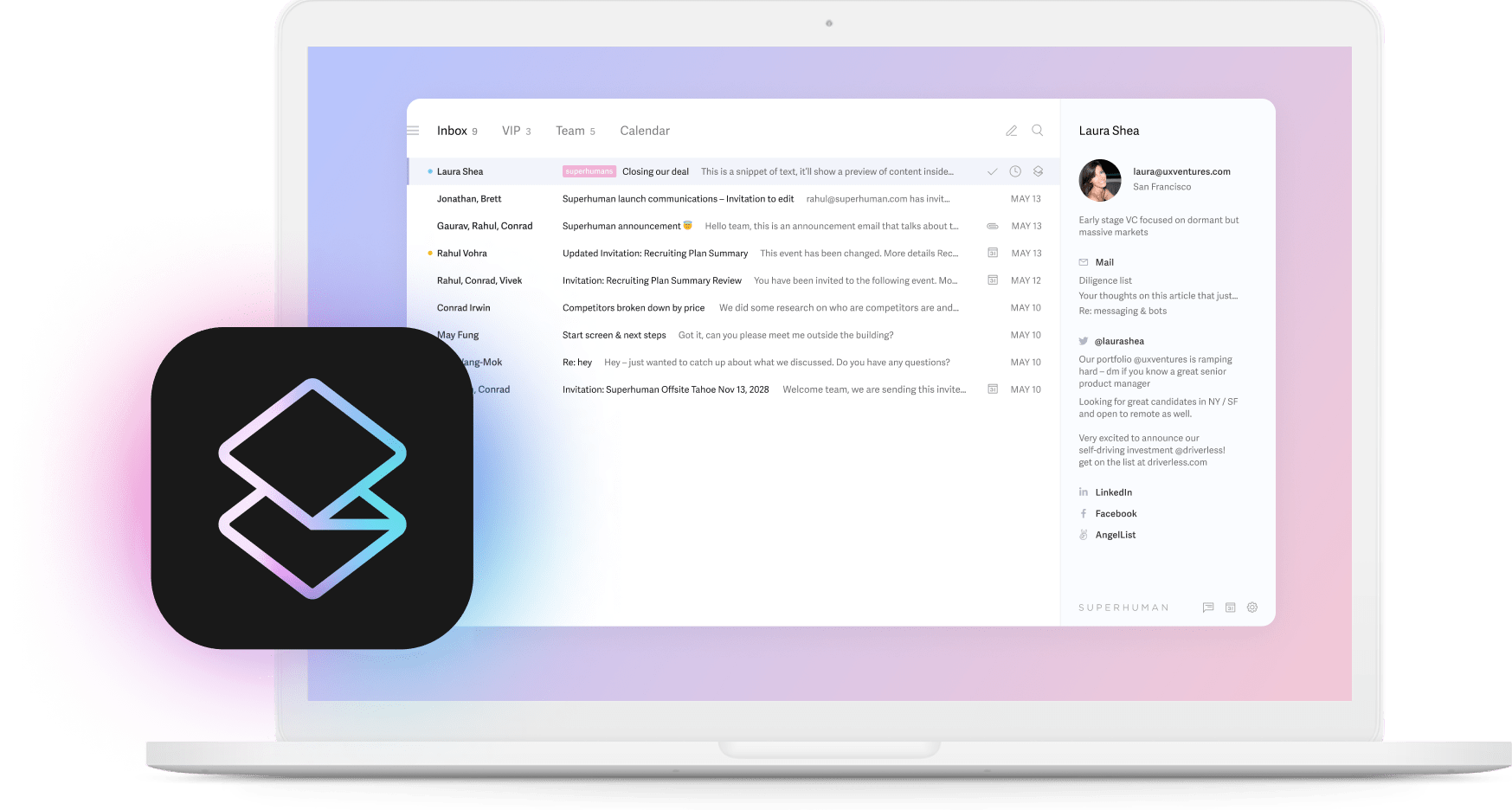
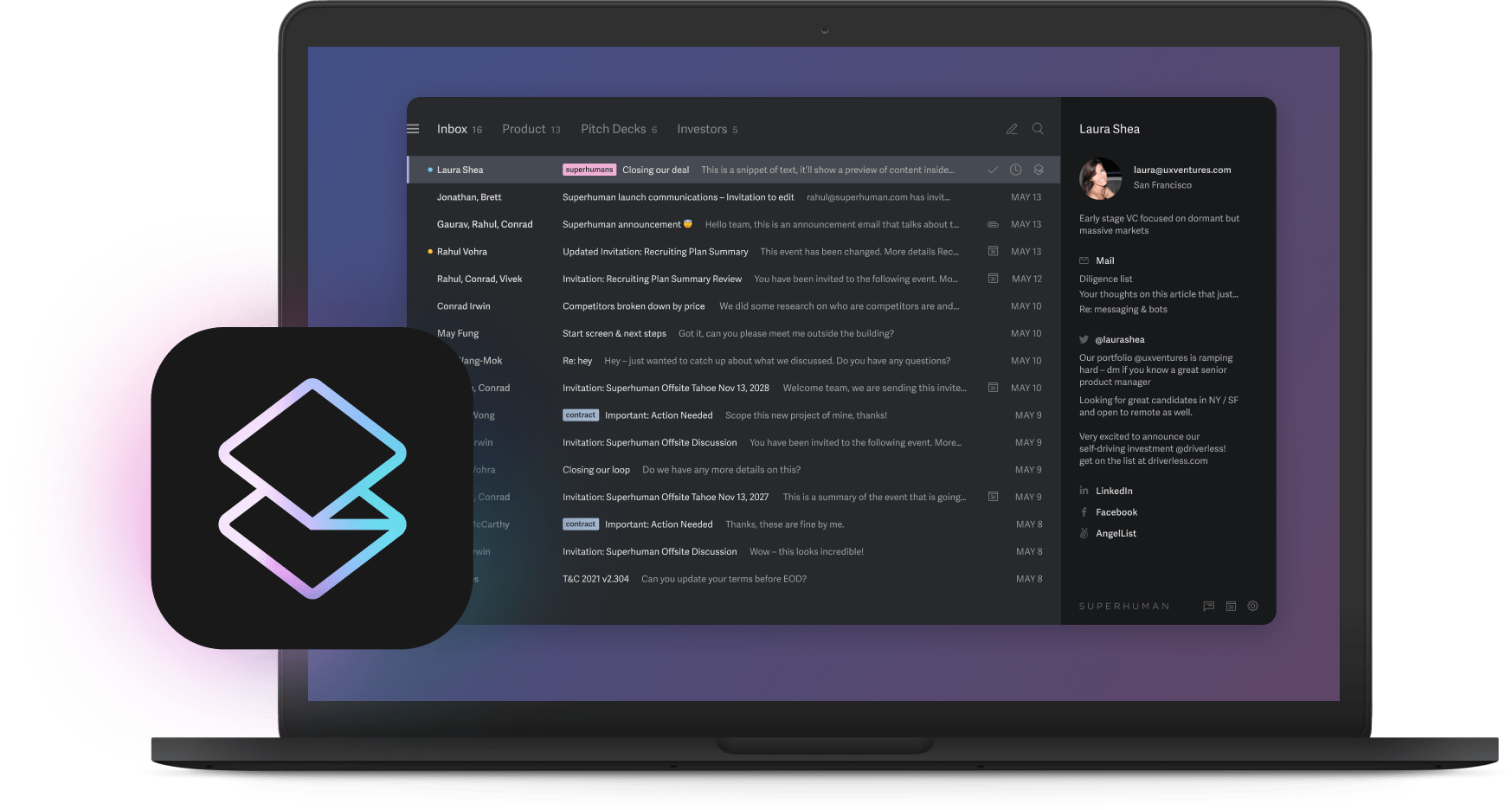
Superhuman Mail helps teams respond 12 hours faster on average. That speed advantage means you're often the first to reply, significantly increasing your chances of conversion.
Job search specifics
Interview follow-ups operate on a different timeline than sales outreach:
- Post-interview thank you: Within 24-48 hours. 80% of hiring managers say it affects their decisions.
- Application status follow-up: Wait 1-2 weeks after submission or after any stated timeline has passed.
- Post-rejection follow-up: Send within a few days if you want to maintain the relationship for future opportunities.
The average time-to-hire has stretched significantly, making consistent follow-up communication more critical for staying top-of-mind during lengthy hiring processes.
Industry-specific variations
Different contexts require different approaches:
- Sales cycles: Complex deals require multi-touch strategies extending beyond email alone. For enterprise sales, use a structured sequence of 5 emails spaced over 10-14 days paired with LinkedIn outreach and phone calls.
- Networking: Post-event follow-ups should happen within 2-4 days while the conversation is fresh. For ongoing professional relationships, quarterly check-ins maintain connections without becoming intrusive.
- Job applications: Be more patient here. Hiring processes move slowly and involve many stakeholders. One follow-up per stage is usually appropriate.
AI-native automation: Productivity gains and ROI
Tracking follow-up timing manually means you'll forget. AI-native tools handle it for you.
Documented time savings
Business professionals using AI tools report saving 15 hours per week on email-related tasks. For a 10-person team at $50/hour loaded cost, this represents $39,000 in monthly labor savings.
Teams using Superhuman Mail save 4 hours per person every week. That's 200+ hours per year per employee freed up for high-value work instead of inbox management.
Performance improvements
AI-native email optimization delivers measurable results:
- Over 50% increase in conversion rates for optimized campaigns
- 11% reduction in sales and marketing expenses in financial services
- 86% higher open rates for automated, well-timed emails
These improvements compound across teams, transforming how organizations handle communication.
Key AI capabilities
Superhuman Mail's AI tools handle the heavy lifting:
- Auto Labels automatically prioritize your follow-ups so you handle the most important messages first
- Split Inbox organizes follow-ups by priority so nothing falls through the cracks
- Snippets let you save your best templates for instant reuse across any follow-up situation
- Smart Send ensures your follow-ups arrive at optimal times, even if you write them at midnight
- Reminders bring emails back to your inbox if you don't hear back, so you never forget to follow up
Keyboard shortcuts let you fly through responses. The combination of AI prioritization with human judgment creates the best of both worlds.
Start flying through your inbox today
Follow-up success comes from combining proven templates with smart timing and automation. The templates here give you starting points for the most common scenarios, but the key is personalizing messages for specific situations and recipients.
Superhuman Mail is the most productive email app ever made. Teams save 4 hours per person every week, respond 12 hours faster, and handle twice as many emails in the same amount of time. Your inbox feels 10x lighter, and workflows become effortless.
With features like keyboard shortcuts, Undo Send, AI Triage, Reminders, and a beautiful design, you'll fly through your inbox and make email feel good again. Superhuman Mail saves teams 15 million hours every single year.
Save your favorite templates as Snippets and start transforming those silent inboxes into active conversations today.