How to use Team Comments to reimagine email collaboration

Learn how to improve email collaboration for teams with shared inboxes, team comments, and collaboration tools. Compare solutions and read best practices.

Key takeaways
- Email collaboration for teams eliminates the chaos of forwarding, screenshots, and scattered conversations by enabling real-time internal discussions directly within email threads
- Knowledge workers spend a significant portion of their workweek managing email, and poor communication directly impacts stress and productivity
- The best email collaboration tools let you @mention teammates, share live email views, and coordinate responses without external recipients seeing internal discussions
- Unlike Microsoft Teams collaboration tools that require switching platforms, native email collaboration keeps context intact and reduces tool sprawl
- Organizations using AI-powered communication tools report saving one full day per week in productivity
What is email collaboration for teams?
Email collaboration for teams transforms your inbox from a solo activity into a shared workspace where teammates can discuss, coordinate, and respond to emails together without recipients ever knowing.
Imagine this scenario:
You receive an email from an important prospect or customer with complex questions. Naturally, you want your team's input before responding.
The old way? Forward the email to everyone, paste screenshots into Slack, or schedule a meeting. Suddenly, you're juggling conversations across multiple platforms just to craft a single response.
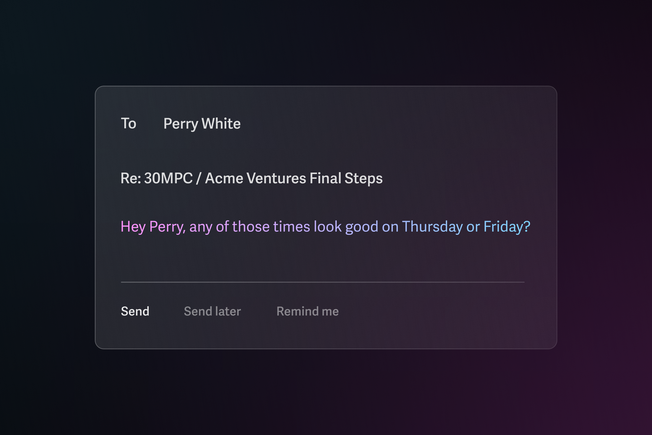
The better way? Simply @mention your coworkers directly on the email and collaborate on the response within your email platform.
With Shared Conversations and Team Comments in Superhuman Mail, this is now possible:
- Share a live view of any email with anyone and start internal discussions with comments
- The conversation and comments land in their inbox, even if they don't use Superhuman Mail
- They can follow along and respond to comments in real time
Finally, email, the one tool everybody uses, is truly collaborative.
Why email collaboration matters more than ever
Before exploring the best email collaboration tools, it's worth understanding why solving this problem is critical for modern teams.
Knowledge workers spend 28% of their workweek managing email, over 11 hours weekly. The volume is staggering: according to Microsoft's 2025 Work Trend Index, the average employee receives 117 emails and 153 Teams messages daily, creating what researchers call the "infinite workday."
The financial and human impact is significant:
- 51% of workers report increased stress from poor communication
- 41% experience lowered productivity due to miscommunication
- Senior employees lose 63 work days per year from ineffective communication
- 79% of employees say communication quality directly impacts how well they understand organizational goals
Teams are investing more time while achieving worse outcomes.
The traditional approach of forwarding emails, copying teammates, and switching between Slack and your inbox creates fragmented context and collaboration drag. That's exactly what modern email collaboration for teams is designed to solve.
Email collaboration tools compared: Finding the best solution
When evaluating email collaboration for teams, you'll encounter several approaches. Here's how they compare:
Native email collaboration (Superhuman Mail)
Best for: Teams wanting seamless collaboration without leaving their inbox
Native email collaboration embeds team features directly into your email client. With Superhuman Mail's Team Comments, you can:
- Start internal discussions on any email with a single keystroke (hit M)
- @mention teammates to bring them into conversations instantly
- Keep all collaboration invisible to external recipients
- Share live email views with anyone, even non-Superhuman Mail users
- See when teammates are typing replies to avoid duplicate responses
Pros: No context switching, maintains email workflow, works with external collaborators
Note: Works as a dedicated email client for Gmail and Outlook accounts
Microsoft Teams collaboration tools
Best for: Organizations already invested in Microsoft 365
Microsoft offers several ways to connect email and Teams:
- Send email to Teams chat group: Forward emails to a Teams channel email address for group visibility
- Teams channel email address: Each channel can receive emails directly, creating a shared inbox effect
- Microsoft Teams email examples: Sales teams forwarding prospect emails to deal channels, support teams routing tickets to triage channels
Pros: Integrates with existing Microsoft 365 investment, familiar interface
Cons: Requires switching between Outlook and Teams, breaks email context, collaboration happens outside the original thread
Shared inbox solutions (Front, Help Scout)
Best for: Support teams managing high-volume customer inquiries
Shared inbox tools create a centralized location for team email:
- Multiple team members access the same inbox
- Assignment and routing rules distribute emails
- Internal comments available within the shared account
Pros: Purpose-built for support workflows, strong routing capabilities
Cons: Requires moving emails to a centralized inbox, doesn't work for personal accounts or relationship-driven roles like sales and recruiting, and can feel impersonal for external communication
Free email collaboration options
Best for: Small teams with limited budgets
Email collaboration for teams free options include:
- Google Groups for shared email access
- Gmail delegation for inbox sharing
- Basic forwarding and CC workflows
Pros: No additional cost
Cons: Limited features, manual coordination required, no collision detection or internal comments
The bottom line
For teams where email is central to revenue, customer relationships, or fast-moving deals, native email collaboration eliminates the friction that plagues workarounds. Free tools require manual coordination, shared inboxes work best for support queues, and sending email to Teams fragments context across platforms. Keeping collaboration inside the email thread, where the work actually happens, removes steps and speeds up response times.
How to set up team email collaboration in Superhuman Mail
Getting started with Team Comments
Setting up email collaboration for teams in Superhuman Mail takes seconds. Here's how to use Shared Conversations and Team Comments:
- Start an internal discussion: Hit M on any email to add a comment. It won't be visible to external recipients unless you explicitly @mention them.
- Bring teammates into the conversation: @mention any colleague to share the email and your comment. They'll receive the conversation in their inbox.
- Share with anyone: Hit Cmd+S (Mac) or Ctrl+S (Windows), then Share to generate a link. Anyone can view the live conversation and respond to comments, even without a Superhuman Mail account.
Pro tip: Hit Cmd+S or Ctrl+S twice to quickly copy the share link. Paste it into your team chat tool like Slack or Teams for easy access.
Collaborating across platforms
Superhuman Mail's email collaboration works regardless of what tools your teammates use:
- Superhuman Mail teammates: Shared conversations appear directly in their inbox for seamless triage
- Non-Superhuman Mail collaborators: They receive an email notification with a link to a live web view where they can see the full conversation and respond to comments
Controlling conversation access
When you share a conversation, you have full control over who can see it:
- Specific people only: Share with selected teammates by @mentioning them
- Anyone with the link: Generate a shareable link for broader access
- Revoke access anytime: Remove teammates from shared conversations when they no longer need visibility
This flexibility makes email collaboration for teams secure while remaining easy to use.
Team collaboration examples by department
While sales teams spend significant time in email, email collaboration for teams benefits every department:
Sales team collaboration examples
- @mention deal desk to approve new deal structures
- Collaborate on follow-up strategies for unresponsive prospects
- Keep leadership informed on critical renewals without forwarding chains
Customer success collaboration
- @mention engineers to resolve customer-flagged bugs with full context
- Loop in product managers on feature requests
- Coordinate responses to escalations across teams
Executive and leadership collaboration
- @mention fellow C-suite members on strategic investor communications
- Get department head input on partnership discussions
- Transform your inbox into a coordination engine that reduces communication friction
Recruiting team collaboration
- @mention hiring managers directly in candidate emails
- Evaluate inbound interest collaboratively
- Speed up the hiring process with rapid, coordinated responses
Marketing team collaboration
- Bring colleagues into agency emails to track and approve work
- Coordinate campaign feedback across stakeholders
- Maintain approval chains without endless forwarding
Product team collaboration
- Gain visibility into product feedback from important customers
- Share user insights across the organization
- Connect customer voices directly to product decisions
Best practices for email collaboration
To maximize the value of team email collaboration, follow these proven practices:
Establish clear ownership and accountability
When multiple team members access the same conversations, designate a clear owner for each thread. Use @mentions to explicitly assign responsibility rather than assuming someone will handle it. This prevents coordination failures that plague traditional shared inboxes where emails fall through the cracks.
Use internal comments for strategy, not status
The most valuable internal discussions happen when teammates collaborate on how to respond, not just whether someone has seen an email. Use Superhuman Mail’s Team Comments to:
- Discuss negotiation strategies before responding to prospects
- Coordinate messaging across multiple stakeholders
- Flag potential issues that need executive input
- Share relevant context from other conversations
Minimize tool switching
Tool sprawl drains productivity. According to Grammarly's 2024 research, workers now spend 88% of their workweek communicating across multiple channels. By keeping collaboration within your email client, you eliminate the context switching that fragments attention and slows response times. For more strategies on reducing digital overload, see our guide to email management software.
Combine AI with team collaboration
Superhuman Mail's AI capabilities enhance team collaboration:
- Use Superhuman AI to generate draft responses before asking colleagues to weigh in
- Auto Summarize long conversations so teammates can get up to speed in seconds
- Give your team a starting point rather than asking them to read dozens of messages
For more on how AI is transforming email workflows, explore our AI productivity tools guide.
How Superhuman Mail solves core email collaboration challenges
Team Comments addresses the pain points organizations face with email collaboration:
What sales leaders see with Team Comments
When a sales leader monitors an important stalled renewal, Team Comments provides:
- Internal conversation visibility: All past and future messages, plus private Team Comments discussions
- Conversation awareness: AI-powered summary of the conversation history
- Account intelligence: Forecasted Revenue, Next Steps, and other data from Salesforce or HubSpot
- Response coordination: Team Read Statuses and Team Reply Indicators prevent collision errors
How AI enhances team email collaboration
The shift toward AI-native collaboration is accelerating. According to Microsoft's 2025 New Future of Work Report, organizations are moving from measuring individual AI productivity gains to understanding collective productivity: how AI enhances team coordination, knowledge sharing, and collaborative work outcomes.
AI features that improve team collaboration
- Superhuman AI drafts responses based on the entire conversation context, giving your team a starting point to refine. When you @mention a colleague for input, they can quickly review and suggest edits rather than starting from scratch.
- Auto Summarize condenses long email threads into digestible summaries. When bringing a teammate into a complex conversation, the AI summary helps them understand the context in seconds.
- Split Inbox automatically categorizes emails to spotlight high-priority messages. Combined with Team Comments, this ensures collaborative discussions focus on emails that truly need team input.
Organizations using AI-powered communication tools report saving one full day per week in productivity, with 73% saying AI helps them avoid miscommunications. For more on AI-powered automation, see our guide on how to use AI to automate tasks.
Measuring email collaboration ROI
One advantage of centralizing collaboration within your email client is the ability to track performance. High-performing teams measure critical indicators:
With Team Read Statuses and Team Reply Indicators, Superhuman Mail provides visibility into how your team handles email without manual tracking or status meetings. When everyone sees whether an email has been read and whether a colleague is drafting a response, unnecessary check-ins disappear.
The ROI is measurable. Companies using AI-powered communication tools can save $16.5 million annually for every 1,000 employees through improved productivity. For more data on workplace efficiency, explore our employee productivity statistics.
Get started with email collaboration for teams
Shared Conversations and Team Comments are available for all teams on Superhuman Mail.
These collaboration features work seamlessly with other team capabilities:
- Team Snippets: Share templates across your team for faster, consistent messaging
- Team Read Statuses: See when teammates have read emails so anyone can follow up with full context
- Team Reply Indicators: See when teammates are replying or have scheduled follow-ups to avoid duplicate work
- Team Scheduling: See when your team is free to schedule at the speed of thought
Ready to transform how your team handles email? Try Superhuman Mail today.
FAQs
What's the difference between a shared inbox and email collaboration?
A shared inbox gives multiple people access to the same email account (like support@ or sales@). Email collaboration is broader: it lets teammates discuss, coordinate, and respond to emails in any inbox, including personal work accounts, without recipients seeing the internal conversation. Shared inboxes work well for support queues; email collaboration works for any team communication.
How do I keep internal team discussions private from email recipients?
The best email collaboration tools separate internal comments from the email thread itself. Teammates can discuss strategy, loop in subject matter experts, or flag concerns without those conversations appearing in replies. Look for tools with dedicated internal commenting rather than relying on forwarded threads or CC chains.
How do I prevent multiple people from replying to the same email?
Collision detection is a key feature in email collaboration tools. The best solutions show real-time indicators when a teammate is drafting a response or has scheduled a follow-up, so you don't send duplicate replies to the same customer or prospect.
Can my team collaborate on email if we use different email clients?
Yes. Some email collaboration platforms let you share live email views with anyone via link, regardless of what email client they use. This means teammates can see the full conversation and add comments without switching tools or creating accounts.
Is email collaboration better than using Slack or Teams for email discussions?
It depends on your workflow. Forwarding emails to Slack or sending email to a Teams channel works but fragments context: the discussion happens in one place while the actual reply happens in another. Native email collaboration keeps everything in the same thread, which reduces steps and helps teammates respond faster with full context.
What features should I look for in email collaboration tools?
Key features include internal commenting (invisible to recipients), collision detection (prevents duplicate replies), real-time presence (see who's viewing or drafting), easy sharing (with teammates who use different tools), and integration with your CRM. AI features like auto-summarization help teammates get up to speed on long threads quickly.
How do I measure whether email collaboration is working for my team?
Track first response time, time to resolution, and backlog size. Effective email collaboration should reduce response times (less back-and-forth finding the right person), eliminate duplicate replies, and decrease the number of emails forwarded internally. If your team spends less time in status meetings asking "did anyone respond to this?" it's working.
Is there free email collaboration for teams?
Basic options exist through Google Groups, Gmail delegation, and forwarding rules, but these lack collision detection, internal comments, and real-time coordination. For occasional collaboration they may suffice, but teams with high email volume or customer-facing communication typically need purpose-built tools.