


Today’s founders must face the same reality that the fundamental principles of building a company — what to build, who to hire, how to sell — are being rewritten in real time.
At the same time, the hype cycle is in full swing. AI wrappers are raising rounds on thin moats. Marketing teams are rewriting their playbooks to stand out in a sea of AI-generated thought leadership. And leaders in regulated industries like healthcare and supply chain are caught between the pressure to move fast and the very real cost of getting data privacy wrong.
So, what does AI adoption actually look like for high-growth startups today?
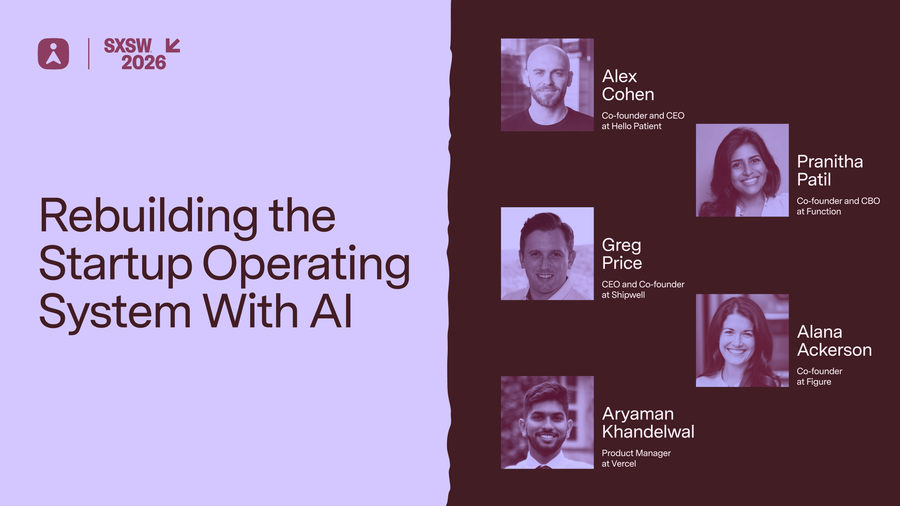
At this year’s SXSW festival, we brought together four startup leaders to try to answer that question: Greg Price, CEO at Shipwell; Pranitha Patil, Co-founder at Function Health; Alana Ackerson, Co-founder at Figure; Aryaman Khandelwal, Product Lead for V0 at Vercel; with moderation from Alex Cohen, Co-founder and CEO at Hello Patient. The conversation was refreshingly candid, covering everything from what's working to what fell flat, and the risks to be mindful of along the way.
Here are 8 lessons that stood out.
1. AI adoption is a people problem.
Greg put it bluntly: "AI is moving much faster than organizations can actually adopt it." Even with mandates and tooling, getting frontline employees to change deeply embedded habits requires hands-on enablement rather than top-down directives. Function Health gamified adoption with leaderboards and ran hands-on training sessions to get non-technical teams comfortable with the tools.
2. Stay in your lane.
The panel was unanimous: don't build what isn't your core competency. Pranitha shared how Function wasted six months building a custom chatbot when they could have used an existing tool, saying: "Buy the thing. We don't have the time or talent to go build each of these things." Vercel's early RAG-based support agent was also a dead end until they rebuilt it to be deeply integrated with their own product.
3. Context is the new bottleneck.
Greg noted that the largest constraint when it comes to AI adoption is no longer engineering capacity, but gathering the right context to feed AI. Product managers, designers, and customer-facing teams are now the rate limiters on speed of execution. Companies that solve this will move dramatically faster than those still treating engineering headcount as the problem.
4. Hire for both agency and taste.
Aryaman's hiring framework: "AI lets you do everything. What we care about is: can you find people who have a history of doing things fast?" The last 20% of any job — where taste and judgment come in — is what separates great hires from AI-assisted mediocrity. Vercel now watches how candidates prompt during live interviews as a high-signal evaluation tool.
5. GEO is the new SEO.
Customers are bypassing Google and asking ChatGPT for product recommendations. Greg warned that competitors gaming LLM training data with low-quality content can outrank legitimate companies. "If you haven't started investing in GEO [Generative Engine Optimization], you need to, because it's quietly killing pipelines."
6. Don't lose the muscle of human judgment.
Alana's through-line for the entire panel: AI should enhance decision-making, not replace it. "There is no substitute for turning your brain off," she cautioned. The executives who thrive will be the ones who use AI to get better context, faster, while keeping critical thinking sharp. Greg added: "Focus on what you're really good at. People still buy from people."
7. Data privacy remains a real constraint.
Both Greg and Pranitha stressed the risks of sending proprietary or patient data to LLMs. Greg shared how an engineer planted a canary string in code that Perplexity surfaced 24 hours later. For regulated industries like healthcare, the push toward proprietary, self-hosted models is accelerating, and startup leaders must diligently balance speed with legal caution.
8. Just go build it.
Pranitha's rallying cry to the audience — especially women, whom she's observed as being more hesitant around AI tools: "Let the AI teach you how to use itself. Ask all your stupid questions. We're not going back." The tools are at your fingertips, and the only barrier is getting started.