
Key takeaways
- The best email for remote teams saves 4+ hours per week per person and cuts response times significantly through shared inboxes, AI automation, and time zone awareness
- Remote email tools must address distributed work challenges, including information silos, duplicate work, and asynchronous communication across time zones
- Budget options work for small teams, while more robust platforms can deliver premium AI-native productivity
- Essential features of leading remote team email platforms include shared inbox visibility, email assignments, internal comments, smart send timing, and AI-powered drafting
- Teams using purpose-built remote email tools respond to 2-3x more emails, with response times dropping by up to 12 hours
Finding the best email for remote teams can transform how your distributed workforce communicates. Your remote team probably sends hundreds of emails daily across multiple time zones. Critical messages get buried. Follow-ups fall through the cracks. Nobody knows who's handling what.
376 billion emails still fly around daily in 2025. Email remains the foundation of business communication, even as teams adopt new collaboration tools.
Disconnection and loneliness consistently rank among the top struggles for remote workers. Your team needs remote email solutions that understand distributed work, enable asynchronous collaboration, and keep teams aligned without endless meetings.
Here's how email clients stack up for remote teams in 2026, matching tools to your team size, budget, and workflow requirements.
Understanding email for remote teams
The best email for remote teams addresses distributed work challenges: time zone differences, asynchronous communication needs, information silos, and duplicate work risks.
Remote-optimized email clients give your whole team visibility into conversations. You can comment without endless reply chains. You'll see who's handling what. They actually respect time zones and enable teams remote access to shared conversations.
They integrate AI to handle repetitive tasks, surface important messages automatically, and help teams respond faster without sacrificing quality. The right solution delivers measurable time savings: real hours, not theoretical productivity gains.
Traditional email creates specific pain points for distributed teams. Information silos block collaboration when team members use individual email accounts for shared responsibilities. Time zones create response delays where a simple answer becomes a 24-hour wait. These challenges compound as teams grow, making purpose-built email tools essential for distributed work.
At a glance: 9 best email tools for remote teams compared
9 best email tools for remote teams
Now that you understand what remote teams need from email, let's dive into the top options available today. We've evaluated each tool based on collaboration features, AI capabilities, pricing, and real-world results from distributed teams.
1. Superhuman Mail: Best for AI-native productivity
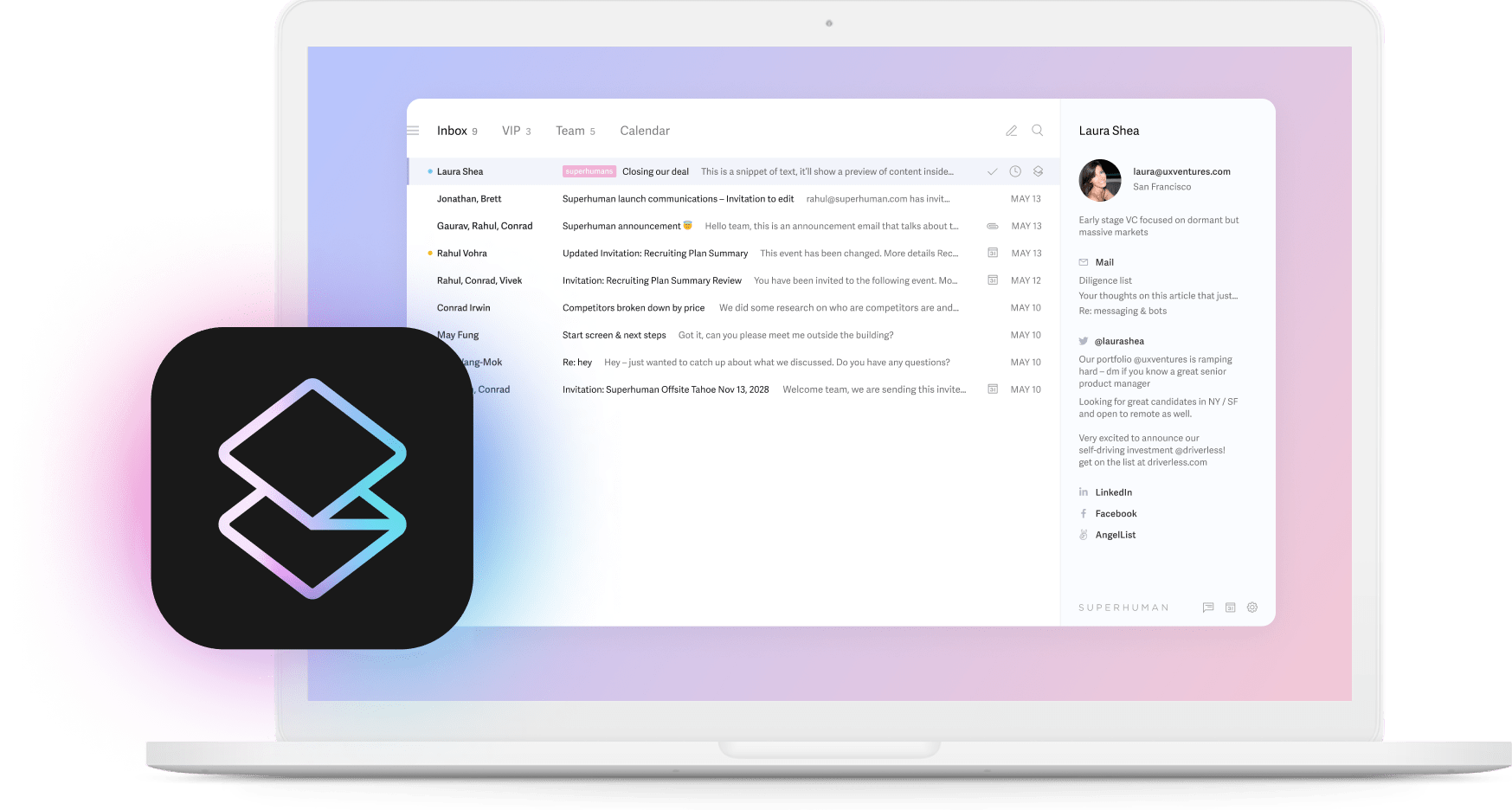
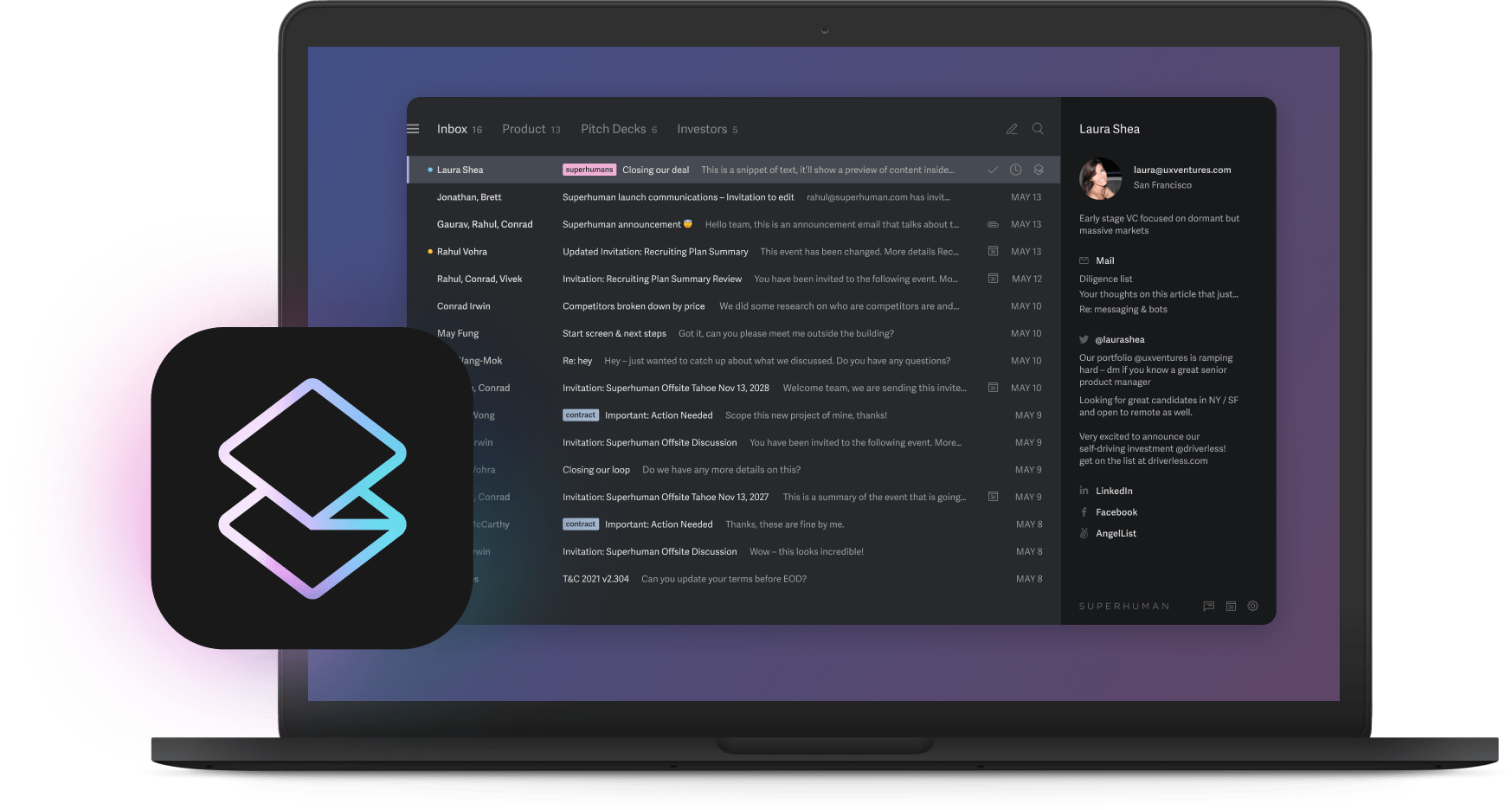
Superhuman Mail delivers the fastest email experience, combined with AI-native features built specifically for remote email productivity. It's designed for teams who want to transform email from a productivity drain into a competitive advantage.
The platform's speed optimization means every action happens in under 100ms, making email feel instantaneous. For distributed teams juggling multiple time zones and high email volumes, this responsiveness compounds into significant daily time savings.
Key features for remote teams
- Shared conversations let remote team members collaborate on emails in real time, with @mentions to rapidly unblock progress on deals and customer requests
- AI that learns your voice analyzes messages you've sent and applies consistent tone to all generated content
- Split Inbox uses AI-generated labels to organize priority conversations from noise
- Instant Reply auto-generates draft replies for every email
- Ask AI provides natural language search across inbox, calendar, and web
Remote team results: Companies like Brex achieved 3x more emails responded to with 3.5 hours faster response time. Teams report 2x emails responded to, response times cut by 12 hours, and deal cycles shortened by 25%.
Security: SOC2 Type 2 compliance, GDPR compliance, SSO support, and zero-day data retention for AI features.
Pricing
Starting at: $25/month per user. Business tier at $33/month adds advanced AI features, including auto drafts, custom AI labels, and CRM integrations. Enterprise tier adds advanced security, controls, and dedicated support.
2. Gmail (Google Workspace): Best for Google ecosystem teams
Gmail through Google Workspace provides tight ecosystem integration with documents, calendar, meetings, and storage. Most remote teams already use Gmail as their foundation, making it a natural starting point for distributed work.
The platform's strength lies in its seamless connection to Google's productivity suite. Remote teams can schedule meetings, share documents, and manage calendars without leaving their email interface. However, Gmail's native collaboration features are more limited compared to purpose-built team email tools.
Key features for remote teams
- Native integration with Google Meet, Drive, and Calendar for unified workflow
- Collaborative inbox features through Google Groups for shared email addresses
- Strong spam filtering and powerful search capabilities across your entire archive
- Enterprise-grade security and compliance certifications for regulated industries
Many teams layer specialized clients like Superhuman Mail on top of Gmail to gain advanced AI features and faster performance while maintaining their Google ecosystem.
Pricing
$6/user/month for Business Starter, $12/user/month for Business Standard, $18/user/month for Business Plus.
3. Outlook (Microsoft 365): Best for Microsoft ecosystem teams
Outlook through Microsoft 365 offers deep integration with the Microsoft ecosystem, making it ideal for teams using Teams, SharePoint, and OneDrive. The platform excels at connecting email with Microsoft's broader productivity and collaboration tools.
For organizations already invested in Microsoft infrastructure, Outlook provides a familiar interface with strong administrative controls. The Focused Inbox feature helps prioritize important messages, though it lacks the AI sophistication of more specialized tools.
Key features for remote teams
- Native Microsoft Teams integration for seamless communication between email and chat
- Shared mailboxes and distribution groups for team email management
- Focused Inbox to automatically prioritize important messages over less urgent ones
- Enterprise compliance and security features including data loss prevention and eDiscovery
Works well as a foundation platform, with many teams adding specialized email clients on top for enhanced productivity and AI capabilities.
Pricing
$6/user/month for Microsoft 365 Business Basic, $12.50/user/month for Business Standard, $22/user/month for Business Premium.
4. Gmelius: Best for budget Gmail teams
Gmelius transforms Gmail into a collaboration platform with unlimited shared inboxes and team AI capabilities. It's an affordable option for teams who want to add collaboration features without leaving the Gmail interface they already know.
The platform integrates directly into Gmail's web interface, so there's no learning curve for team members. Gmelius also offers Kanban-style boards for managing email as tasks, which can help teams track customer conversations and projects visually.
Key features for remote teams
- Shared inboxes directly within the familiar Gmail interface
- Email assignments and collision detection to prevent duplicate replies
- Internal notes and team collaboration without forwarding emails
- Kanban boards for email project management and workflow visualization
Pricing
$10/user/month for Lite plan, $24/user/month for Growth plan with advanced automation, $36/user/month for Pro plan with full features.
5. Spark Teams: Best for platform-independent small teams
Spark Teams delivers draft co-editing, shared inboxes, and private team comments across Gmail, Outlook, and other providers. Its cross-platform compatibility makes it attractive for teams using mixed email providers.
The app is available on Mac, Windows, iOS, and Android, providing a consistent experience across devices. Spark's smart inbox automatically categorizes emails into personal, notifications, and newsletters, helping team members focus on what matters.
Key features for remote teams
- Cross-platform support working with Gmail, Outlook, iCloud, and other providers
- Collaborative email drafting where multiple team members can edit before sending
- Private team comments on emails visible only to your organization
- Smart inbox with priority sorting to surface important conversations
Pricing
Free for basic features, $6.99/user/month for Premium Teams with advanced collaboration (billed annually).
6. Missive: Best for shared inbox workflows
Missive focuses on team email collaboration with shared conversations, internal discussions, and task assignments. The platform treats email as a team sport, with every feature designed around collaborative workflows.
Missive stands out for its multi-channel approach, allowing teams to manage email alongside SMS, WhatsApp, and social media messages in one interface. This makes it particularly useful for customer-facing teams handling communications across multiple platforms.
Key features for remote teams
- Shared conversations with internal chat running alongside email threads
- Task assignments within email threads to track responsibility and deadlines
- Rules and automation for workflow management and routing
- Multi-channel support, including SMS, WhatsApp, Facebook, and Instagram messaging
Pricing
$18/user/month for Starter, $28/user/month for Productive, $42/user/month for Business with advanced features.
7. Zoho Mail: Best for budget-conscious teams
Zoho Mail offers an affordable email solution with basic collaboration features and integration with the broader Zoho suite. For teams already using Zoho CRM or other Zoho products, the native integration creates a unified workflow.
The platform emphasizes privacy with an ad-free experience and doesn't scan emails for advertising purposes. Zoho Streams provides a social-media-style interface for internal team discussions about specific emails.
Key features for remote teams
- Streams for internal team communication and discussions about emails
- Shared folders and email delegation for basic collaborative workflows
- Integration with Zoho CRM, Projects, and other Zoho applications
- Ad-free, privacy-focused email without data mining for advertising
Pricing
Free for up to 5 users with 5GB storage, $1/user/month for Mail Lite, $4/user/month for Mail Premium with advanced features.
8. ProtonMail: Best for security-focused teams
ProtonMail provides end-to-end encryption for teams handling sensitive information. Based in Switzerland, the platform operates under strong privacy laws and uses zero-access encryption, meaning even ProtonMail cannot read your emails.
For remote teams in healthcare, legal, finance, or other regulated industries, ProtonMail offers compliance-friendly security. The platform also includes encrypted calendar and file storage for comprehensive secure communication.
Key features for remote teams
- End-to-end encryption by default for all messages between ProtonMail users
- Zero-access architecture ensuring even the provider cannot access your data
- Swiss privacy laws protection with servers located in Switzerland
- Self-destructing messages with customizable expiration timers
Pricing
Free for basic use, $6.99/user/month for Mail Essentials, $12.99/user/month for Business Suite with all features.
9. Mailbird: Best for Windows multi-account users
Mailbird offers a unified inbox experience for Windows users managing multiple email accounts. The desktop client brings all your email accounts into one interface with a clean, customizable design.
The platform integrates with popular productivity apps like Slack, Asana, and Trello, letting you manage tasks and communications from one place. Mailbird's speed reader feature helps users process emails faster by displaying messages word by word.
Key features for remote teams
- Multi-account management brings all email accounts into one unified interface
- App integrations with Slack, Asana, Trello, and other productivity tools
- Speed reader feature for quick email processing and faster reading
- Customizable layout and themes to match your workflow preferences
Pricing
Free version with limited features, $3.25/month for Personal (billed annually), $4.92/month for Business with priority support.
3 key features remote teams need from email clients
Shared visibility and collaboration
Shared inboxes let multiple team members see and respond to emails sent to support@, sales@, or hello@. Everyone views the full conversation history without forwarding or CCing.
Email assignments prevent duplicate replies and missed messages. Visual indicators show which team member owns each conversation. Internal comments enable team collaboration without cluttering the customer inbox.
Time zone awareness and async communication
Smart send timing automatically delays emails to arrive during recipient working hours. Read receipts and team read statuses show when emails have been opened, enabling remote teams to reduce communication overhead.
Snooze and defer capabilities enable team members to manage their inbox based on their work schedule rather than when emails arrive.
AI-native productivity
AI writing and response generation creates draft replies automatically. The best AI tools analyze messages you've sent to specific recipients and match your tone and voice, not generic templates.
Natural language search lets you find emails using conversational queries like "where's the offsite" rather than remembering exact keywords. Auto-categorization organizes incoming mail automatically, routing marketing emails and cold pitches away from priority conversations.
Best practices for email management in remote teams
Default to asynchronous communication
With remote work growing, async communication becomes essential. About 74% of remote teams operate across multiple time zones, making async-friendly tools critical for productivity.
Create clear processes for when to use async versus synchronous communication. Set specific email processing times rather than monitoring continuously. Use delayed send features to respect recipients' working hours.
Implement shared inbox workflows
Move team email addresses from individual forwarding to shared inbox tools. This gives everyone visibility into customer interactions, prevents duplicate work, and preserves institutional knowledge.
Establish clear ownership protocols and set service level agreements for response times based on message priority.
Use AI to reduce repetitive work
Identify email tasks your team does repeatedly: acknowledgment messages, meeting scheduling, status updates. Use AI drafting to handle these efficiently.
The time savings compound. If a 20-person team spends 30 minutes daily on repetitive emails, that's 10 hours wasted every day. AI tools can reclaim most of that time for strategic work.
Getting started with remote team email
Email remains essential for business communication, with billions of emails exchanged daily worldwide.
If you're on a tight budget, start with Gmelius ($10/month) or Spark Teams ($7/month). Mid-size teams might evaluate Missive ($18-42/month).
But teams serious about transforming email choose Superhuman Mail. Response times drop significantly. Teams handle substantially more emails. UserGems closed deals 25% faster. Brex responded to 3x more emails while saving 183 hours weekly.
Superhuman Mail combines speed optimization with AI that learns your voice, maintaining communication quality across distributed teams. Shared conversations with team comments keep everyone aligned across time zones.
Your remote team deserves email that makes work feel good again.
Try Superhuman Mail and discover what email should have been all along.
FAQs about email tools for remote teams
What is the best team communication app for remote teams?
The best team communication app depends on your workflow. For email-centric communication, Superhuman Mail offers the fastest experience with AI-native features. For instant messaging, tools like Slack or Microsoft Teams work well. Most effective remote teams use email for asynchronous documentation and formal external communications, while using chat apps for quick internal questions.
What is the 5 email rule?
The 5 email rule suggests that if an email exchange requires more than five back-and-forth messages to resolve, you should switch to a phone call, video chat, or meeting instead. This rule helps remote teams communicate effectively by recognizing when asynchronous email becomes less efficient than synchronous conversation.
How to communicate effectively with remote teams?
Effective remote team communication requires clear asynchronous guidelines, shared inbox workflows for team visibility, and the right tools for different communication types. Use email for documentation and formal communications, instant messaging for quick questions, and video calls for complex discussions. Tools like Superhuman Mail help by providing shared conversations and team comments that keep everyone aligned without requiring synchronous meetings.