AI Summit for Texas Higher Education: What Happened When 25 Institutions Got in a Room Together
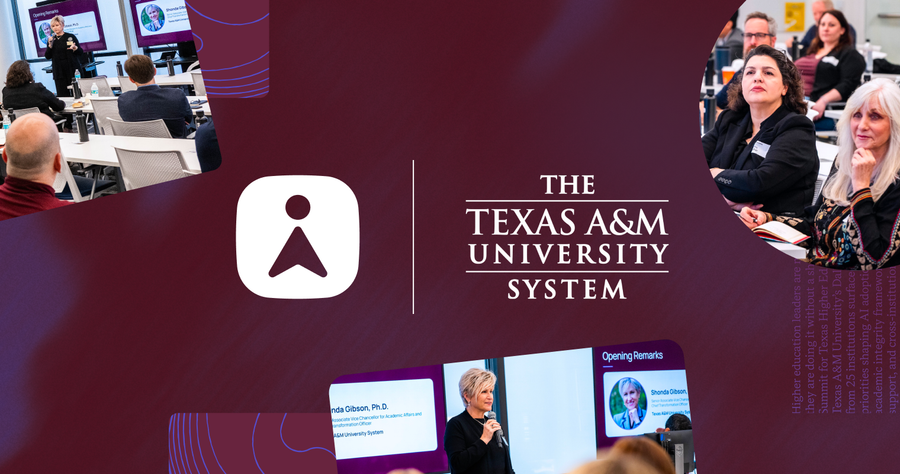

Higher education leaders are moving fast on AI, but they are doing it without a shared playbook. At the AI Summit for Texas Higher Ed, held April 22 at East Texas A&M University’s Dallas campus, 65 leaders from 25 institutions surfaced three consistent priorities shaping AI adoption in higher education: academic integrity frameworks, faculty adoption support, and cross-institutional collaboration.
Co-hosted by Superhuman and the Texas A&M University System, the summit brought together a highly engaged group, 60% of them institutional leaders, focused on working through real challenges, not just discussing possibilities.
What the day made clear is that Texas institutions are not waiting for permission to figure this out.
Here is what emerged most clearly over the course of the day:
Key takeaways from the AI Summit for Texas Higher Ed
- Academic integrity is the starting point for every AI conversation.
Leaders kept coming back to the same question: What does authorship and responsible use look like when AI is part of the writing process? - Faculty adoption hinges on real use cases, not just policy.
When attendees saw AI writing tools in action, the conversation quickly shifted from abstract concerns to practical applications in classrooms and administrative work. - The focus is moving from policy to practice.
Many universities are past the “Should we use AI?” stage and are now actively testing tools and defining how they fit into day-to-day work. - Collaboration is speeding everything up.
The most valuable moments came from peer-to-peer discussion, where institutions compared approaches and worked through challenges together. - Choosing the right partners matters.
As universities move forward, there is a growing emphasis on working with partners who support transparency, academic integrity, and long-term success.
Academic integrity and AI: The questions every institution is working through
The day opened with a session on academic integrity: what authorship and attribution mean when AI is part of the writing process, and what responsible use looks like for students and institutions alike. For many in the room, it was the first time they had seen Grammarly Authorship in depth.
Every institution in the room was navigating the same underlying question: How do you maintain trust and transparency in student work when AI is part of the process? For many, the conversation had already moved past detection toward something harder: rebuilding confidence in what students actually know.
A faculty and administrator panel from four Texas institutions, “AI-Supported Writing on Campus,” kept that thread going. The conversation was candid: What is working at the institutional level, where policies are lagging, and how different campuses are approaching the same problems from different starting points. Panelists came from across the Texas A&M University System and peer institutions including UT Dallas, University of North Texas, and East Texas A&M. They did not smooth over the complexity, and the conversation was better for it.
AI writing tools in higher ed: From policy to classroom practice
Two sessions after the morning break moved from principle to practice. A live demonstration of docs with agents showed faculty and administrators what AI agent–assisted writing looks like in real classroom and administrative contexts. When the agents ran, something shifted. People started identifying use cases before the demo was over.
The follow-on session, “From Grammarly to Superhuman Go,” traced that arc directly: how AI writing tools have evolved from stand-alone assistance into a governed platform layer that extends across the full range of institutional work, and what that shift means for the partners institutions choose to build with.
“We need partners to do this well”: Building institutional AI strategy together
The afternoon breakout sessions split attendees into three tracks: academic integrity and Authorship in one room, AI-supported writing in practice in another, and Superhuman Go and agents in a third. What was designed as structured discussion became something more organic. Every room was deeply engaged, with minimal prompting, in peer-to-peer problem-solving that typically takes years of relationship-building to unlock.
The closing fireside chat brought the day together. Shonda Gibson, Chief Transformation Officer and Senior Associate Vice Chancellor for Academic Affairs at the Texas A&M University System, joined Korry Castillo, Chief Strategy Officer for the Texas A&M University System, for a conversation about keeping people at the center of AI adoption, building across institutional lines, and what it means for Texas when its universities move forward together.
Gibson has led AI strategy across all 12 Texas A&M University System institutions and has been a consistent voice on the subject at EDUCAUSE and beyond. Her take on the partnership was direct: “We need partners to do this well, and Superhuman has been the best partner. You should push all of your vendor partners to be like Superhuman.”
Kimberly Rynearson, Assistant Vice Chancellor for Faculty Innovation at the Texas A&M University System, named the institutional value plainly: When AI is integrated thoughtfully, it shifts faculty time away from routine tasks and back toward the work that matters most, including more responsive engagement with students, deeper scholarship, and stronger service to their institutions.
Sarah Moore from UT Dallas named the thread running through the whole day: “Texas higher ed moves farther, faster when we lead with our values and work together.”
Building AI literacy at scale: The Texas A&M University System model
The summit was one event in the Texas A&M System’s AI Learnathon, a sustained, systemwide effort to build AI literacy and capability across all 12 member institutions. The program was built with institutional leadership from the start, and it showed in how the day ran.
For institutions working out their own approach to AI, the day offered a model for cross-institutional collaboration, frameworks for thinking about academic integrity and faculty adoption, and a clear reminder that you do not have to build this from scratch.
Ready to build an AI strategy for your institution?
We have been building alongside Texas institutions for over a decade, first as Grammarly, now as Superhuman for Education. If you are working through your AI strategy, figuring out what to adopt, how to govern it, or the best way to bring faculty along, talk to our team.