AI Blind Spots: Advice From Superhuman’s VP of Product, CISO, and CFO
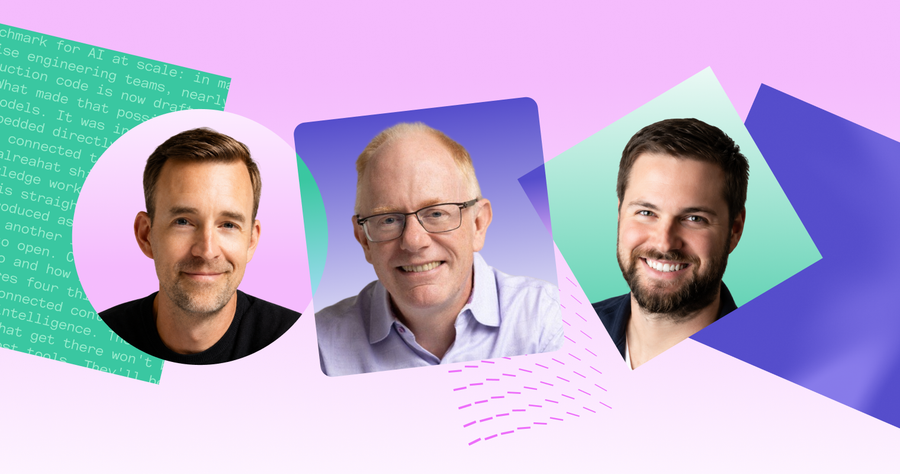

Most enterprise AI conversations happen about two steps removed from reality: in board decks and vendor pitches, where the story is always promising. Closer in—inside the actual workflows, budgets, and security decisions—the picture is more complicated: Spend is rising, adoption is uneven, and ROI is genuinely hard to find.
Luke Behnke, Giles Douglas, and Matt Hudson sit close enough to see the gap clearly. Here’s what Superhuman’s VP of Product, CISO, and CFO are thinking about.
Workers don't need more AI tools
In many enterprise engineering teams, nearly half of new production code is now drafted by AI agents. What made that possible was infrastructure: agents embedded directly into real workflows, connected to the systems engineers already lived in.
That shift hasn’t reached knowledge work yet. Luke Behnke, VP of Product Management, argues the reason is familiar: AI keeps arriving as another destination, another tab, another interface to remember. Closing the gap between what AI can do and how it actually shows up at work requires four things: ubiquity, proactivity, connected context, and collaborative intelligence. The organizations that get there will be the ones with AI woven into how work already happens.
Why enterprise AI fails without trust by design
From where Giles Douglas, CISO and Director of Engineering, sits, AI initiatives stall for one reason: trust. Not trust in the abstract, but earned confidence that AI systems are secure, guardrails are real, and that using AI won’t create unintended risk. When that confidence is missing, employees hold back, and when they do, AI never scales.
Three problems drain that confidence: disconnected systems with inconsistent policies, controls built for APIs that buckle against natural language interfaces, and governance that lags behind usage. The answer is to design trust in from the beginning through secure defaults, clear agent boundaries, and governance that scales with adoption rather than reacting to it.
Read Giles's piece →
Your AI strategy is burning cash, not building leverage
Matt Hudson, CFO, has had the same conversation with CFOs and operators across dozens of companies. Everyone feels the pressure to move fast on AI. Most are measuring the wrong thing. Tokens consumed isn’t a business outcome—and without the right measure, experimentation quietly hardens into architecture. That architecture is expensive.
He identifies three pitfalls. A productivity tax that redistributes friction instead of eliminating it (one hour of context switching per day costs roughly $19,000 per employee annually). Vendor lock-in that scatters data across walled gardens, leaving employees to act as the integration layer. And AI value that stays local rather than compounding across the business. The companies that win will be those that turn exploration into a coherent architecture and measure success by outcomes rather than tokens.