AI Agents Are Already in Your Institution. Here’s What That Means.
The next AI agent on your campus probably won’t arrive through a purchase decision. It will show up switched on inside a tool your institution already runs, added in an update to software that was up for renewal anyway.
That’s how AI agents are spreading across higher education, through systems already in place, and faster than most institutions can write rules for them. Most chief information officers (CIOs) know the term by now. Far fewer have a clear picture of what agents do, how they differ from their chatbot predecessors, and what it’ll actually take to govern them. That’s worth sorting out before the agents outnumber the policies.
What is an AI agent, and how is it different from a chatbot?
An AI agent is software that acts autonomously on your behalf, within the constraints you set. It completes tasks, makes decisions, and coordinates across systems to reach a shared outcome.
A chatbot responds, while an agent acts. That one-word difference carries most of the governance weight.
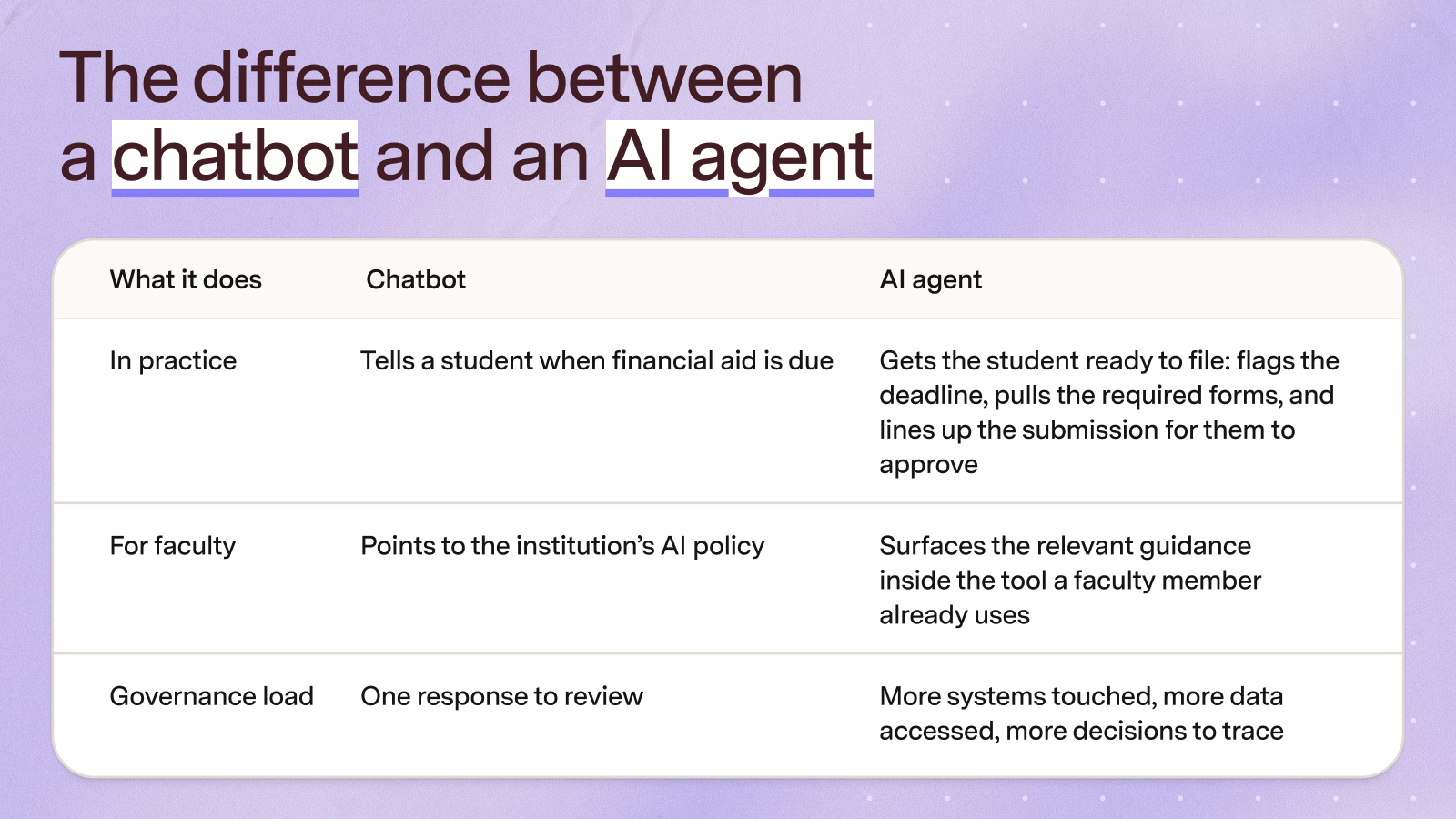
This autonomy is exactly what raises the stakes. Agents reach into more systems, touch more data, and produce outcomes that are harder to audit than any single chatbot reply. Knowing what your agents are doing, and whether they’re doing it consistently, becomes a governance question as much as a technical one.
Real-world examples of institutional AI agents
- At MIT’s Sloan School, Tutor AI walks students toward answers with hints rather than handing them over, so the work stays theirs.1
- At Michigan State’s Broad College, an advising agent wired directly into the registration system builds requirement-aware academic plans for each student.2
What happens when one agent becomes many?
One agent is manageable. The trouble starts when a campus is running dozens: some stood up by IT, some adopted inside departments, and some switched on automatically in enterprise apps that were already up for renewal.
This is the same AI adoption wave reshaping the rest of campus, only moving faster. By the end of 2026, 40% of enterprise applications will have task-specific AI agents built in, up from less than 5% in 2025.3 That shift is arriving in the tools institutions are renewing right now.
Most of those agents are landing in exactly the categories institutions govern least. In the research Superhuman conducted with Higher Ed Dive’s Studio, 87% of institutions’ AI policies cover generative AI (gen AI) tools, but only 64% cover productivity agents and 59% cover academic support agents.
“This is one of the most interesting tensions in higher ed right now,” says Yolanda Wiggins, senior researcher at Superhuman. “Institutions are still very much trying to catch up with just how quickly AI adoption is happening, especially informally, across campus.”
Picture an orchestra before the conductor arrives. Every musician is capable and every instrument works, but without coordination you get noise instead of music. Orchestration is the conductor. It puts the right agent on the right task at the right time, with visibility into what each one is doing. Without it, every new agent adds complexity. With it, the pieces start to work as one system.
It rarely stops at one agent. UCLA’s Anderson School already runs 25 to 30 production agents in daily use, from class tutors to career coaches, coordinated by a master assistant that orchestrates a dozen or more subagents behind the scenes.4 They’ve built an ecosystem that’s held together only because something decides which agent handles what, for whom, and when. That’s orchestration, and without it, more agents just means more fragmentation.
What does this look like on real campuses?
Business schools are often the leading edge here, and the range of what they’ve built shows how fast an ecosystem forms. Several of the business-school examples below were spotlighted in the Inspire Higher Ed report.5
- Tutoring and coaching: Columbia built CAiSEY, an agent that holds voice-to-voice conversations with students and gives real-time feedback. It now serves more than 4,000 students across 23 business schools.6
- Advising and operations: American University’s Kogod School runs an AI advising and scheduling agent for current students, alongside an application chatbot that guides prospective students through the process.7
- Student-built and domain-specific: At the University of Illinois’s Gies College, an AgentLab studio has students design, build, and iterate on their own AI agents from the ground up.8 At Purdue’s Daniels School, a Supply Chain and Operations Analytics Consulting course puts student teams on live projects for partners like Wabash, Corteva, and Rolls-Royce, applying AI and data analytics to real supply-chain challenges.9
Institutions building with Superhuman Go are doing the same, each starting from a real need rather than the technology:
- Indian River State College built an AI fluency agent to bring faculty, staff, and students to a shared baseline of AI readiness, closing knowledge gaps before they turned into barriers.
- New Mexico State University is putting a marketing agent to work inside its internal communications team, adding the capability into the workflow rather than bolting on another tool.
- St. John’s University is deploying a campus life agent to help students find their footing, answering housing, advising, and student-services questions in a single conversation.
None of these institutions started with the technology. Each started with a problem its people actually had, then chose governed AI that fit the way those people already worked. That order is the part worth replicating.
Why the governance question can’t wait
Without a governance framework, every new app with an embedded agent adds friction.
Departments run different agents for the same task and get different results. A faculty member gets one answer about acceptable AI use from a policy tool and a different one inside the app they’re grading in. A student plans a semester with an advising agent, then a registration agent flags half of it as ineligible. None of it is catastrophic on its own. Together, it teaches everyone on campus not to trust the agents they’ve been handed.
No one has a full view of what’s deployed or whether it’s working, there’s no reliable way to measure return, and risk grows as access and capability expand. It’s telling that only 13% of institutions currently measure the return on their AI tools at all, according to EDUCAUSE.10 You can’t govern, or defend, what you can’t see.
At Suffolk’s Sawyer Business School, students were asked to audit an AI hiring tool that had screened out nearly all women applicants.11 Most teams adjusted the tool’s settings but never questioned the flawed setup underneath, and eight of nine never rebuilt it. Even when people are looking directly at a broken agent, the deeper problem is easy to miss. Across an institution that can’t see its agents at all, those blind spots multiply unnoticed.
The cost of skipping this step is already visible across the sector.
MIT Project NANDA’s 2025 State of AI in Business report found that 95% of enterprise gen AI pilots have yet to deliver measurable financial return, most often because the tools were never integrated into how people actually work.12 And the risk is showing up in the pipeline too: Gartner expects more than 40% of agentic AI projects to be canceled by the end of 2027, with weak governance, unclear ROI, and runaway cost as the main drivers.13
Ungoverned, uncoordinated AI doesn’t only add risk. It wastes money.
This is where Superhuman Go fits. Go gives an institution one governed layer over every agent it runs, whether first-party, third-party, or its own, with central visibility and controls, so every agent can access only the data its user is already allowed to see. And because Go works inline, inside the apps faculty, staff, and administrators already use, those agents get used rather than deployed and forgotten, the integration gap that stalls most pilots.
That’s how an institution moves from scattered AI experimentation to a governed AI strategy it can measure and stand behind.
Know where your institution stands
Your agentic ecosystem is already forming, one renewal at a time. The only real choice is whether you build the infrastructure to coordinate it now, or inherit a fragmented version later, when untangling it costs far more.
Start by getting honest about your current governance posture. The State of AI Governance in Higher Education is a free playbook that helps CIOs and technology leaders locate where their institution actually sits across a five-stage maturity model and see the decisions that need clear owners before the next agent arrives.
¹ MIT Sloan Teaching & Learning Technologies. “Teaching with Generative AI Resource Hub.” MIT Sloan School of Management. Accessed August 31, 2026. https://mitsloanedtech.mit.edu/ai/.
² Broad College of Business. “AI at Broad College.” Michigan State University. Accessed August 31, 2026. https://broad.msu.edu/research-innovation/ai-at-broad/.
³ Gartner. “Gartner Predicts 40% of Enterprise Apps Will Feature Task-Specific AI Agents by 2026, Up from Less Than 5% in 2025.” Press release. August 26, 2025. https://www.gartner.com/en/newsroom/press-releases/2025-08-26-gartner-predicts-40-percent-of-enterprise-apps-will-feature-task-specific-ai-agents-by-2026-up-from-less-than-5-percent-in-2025.
⁴ UCLA Anderson School of Management. “AI @ Anderson.” University of California, Los Angeles. Accessed August 31, 2026. https://www.anderson.ucla.edu/about/ai-anderson.
⁵ Means, Tawnya. A Framework for Artificial Intelligence in Business Education: Exemplars and Critical Themes for Successful Integration. Inspire Higher Ed, in partnership with AACSB International, Graduate Business Curriculum Roundtable, and GMAC. January 2026. https://inspirehighered.com/report.
⁶ CAiSEY. “Voice AI Homework for Students.” Accessed August 31, 2026. https://www.caisey.me/.
⁷ Kogod School of Business, American University. “Institute for Applied Artificial Intelligence.” Accessed August 31, 2026. https://kogod.american.edu/iaai.
⁸ Sachdev, Vishal. “AgentLab: Pioneering Multi-Agent AI for Education.” GitHub. Accessed August 31, 2026. https://github.com/vishalsachdev/AgentLab.
⁹ Purdue Mitch Daniels School of Business. “Driving Digital Transformation.” Purdue University, 2025. https://business.purdue.edu/news/features/2025/purdue-digital-supply-chain-ai-course.php.
¹⁰ Robert, Jenay. The Impact of AI on Work in Higher Education. Research report. Boulder, CO: EDUCAUSE, January 2026. https://www.educause.edu/research/2026/the-impact-of-ai-on-work-in-higher-education.
¹¹ Kowalski, Joslyn. “The Newest Employee Acquisition Tool—AI: Can Anti-Discrimination Law Regulate Bias and Who Should Be Liable?” Suffolk Journal of Trial and Appellate Advocacy 31, no. 1 (2025). https://dc.suffolk.edu/cgi/viewcontent.cgi?article=1656&context=jtaa-suffolk.
¹² MIT Project NANDA. State of AI in Business 2025 Report. Version 0.1. Massachusetts Institute of Technology, 2025. https://mlq.ai/media/quarterly_decks/v0.1_State_of_AI_in_Business_2025_Report.pdf.
¹³ Gartner, “Gartner Predicts 40% of Enterprise Apps.”