AI Literacy Starts with Staying Human
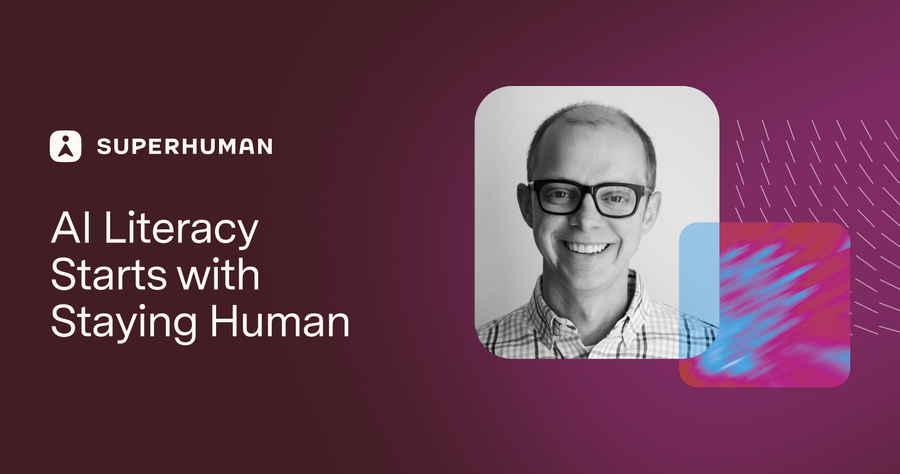
Superhuman's Chris Cummings joins Cedarville University's podcast to explore what AI literacy really means and why keeping the human voice matters most.
Employers often ask universities to ensure their graduates are “AI literate,” but this isn’t something you can simply check off a list, according to Superhuman’s own Chris Cummings. With the constant shifts in AI development, any system built today to promote AI literacy will likely look different in a year.
The greatest thing we can be doing right now is helping our students recognize the power they have as humans and how they can maintain their human voice in this world.
Chris Cummings, senior manager of growth at Superhuman, appeared on the July 31 episode of Cedarville University’s Transform Your Teaching podcast. He posited that AI literacy is more about helping students keep their own voice, judgment, and creativity than it is about just mastering the tools.
During the podcast’s AI Literacy series, Cummings spoke with hosts Dr. Rob McDole and Dr. Jared Piles. Drawing on his two decades in edtech and his experience as a high school English teacher, he explained that AI literacy means purposefully adding AI to the curriculum, finding a balance between banning and fully embracing it, and focusing on key human skills for the workplace. For students, the habits they build now will shape whether AI helps their thinking or just replaces it.
Here are some more highlights from their conversation.
Key takeaways from Transform Your Teaching
- There is no fixed checklist for AI literacy. The key is to help students use powerful tools to boost their creativity and intellect, not to give up their own abilities.
- Blanket policies don’t build AI literacy. It grows on a case-by-case basis, as educators decide where to use AI, where to opt out, and where to let students experiment and reflect.
- A balanced approach works best. It’s neither a full adoption nor a total ban.
- In the future, clarity in written communication will be the most valuable human skill.
- The best tools bring people together. Well-designed tools encourage interaction and help build trust.
How can institutions protect academic integrity with AI?
Cummings’s answer starts somewhere unexpected: Drop the word cheating. He says starting with that term means the conversation is already off track, because assuming students are cheating leads to “an erosion of trust” and makes everything harder. The better question, he suggests, is how institutions can provide AI support that fits students’ actual learning experiences.
Right now, if a student puts an assignment prompt into a general chatbot, the tool doesn’t know which course they’re in, who their teacher is, or what good work looks like for that assignment. The chatbot gives a confident answer, the student edits it, and the university never knows. Cummings sees an opportunity here: context-aware agents that institutions can customize.
Listen to the episode:
• Transform Your Teaching
• Apple Podcasts
• Spotify
Superhuman closes the context gap
That gap is what Superhuman is building for. Its tools already appear within the environments students and faculty use every day, offering proactive support rather than a generic chatbot. A system that knows the syllabus, for example, can surface an answer the moment a student starts typing a question about a due date, before the email is ever sent.
The same infrastructure lets institutions build agents that understand a specific course’s goals and expectations, with centralized, policy-aligned controls so leaders can govern how AI is adopted across campus. For students, that means clearer writing through integrated tools and less time juggling disconnected apps. For faculty and administrators, it means AI that reinforces teaching, eases grading, and cuts administrative friction.
When done well, that visibility acts as a feedback loop rather than a surveillance tool. Faculty can use insights about where students struggle to improve the experience for future classes.
Can AI policy influence AI literacy?
This idea ties back to Cummings’s main point about AI literacy. Employers want graduates who are “AI literate,” but there is no quick six-month boot camp that can guarantee this. As he says, the real goal is to help students see their own value as people and figure out “how you don’t give up your capabilities, your creativity, and your intellect to such powerful tools, but instead use them to enhance who you are.”
To get there, one has to go beyond policy. As Cummings points out, institutional rules, and even rules at the individual course level, often confuse students and place an excessive burden on them. The real work happens “assignment by assignment and learning moment by learning moment,” as educators decide where to use AI, where to leave it out, and where to let students try things and reflect on what they learn. This approach avoids both extremes: relying on unsustainable assumptions or rejecting tools students already use.
Cummings also pointed to the human skill he thinks will matter most: clarity in written communication. We steer these tools with plain language, so a vague prompt produces a vague result. The ability to be precise, provide context, and state exactly what you mean is a valuable skill, and each unclear prompt is a chance to hone it.
The hosts were most struck by the idea that the best tools help people connect. For example, a program could notice when a student is struggling and suggest, “This is a good question to take to your instructor,” along with a link to book office hours.
Listen to the full episode:
• Transform Your Teaching
• Apple Podcasts
• Spotify
Are you ready to build an AI strategy for your institution?
We have years of experience working with top educational institutions, first as Grammarly and now as Superhuman for Education. If you are building your AI strategy, choosing tools, setting policies, or looking for ways to support your faculty, our team can help.
Book a meeting →