Why Most Campus AI Strategies Never Leave Paper


Nearly every college and university now has an AI strategy on paper. According to EDUCAUSE, 92% of institutions report a work-related AI strategy, most often built from piloting tools, weighing opportunities and risks, encouraging staff and faculty to use AI, and drafting policies and guidelines.1 By that measure, higher education has caught up with the moment.
The ground tells a different story. Only 13% of institutions measure whether any of that AI activity returns value, and among the staff and faculty expected to follow these strategies, just 54% are even aware of the policies meant to guide them.2 A strategy that nearly everyone has, that almost no one measures, and that half of the campus can’t see, isn’t really a strategy yet. It’s an intention.
That gap is the real story of AI policy in higher education right now.
“Institutions are not struggling with AI access as much as they are struggling with AI coordination, governance, and measurable integration across workflows,” says Yolanda Wiggins, senior researcher at Superhuman. The institutions pulling ahead aren’t the ones with the most tools or the strictest rules. They’re the ones whose AI policy actually shapes what happens on the ground.
Here’s what separates a policy that works from one that exists only on paper.
What does an effective AI policy in higher education actually cover?
In practice, an effective AI policy in higher education settles four questions early, before an incident forces the answer:
- What AI use is acceptable?
- What data can those tools touch?
- Who’s accountable when something goes wrong?
- Where does human judgment have to stay in the loop?
Wait until a mishandled student record or an academic integrity dispute forces the issue, and the policy is already a step behind. The institutions seeing returns treat those answers as operating infrastructure, not a document filed away once a committee signs off.
New research from Superhuman and Higher Ed Dive’s Studio, based on a survey of more than 150 higher education executives, shows how few institutions have turned those four questions into practice. Coverage thins out exactly where the questions get harder to answer.
Institutional AI policies most often address generative AI tools like ChatGPT, Gemini, and Claude (87%), but far fewer extend to productivity agents such as Copilot and Superhuman Go (64%), or academic support tools like Grammarly (59%). Every tool a policy doesn’t name is a category of AI use no one has decided how to govern.
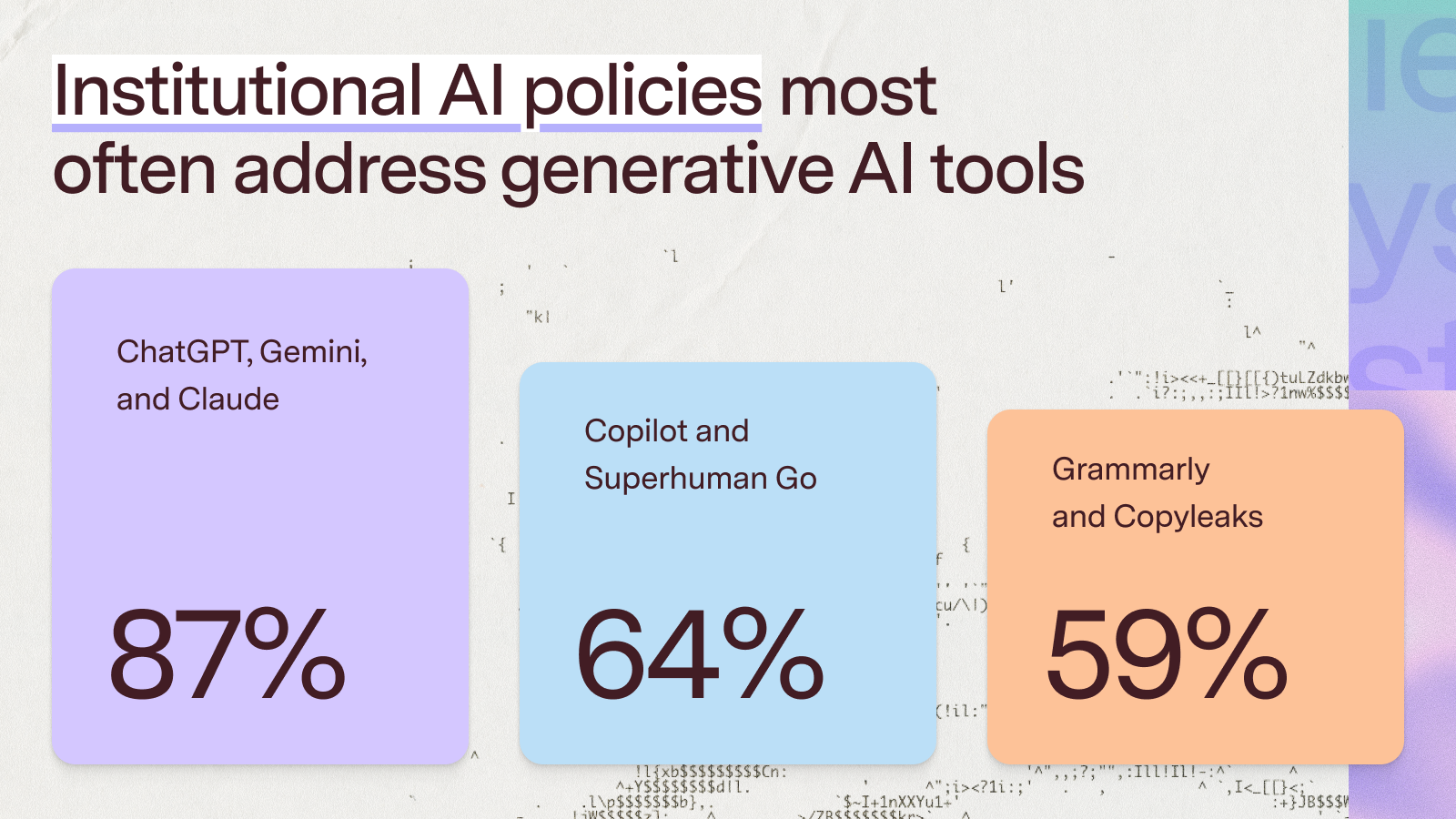
The same 87/64/59 split shows up in how institutions teach people to use AI: strong at the institutional level, weaker at the department level, weakest at the level of individual faculty or courses, which is exactly where students meet AI day-to-day. Support is strongest furthest from the classroom and thinnest closest to it.
A policy people can’t cite can’t guide the decisions they make every day, so they make those decisions on their own. That is how adoption keeps climbing while the strategy behind it stalls.
Why does adoption keep climbing while returns stay flat?
Adoption and strategy aren’t the same thing. Adoption is how many people are using AI. Strategy is whether that use adds up to something an institution chose, can steer, and can measure. Higher education is proving the difference in real time.
Institution-wide adoption reached 66% in 2025, up from 49% a year earlier, and 88% of administrators expect it to keep rising.3 Students are further ahead than any policy: Gallup and Lumina Foundation find 57% use AI in their coursework at least weekly, and just 13% never touch it.4 Discouragement barely dents that: even at institutions that discourage or prohibit AI, nearly half of students (48%) still use it weekly.
When adoption outruns governance, AI shows up as scattered wins: a chatbot fielding routine questions, cleaner email, a few administrative hours saved. Those gains are real, but they don’t compound. They stay fragmented, and the Superhuman and Higher Ed Dive data shows how deep that fragmentation runs. Asked how much of their AI use is actually sanctioned, just 19% of institutions said AI is formally embedded in strategy, policy, and procurement. The rest described use that is only partly formalized, limited to a few areas, or still experimental.
That’s the difference between an institution that’s busy with AI and one that’s strategic about it.
The two ways AI policy breaks down
Our research surfaces two patterns behind that fragmentation, and most institutions will recognize at least one.
The first is sanctioned fragmentation
IT approves a tool, departments deploy it, and each team builds its own use cases and informal norms. Everyone is technically compliant, yet no one can see the whole picture or measure a shared outcome. The chief information officer (CIO) inherits a stack that is impossible to govern as a system.
The second is shadow AI
When governance moves slower than adoption, people find their own tools. This usually comes from good intentions: faculty chasing efficiency, staff solving a problem faster than procurement allows. The gap is right there in the numbers, where nearly all staff and faculty have used AI for work but only about half can point to a policy that covers it. The workaround meets a genuine need, and the absence of a usable policy is what created the need.
Both look like adoption. But they are really fragmentation: tools in use with no shared infrastructure underneath them.
The blind spot in how institutions buy AI
This is where policy works against strategy.
When higher ed leaders evaluate AI tools, they prioritize data privacy and security (62%), user-friendliness (46%), and ease of implementation (39%). Those matter. But the criteria most tied to long-term impact rank far lower: scalability across the institution (29%), alignment with strategic goals (21%), and fit with real learning needs (19%).
The same leaders name their most important outcomes as preparing students for the workforce (79%), supporting the ethical use of AI (78%), and improving learning objectives (75%). There’s a mismatch between what institutions want AI to achieve and what they screen for when they buy it.
And the stakes behind that top outcome are climbing: Employers now name AI and big data as the single fastest-growing skill of the next five years, and expect 39% of workers’ core skills to change by 2030.5 Preparing students for that market means knowing what AI genuinely helps, which is exactly what an unmeasured strategy can’t tell you.
As Wiggins puts it, “When AI adoption is being driven defensively rather than tied to institutional goals, institutions struggle to clearly demonstrate impact.” This compounds further downstream. The single biggest barrier to expanding AI use, named by 30% of leaders, is lack of senior management support, and that support tends to arrive only when someone can show a return.
What it looks like when governance is the foundation
The institutions getting this right aren’t the most restrictive. They find the balance between two extremes:
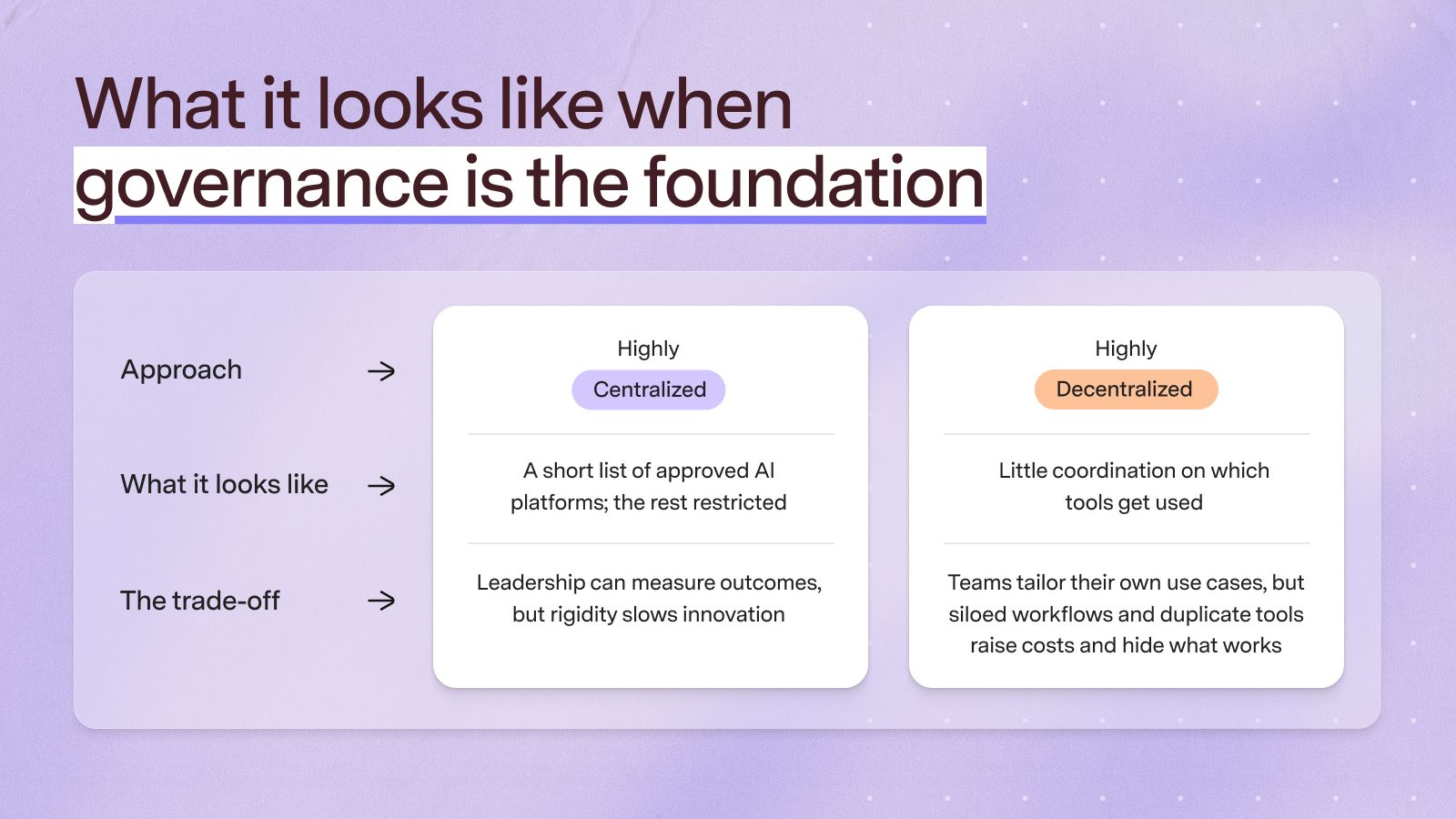
The institutions seeing compounding returns sit in the middle: enough structure to measure and govern, enough room for departments to find what genuinely helps. That balance looks less like tighter monitoring and more like shared expectations people can actually see.
Build AI policy your institution can see, follow, and measure
Aligning AI activity with AI strategy starts with a plan.
Most institutions land somewhere between stages two and three of AI maturity: aware that AI is everywhere, not yet governing it consistently. Knowing where you sit is the first move.
The State of AI Governance in Higher Education is a free playbook that gives CIOs and technology leaders a practical framework for building governance at any starting point: a five-stage maturity model, from experimental to reflective, to locate where your institution really is, the decisions that need clear owners before an incident forces them, and a set of lightweight first steps.
¹ Robert, Jenay. The Impact of AI on Work in Higher Education. Research report. Boulder, CO: EDUCAUSE, January 2026. https://www.educause.edu/research/2026/the-impact-of-ai-on-work-in-higher-education.
² Robert, Impact of AI on Work.
³ Ellucian. “Ellucian’s 3rd Annual Higher Education AI Survey Signals Shift from Individual AI Use to Institutional Strategy, Data Privacy Still the Top Barrier.” Press release. March 4, 2026. https://www.ellucian.com/newsroom/ellucians-3rd-annual-higher-education-ai-survey-signals-shift-individual-ai-use.
⁴ Lumina Foundation and Gallup. State of Higher Education. Research hub. Accessed August 31, 2026. https://www.gallup.com/analytics/644939/state-of-higher-education.aspx.
⁵ World Economic Forum. The Future of Jobs Report 2025. Geneva: World Economic Forum, January 2025. https://www.weforum.org/publications/the-future-of-jobs-report-2025/.