7 best Gmail alternatives (free & paid)

Looking for a Gmail alternative? Compare top email apps for security, AI features, and inbox zero. Find the best fit for your workflow.

Gmail blocks 99% of spam, offers industry-leading encryption, and packs features like Smart Compose, Meet, and Chat. These capabilities have helped it become one of the most popular email providers worldwide.
But popularity doesn't mean perfection. If Gmail's cluttered interface, privacy trade-offs, or limited power-user features are slowing you down, you have options. Below are seven of the best alternatives to Gmail.
Top 7 Gmail alternatives
- Superhuman Mail — Best overall for speed and productivity
- Outlook — Best for Microsoft ecosystem users
- Tuta — Best for end-to-end encryption
- Zoho Mail — Best for budget-conscious teams
- Mailfence — Best for PGP encryption
- Proton Mail — Best for zero-knowledge privacy
- Yahoo Mail — Best for maximum free storage
What are the best Gmail alternatives?
Gmail alternatives are email services or clients that let you send, receive, and manage email outside of Google's ecosystem. Some alternatives are full email providers with their own domains (like Proton Mail or Zoho Mail), while others are email clients that connect to your existing Gmail account but offer a different interface and feature set (like Superhuman Mail or Apple Mail).
People switch from Gmail for several reasons: privacy concerns about Google's data practices, frustration with a slow or cluttered interface, need for advanced productivity features, or simply wanting an ad-free experience.
Quick comparison: Gmail alternatives at a glance
Is there a better alternative to Gmail?
For many users, yes. Gmail is popular, but it comes with trade-offs.
Common complaints include:
- Slow, cluttered interface that's grown bloated over time
- Limited support options for Google Workspace users
- Privacy concerns – Google scans email content for advertising purposes
- No true keyboard-first workflow for power users
- Distracting promotions tab and social features
(And if you prefer dark mode, Gmail's implementation leaves much to be desired.) Free also doesn't mean free of cost. If Gmail is costing you time and focus, these seven alternatives may serve you better.
1. Superhuman Mail: Best for speed and productivity
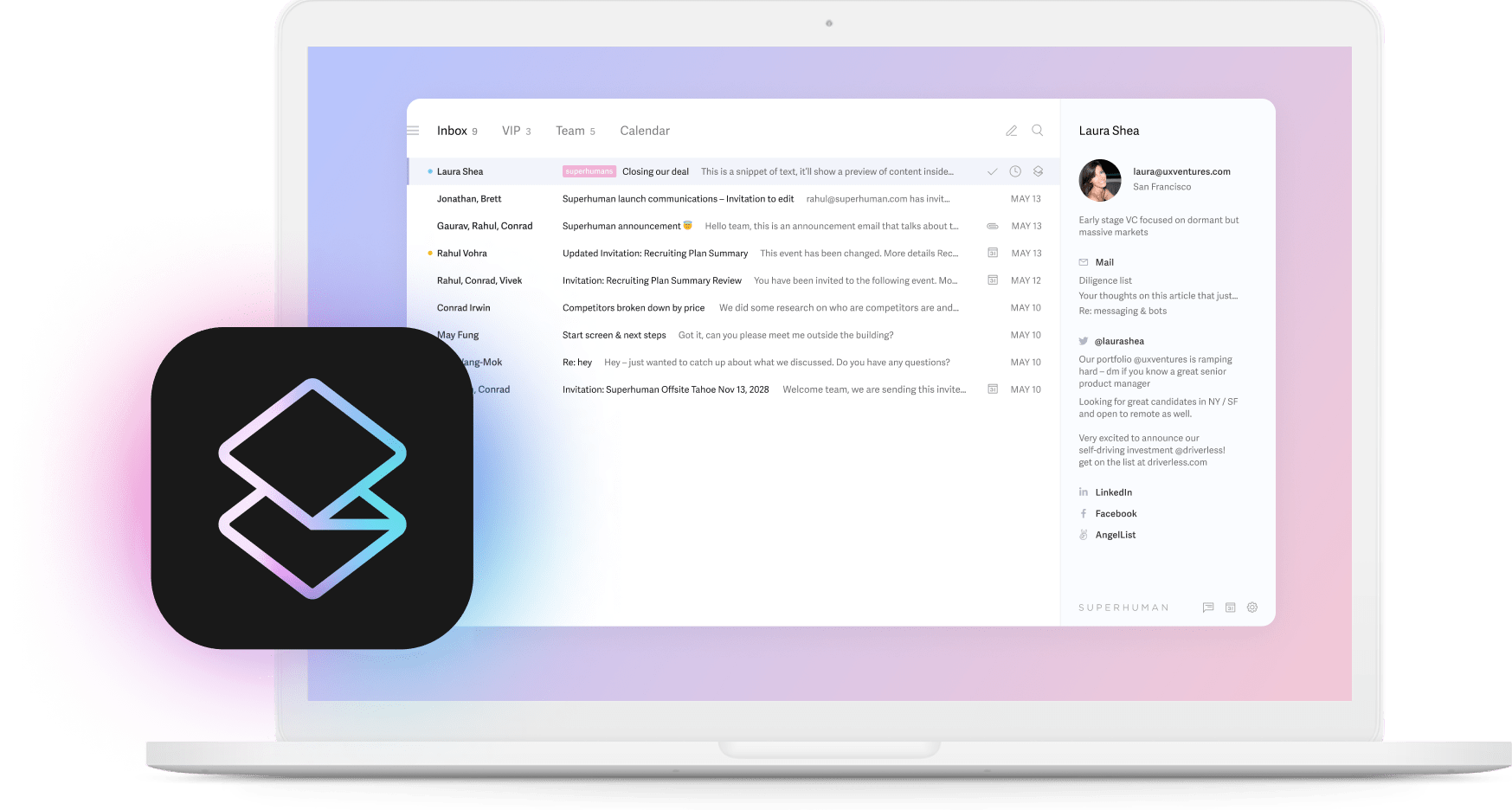
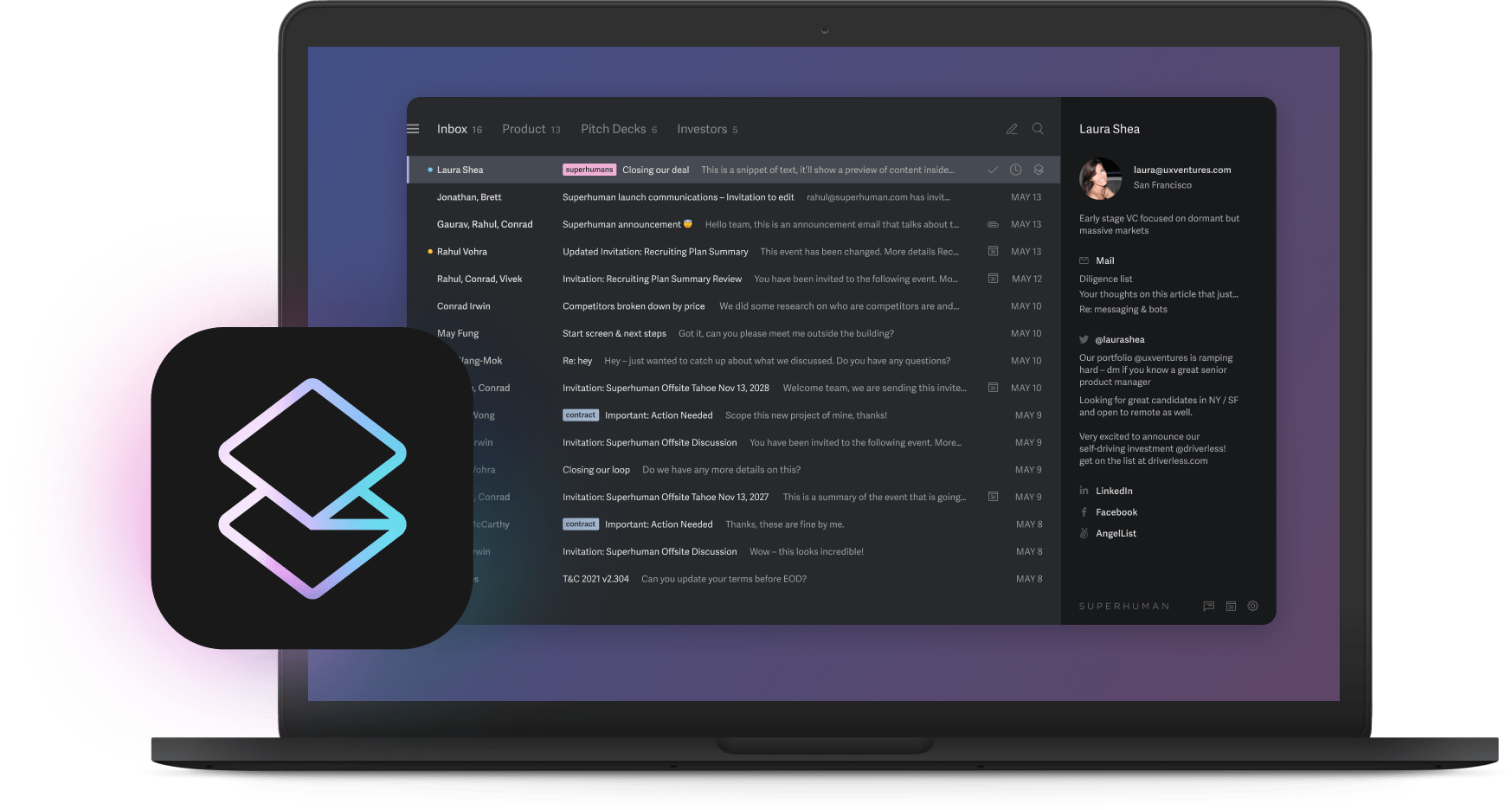
Superhuman Mail is built for people and teams who receive high volumes of email. The interface is fast, minimal, and distraction-free, helping users move through their inbox twice as fast and reach Inbox Zero daily.
Key features
- Split Inbox – Triage email into separate, easily manageable streams like Important, Other, VIP, Team, and Calendar
- Custom Split Inbox – Create your own splits based on sender, domain, subject, or Auto Labels
- Keyboard shortcuts and command palette – Navigate entirely without a mouse (press ⌘ K / Ctrl K)
- One-keystroke unsubscribe (⌘ U / Ctrl U) – Instantly unsubscribe, block senders, or entire domains
- 30ms search – Blazing-fast search across your entire inbox
- Offline mode – Full functionality even without an internet connection
- Scheduled send & Snooze – Send emails at the perfect time and snooze messages to resurface later
- Remind Me – Set follow-up reminders so nothing falls through the cracks
- Read Statuses – Know when and how recipients read your emails
- Snippets – Save and insert templated responses with a single keystroke
- AI-powered writing and summarization – Write with AI, Auto Summarize threads, Instant Reply, and Ask AI
- Auto Labels and Auto Archive – Automatically organize your inbox without lifting a finger
- Share Availability – Share your calendar availability directly from email
- Team Collaboration Features – Shared Conversations, Team Comments, Team Read Statuses, Team Reply Indicators, and Team Snippets
Pricing
Superhuman offers three pricing tiers designed to scale with your needs:
- Starter: $30/month or $25/month billed annually ($300/year) – Best for individuals and small teams. Annual billing saves you $60/year and unlocks all core productivity features, including Split Inbox, Snippets, Remind Me, Snooze, Read Statuses, and most Superhuman AI features.
- Business: $40/month or $33/month billed annually ($396/year) – Best for growing teams that rely heavily on email. Includes everything in Starter plus Auto Drafts, Ask AI, Custom Auto Labels with AI, HubSpot and Salesforce integrations, Recent Opens feed, centralized billing, and team management.
- Enterprise: Custom pricing – Best for larger organizations with advanced security needs. Includes everything in Business plus SSO, SCIM user provisioning, advanced admin controls, audit logs, dedicated account management, and custom compliance options.
Why annual billing is worth it: Beyond the cost savings, committing annually helps establish the habit of using Superhuman daily, and users who do report saving 4+ hours every week.
Pros
- Fastest email experience available
- Clean, distraction-free interface
- AI features that learn your writing style
- Works with Gmail and Outlook accounts
- Extensive team collaboration features
Cons
- No free plan
- Incomparable features come with a higher cost compared to basic email clients
Recommended for
Founders, executives, and teams who handle 150+ emails per day and value speed over everything else.
2. Outlook: Best for Microsoft ecosystem users
Outlook is bundled with Windows and integrates deeply with Microsoft 365. With approximately 3.5% of the email client market share, Outlook remains the third-largest email client globally.
Key features
- Free email and calendar (15GB mailbox)
- POP, IMAP, and SMTP support
- Focused Inbox (similar to Gmail's Priority Inbox)
- Web versions of Office apps and OneDrive integration (5GB free)
- Copilot AI assistance (paid plans)
Pricing
Outlook is available for free with limited features, or as part of Microsoft 365 subscriptions:
- Free (Outlook.com): 15GB mailbox, web access, ads included
- Microsoft 365 Personal: $6.99/month or $69.99/year – 1 user, 1TB OneDrive, full Office suite
- Microsoft 365 Family: $9.99/month or $99.99/year – Up to 6 users, 1TB OneDrive per user
- Microsoft 365 Business Basic: $6/user/month (annual commitment) – 50GB mailbox, 1TB OneDrive
- Microsoft 365 Business Standard: $12.50/user/month (annual commitment) – Includes desktop Office apps
Pros
- Deep integration with Microsoft 365 and OneDrive
- Built-in calendar and task management
- Available on all major platforms
- Generous free storage
Cons
- Ads in free version can be distracting
- Search isn't as powerful as Gmail's
- Interface can feel cluttered
Recommended for
Microsoft power users or anyone who needs familiar email plus tight Office integration.
3. Tuta: Best for end-to-end encrypted email
Tuta (formerly Tutanota) was the first email service to offer end-to-end encryption by default. Establishing itself as a privacy leader, all of Tuta's data is stored on servers in Germany under strict GDPR, and the source code is open-source.
In 2024, Tuta became the first email provider to implement post-quantum cryptography, protecting users against future quantum computing threats.
Key features
- End-to-end encrypted email, calendar, and contacts
- Post-quantum cryptography (TutaCrypt protocol)
- Full-text search executed locally (never on servers)
- Anonymous signup; no personal data required
- Powered by 100% renewable energy
Pricing
Tuta offers both personal and business plans:
- Free: 1GB storage, 1 email address, limited features
- Revolutionary: €3/month (~$3.50) – 20GB storage, 15 email aliases, 3 custom domains, unlimited search, offline mode, calendar sharing
- Legend: €8/month (~$9) – 500GB storage, 30 email aliases, priority support, beta features access
Business plans start at €6/user/month with additional admin controls and team management features.
Pros
- Industry-leading encryption
- Open-source and independently auditable
- No ads, no tracking
- Encrypts subject lines (unlike PGP)
Cons
- Limited free storage (1GB)
- No IMAP/POP support – must use Tuta apps
- Fewer third-party integrations
Recommended for
Users who need a privacy-focused, open-source email solution and want protection against future threats.
4. Zoho Mail: Best for budget-conscious teams
Zoho Mail offers a clean interface, reliable support, and seamless integration with Zoho's business suite, all at competitive prices. With approximately 4% global market share and over 10 million users, Zoho Mail has become a solid choice for small businesses. Custom-domain email is available through web and mobile apps.
Key features
- Custom domain email for branded addresses
- Integration with Zoho Workplace (Docs, Sheets, Projects)
- Offline mode for reading and composing
- Built-in calendar and task management
- eDiscovery and retention policies (business plans)
Pricing
Zoho Mail offers some of the most competitive pricing in the market:
- Free: Up to 5 users, 5GB storage per user, web access only (available in select regions)
- Mail Lite: $1/user/month – 5GB or 10GB storage options, IMAP/POP access, mobile apps
- Mail Premium: $4/user/month – 50GB storage + 50GB archival, S/MIME encryption, white labeling
- Workplace Standard: $3/user/month – Email plus online office apps
- Workplace Professional: $6/user/month – Full productivity suite with 100GB storage
All prices are for annual billing.
Pros
- Affordable for business users
- No ads, even on free plans
- Strong security features and compliance certifications
- Full productivity suite integration
Cons
- Mobile app experience could be smoother
- Limited third-party integrations outside Zoho ecosystem
- IMAP/POP access requires paid plan
Recommended for
Small businesses and startups who need professional email with CRM and productivity tool integration at a low cost.
5. Mailfence: Best for PGP encryption
Based in Belgium, Mailfence offers end-to-end PGP encryption plus SSL certificates that avoid US certificate authorities. This ensures compliance with European data protection laws rather than US jurisdiction. No ads, spam filtering, or trackers.
Key features
- Built-in PGP encryption with key management
- Digital signatures for email authentication
- Integrated calendar, contacts, and document storage
- Two-factor authentication
- IMAP, POP, and SMTP access (paid plans)
Pricing
Mailfence pricing is structured annually:
- Free: 500MB email storage, 500MB documents, 1 email address
- Entry: €3.50/month (~$3.85) – 5GB email, 12GB documents, 10 aliases, IMAP/POP access
- Pro: €9.50/month (~$10.45) – 20GB email, 24GB documents, 50 aliases, phone support
- Ultra: €29/month (~$31.90) – 50GB email, 70GB documents, 100 aliases, priority support
Custom business plans are available with personalized domains and enhanced features.
Pros
- True PGP implementation with full key control
- Belgium jurisdiction (strong privacy laws)
- Includes calendar and document storage
- Supports IMAP for third-party clients
Cons
- Limited free storage (500MB)
- Interface feels dated compared to competitors
- Smaller user base means fewer resources for development
Recommended for
Users who specifically need PGP encryption and prefer European data jurisdiction over Swiss or German alternatives.
6. Proton Mail: Best for zero-knowledge privacy
Proton Mail uses zero-access end-to-end PGP encryption and is protected by Swiss privacy laws. With over 100 million Proton accounts as of 2023, Proton has established itself as the largest secure email provider. Anonymous payment via Bitcoin or Monero is supported.
Key features
- Zero-access encryption – even Proton cannot read your emails
- Self-destructing messages with expiration timers
- Password-protected emails for non-Proton recipients
- Proton Scribe AI writing assistant (runs locally for privacy)
- Bundled VPN, calendar, and cloud storage
Pricing
Proton offers individual, family, and business plans:
- Free: 500MB storage (up to 1GB with checklist), 150 emails/day, 1 email address
- Mail Plus: $4.99/month – 15GB storage, 10 email addresses, custom domain support
- Proton Unlimited: $12.99/month – 500GB storage, all Proton apps (VPN, Drive, Calendar, Pass)
- Proton Family: $29.99/month – Up to 6 users, 3TB total storage
Business plans:
- Mail Essentials: $7.99/user/month – 15GB storage, 3 custom domains, calendar sharing
- Business Suite: $12.99/user/month – 500GB storage, 10 custom domains, 10 VPN connections
Discounts available for annual and 2-year billing.
Pros
- Robust privacy protections backed by Swiss law
- Largest encrypted email provider (network effects)
- Full ecosystem: VPN, Drive, Calendar included
- Open-source and independently audited
Cons
- Limited free storage (1GB, 150 emails/day)
- More expensive than some alternatives
- Can't use external email clients without Bridge (paid)
Recommended for
Privacy-conscious users who want a completely encrypted ecosystem and trust Swiss jurisdiction.
7. Yahoo Mail: Best for maximum free storage
Yahoo Mail has been around since the early days of webmail and still serves approximately 200 million monthly users. While it may not have the cutting-edge features of newer providers, it offers a standout feature: generous free storage.
Key features
- Generous free storage – far exceeding Gmail's 15GB
- One-click unsubscribe from mailing lists
- Built-in spam and phishing protection
- Customizable themes and organization tools
- Travel and shopping email organization
Pricing
Yahoo Mail recently updated its storage policies:
- Free: 20GB storage (reduced from 1TB as of August 2025), ad-supported
- Yahoo Mail Plus: $5/month – 200GB storage, ad-free experience, 500 temporary email addresses, 24/7 support
- Storage add-ons: 100GB for $1.99/month or 1TB for $9.99/month
Note: Free accounts exceeding 20GB storage must upgrade or reduce storage to continue sending/receiving emails.
Pros
- Generous free storage (20GB)
- Simple, familiar interface
- Strong spam filtering
- Affordable paid upgrade options
Cons
- Ads in free version are prominent
- No end-to-end encryption
- History of security breaches (though improved)
- Fewer productivity integrations
Recommended for
Users who receive large volumes of email with attachments and want to archive everything without paying for storage.
Which Gmail alternative should you choose?
Choosing the right Gmail alternative ultimately comes down to how you work and what you value most. Outlook, Proton Mail, Tuta, Zoho, Mailfence, and Yahoo each excel in specific areas, whether that's privacy, ecosystem integration, budget-friendliness, or generous storage. Each platform offers its own strengths, and for many users, aligning those strengths with their daily workflow will lead to a meaningful upgrade from the standard Gmail experience.
That said, if your priority is moving through email faster, staying focused, and ending each day with a clean inbox, Superhuman Mail stands apart. Its speed-driven design, thoughtful interface, and productivity-focused workflow make it the strongest choice for anyone who wants email to feel less like a chore and more like a competitive advantage. If you're ready to experience what that feels like, try Superhuman Mail and decide for yourself.