Meeting recap email example: 3 steps to writing follow-ups that actually get read
Send meeting recap emails that keep projects moving. Get proven examples, templates, and AI tools to write clear follow-ups in under 10 minutes.
You just wrapped an important client meeting. Five stakeholders attended, decisions were made, and everyone agreed on next steps. Then the recap email arrives three days late, attributes action items to the wrong people, and buries critical deadlines at the bottom.
Your team now wastes time clarifying who owns what while the project stalls. This scenario plays out thousands of times daily across organizations. 44% of meeting action items never reach completion due to poor documentation. That translates to between $25,000 to $55,000 per employee annually in lost productivity.
When recaps fail to clearly communicate decisions and timelines, projects slow down and opportunities slip away. Your meeting recap quality directly impacts team efficiency, client satisfaction, and project success.
What is a meeting recap email?
A meeting recap email is a follow-up sent within 24 hours of any important meeting. It documents key discussion points, confirms mutual understanding, establishes clear ownership of action items, and maintains momentum toward completion.
Unlike generic meeting notes stored in shared folders, effective recaps land directly in inboxes where people work. They provide a professional framework that keeps everyone aligned without requiring constant check-ins.
When to send a meeting recap email
Send your recap within 24 hours of your meeting, with 12-16 hours being ideal. Emails sent between 9-11 AM on Tuesday through Thursday generate the highest engagement rates.
Send a meeting recap email after:
- Client meetings when you've discussed project requirements or deliverables
- Team planning sessions to confirm priorities and resource allocation
- Stakeholder updates when executives need visibility on project status
- Vendor discussions to document pricing, timelines, and next steps
- Problem-solving meetings to ensure everyone understands the agreed solution
How to write a meeting recap email in 3 steps
Step 1: Lead with next steps
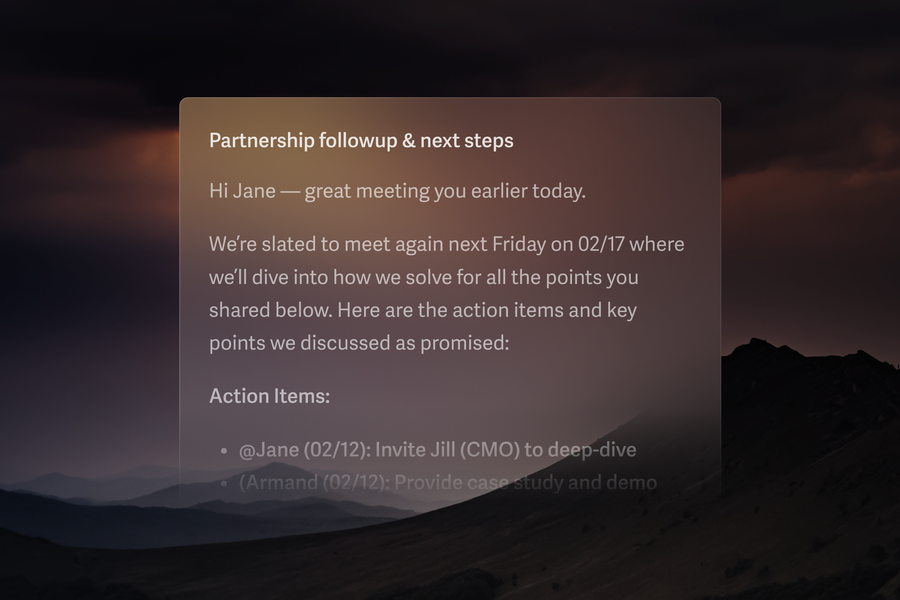
Open by immediately stating when your next interaction is scheduled. Busy professionals skim emails quickly. If your action items are buried, they may never see the critical information.
Combine your greeting with the next meeting date in bold: "Hi Jennifer, thanks for joining today's planning session. Our next meeting is scheduled for Tuesday, April 22nd at 2 PM EST."
Format action items as a bulleted list with three components: the specific action required, the person responsible, and the deadline.
Next Steps:
- Jennifer: Share Q2 budget allocation by Friday, April 18th
- Jennifer: Connect us with your IT director for security review
- Michael: Send updated project timeline by Thursday, April 17th
- Michael: Provide vendor comparison analysis
Best practices for next steps:
- Use specific deadlines rather than vague timeframes
- Confirm the person you're asking can actually complete the task
- Limit action items to 4 maximum
- Bold key dates and deadlines
- Separate reference materials from action items
Step 2: Summarize key decisions and discussion points
Structure your meeting summary around the most important outcomes rather than a chronological play-by-play. People don't need a transcript. They need clarity on what changed, what was decided, and why it matters.
List 3-4 key decisions or discussion points using specific language that captures the importance. Instead of "discussed timeline," write "agreed to move launch date to June 15th to accommodate additional testing."
Key Decisions:
- Moved launch date to June 15th to accommodate additional testing phase
- Approved $50K budget increase for third-party integration costs
- Selected vendor B over vendor A based on faster implementation timeline
- Decided to proceed with phased rollout starting with pilot group
When mentioning discussion points, focus on conclusions reached: "Team confirmed that current approach meets security requirements" focuses on the outcome, not the debate.
Include specific numbers or commitments mentioned during the meeting: "budget increased from $150K to $200K" or "implementation timeline reduced from 12 weeks to 8 weeks."
Step 3: Format for mobile scanning
Most business professionals now check email on mobile devices first. Everything important must fit on a single phone screen without scrolling.
Use bold formatting for section headers, strategic white space to separate topics, and consistent bullet formatting that enables rapid scanning. Keep descriptions to 2 lines maximum per bullet point.
Subject lines should stay under 50 characters to avoid truncation. Individual bullet points should not exceed 120 characters to maintain scannable formatting.
Format hierarchy:
- Bold underlines for major sections
- Bold text for headers within sections
- Red highlighting exclusively for urgent action items
- Standard text for descriptive content
Meeting recap email examples
Here are three proven templates for different meeting types:
Client meeting recap example
Subject: Next steps from today's meeting
Hi [Name],
Thanks for taking the time to meet today. Our next check-in is scheduled for [Day, Date] at [Time].
Next Steps:
- You: [Action] by [deadline]
- You: [Action] by [deadline]
- Me: [Action] by [deadline]
- Me: [Action] by [deadline]
Key Decisions:
- [Decision 1 with specific details]
- [Decision 2 with specific details]
- [Decision 3 with specific details]
Open Items:
- [Question or dependency 1]
- [Question or dependency 2]
Let me know if I missed anything.
Best, [Your name]
Team meeting recap example
Subject: Action items from [Project Name] planning
Hi team,
Great discussion this morning. Our next sync is [Day, Date] at [Time].
Action Items:
- Sarah: [Task] by [deadline]
- Mike: [Task] by [deadline]
- Alex: [Task] by [deadline]
Decisions:
- [Decision 1]
- [Decision 2]
- [Decision 3]
Blockers:
- [Issue 1 and owner]
- [Issue 2 and owner]
Questions? Reply here.
[Your name]
Stakeholder update recap example
Subject: Summary of Q2 planning discussion
Hi [Name],
Thanks for joining today's planning review. Next executive update: [Day, Date] at [Time].
Key Outcomes:
- [Major decision or approval]
- [Budget or resource allocation]
- [Timeline confirmation]
What We Need from You:
- [Request 1] by [deadline]
- [Request 2] by [deadline]
Next Milestones:
- [Milestone 1] on [date]
- [Milestone 2] on [date]
I'll send a detailed project status update by end of the week.
Best, [Your name]
Write meeting recap emails faster with Superhuman Mail
Superhuman Mail transforms your recap email process from time-consuming manual work into streamlined communications that maintain personal touch.
Snippets eliminate the need to recreate effective email structures from scratch. Templatize your recap emails, action item lists, and follow-up formats. Team Snippets enable entire organizations to share proven templates and best practices across teams. New team members can immediately leverage the collective experience of top performers.
Auto Summarize displays a one-line summary above every email conversation, with expanded summaries available through a single keystroke. This proves invaluable when reviewing long email threads or digesting complex project updates. Auto Summarize identifies the most critical information so you can capture it accurately in your recap.
Superhuman AI learns from your writing patterns and maintains your personal style while accelerating content creation. Unlike generic AI writing tools, Superhuman AI understands professional communication context and provides suggestions that align with proven methodology.
Meeting recap emails separate organized teams from chaotic ones. Most recaps end up ignored because they bury action items, arrive too late, and read like transcripts rather than strategic summaries.
The right structure changes everything. Lead with next steps, summarize key decisions, and format for mobile scanning. Your team will know exactly what happens next and why it matters.
Ready to fly through your inbox and write better meeting recaps? Try Superhuman Mail for free and save 4 hours per person every week.