Built With Institutions: Takeaways from EDUCAUSE 2026

The theme of EDUCAUSE 2026 was clear: the institutions making real progress with AI are building it with their own people. Three takeaways from our week in the room.
Coming out of the EDUCAUSE Annual Conference, I noticed a few themes surfacing in our session, in booth conversations, and in the walkways in between. Campuses are taking a harder look at the pile of point tools they’ve accumulated. Leaders are done treating governance and adoption as a tradeoff. And authenticity has become an institution-wide priority—one that now reaches every department well beyond the writing center.
Underneath all three themes was the same idea: AI is already everywhere on campus, but the guidance meant to shape it hasn’t reached the people using it. In a recent EDUCAUSE survey, 94% of respondents said they’d used AI tools for work in the past six months, yet only 54% were aware of the policies meant to guide that use.¹
The institutions pulling ahead are answering that by building AI with their own people, for the problems only they can see clearly. That was the throughline of our session, Built With Institutions: How Three Campuses Built AI on Their Own Terms. Here are three takeaways I brought home from Denver.
Campuses are rethinking tool sprawl
Almost every campus has accumulated AI tools the way you accumulate browser tabs: one at a time, each solving a slice of the problem, with none of them talking to each other. This year, many leaders told me they’re done adding to the pile.
The campuses making progress are building what they need on a foundation they already have. Grammarly already works across the tools students and faculty at more than 3,000 educational institutions use every day. Superhuman Go extends that into a platform where institutions can build their own agents for their unique use cases. And Docs gives teams a connected place to collaborate on the plans, policies, and shared work that guide how AI gets used. A new capability becomes something your campus shapes and owns, and it completes the AI investments you’ve already made instead of adding one more system to manage.
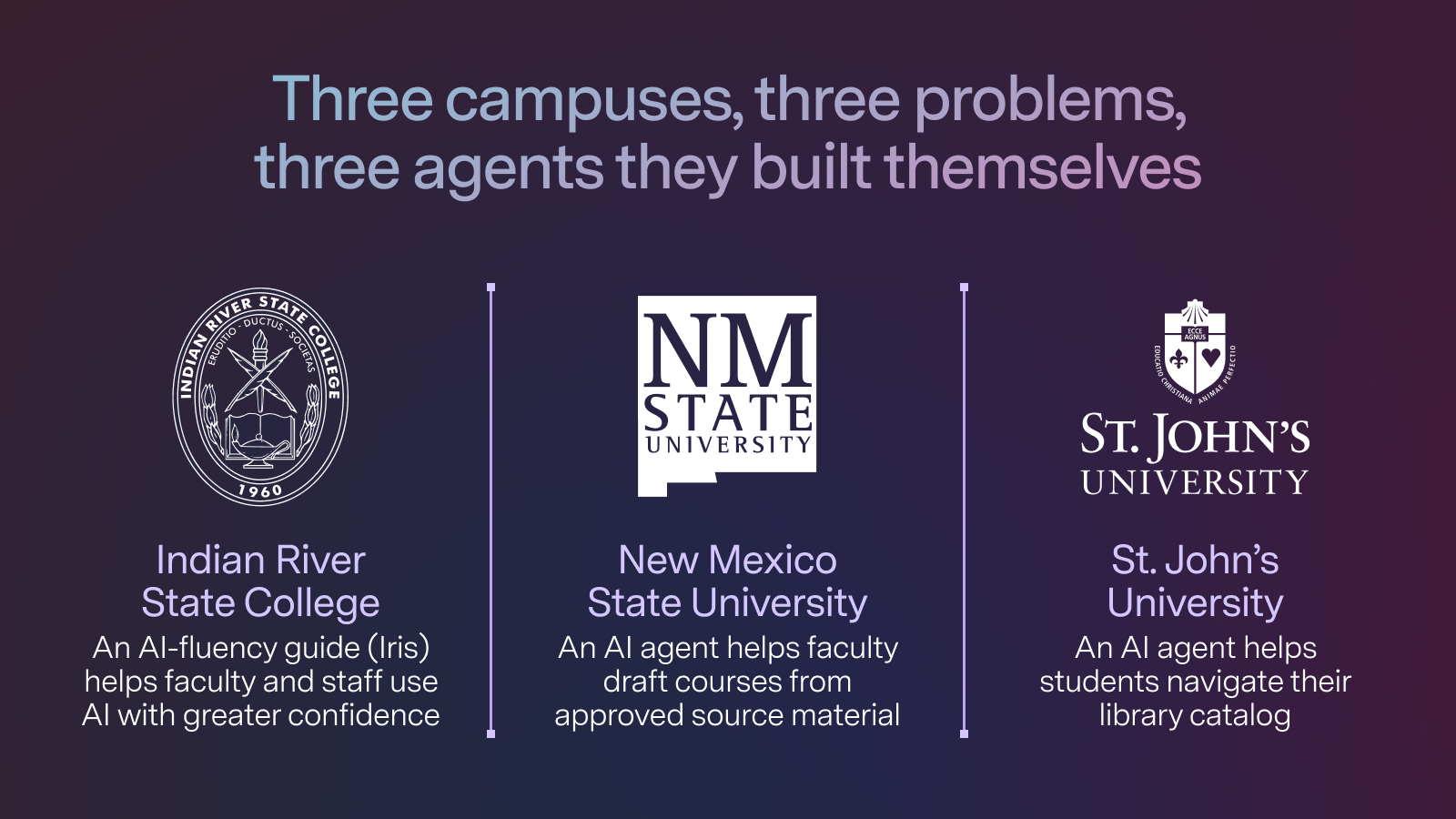
New Mexico State University, for example, used Superhuman Go to build an agent that helps draft courses, and St. John’s University used Go to build one that helps students navigate their library catalog. Both schools built on technology their campuses already use rather than adding another standalone tool, and the same shift is happening well beyond higher education. Gartner expects 40% of enterprise applications to include task-specific AI agents by the end of 2026, up from less than 5% in 2025.²
Campuses ahead of that curve are shaping those agents themselves, giving faculty and staff time back for the work only they can do.
Governance has to make room for adoption
The old assumption was that you could have control or adoption but not both. Lock AI down and stay safe. Open it up and lose oversight. The institutions furthest along no longer believe that.
They’ve realized that when governance blocks people, AI usage becomes invisible. Oversight and adoption rise when AI shows up where people already work, giving institutions the visibility they need to lead responsibly. A policy governs only when people actually follow it. Campuses that get this right make the trusted path the natural one, so using AI well becomes the simplest thing to do.
Getting governance right at the institution level raises the question behind my final takeaway: How much AI belongs in a given course? That answer has to come from the people teaching it.
Authenticity depends on faculty judgment
For a while, the question of authentic student work sat mostly with a school’s writing center or integrity office. That’s changed. Provosts, deans, and faculty across departments are now asking a version of the same question: When AI can produce a finished essay in seconds, how do we help students actually learn and show how their work came together?
What I heard most is that there’s no single right answer across a campus. The right amount of AI in a first-year composition course looks different from a nursing practicum or a senior design project. The people best placed to make that call are the faculty who know the discipline and the learning outcomes their students need to reach, and institutions need room to support those choices course by course. A single campus-wide rule rarely does that.
Indian River State College is a good example of support built around that reality. Students build on the writing support they already know from Grammarly, and the college’s AI-fluency guide, Iris, helps faculty and staff build the skill to use AI well so they can guide students with greater confidence.
That’s where authenticity tools earn their place. Grammarly Authorship gives an instructor a clear record of how a piece of writing came together, and GPTZero—a leading AI content detector now part of Superhuman—adds a trusted signal of whether AI was involved. Neither one makes the call for the instructor. Used side by side, they give faculty the context to decide what authentic work looks like in their course, whether an assignment welcomes AI, limits it, or asks students to start without it.
With governance in place at the institution level, the next opportunity is to extend authenticity support to the departments and courses where faculty expertise lives. That’s where we’re putting our energy.
The work worth doing
The institutions that inspired me most at EDUCAUSE were the ones building carefully, with their people at the center, prioritizing one real problem at a time.
Tool sprawl, governance, and authenticity can feel like three separate problems. At EDUCAUSE, I saw how closely they connect. Fewer, more trusted tools make governance workable, and effective institutional governance gives faculty the room to decide what authentic work looks like in their own courses.
Grammarly is now part of Superhuman, and we’re building this next chapter with our education partners, not just for them. The best AI for your campus is one you help build. If that’s the work you’re trying to do, our Education team would love to talk. Let’s build something together.
- Jenay Robert, “The Impact of AI on Work in Higher Education,” EDUCAUSE, January 2026, https://www.educause.edu/research/2026/the-impact-of-ai-on-work-in-higher-education.
- Gartner, “Gartner Predicts 40% of Enterprise Apps Will Feature Task-Specific AI Agents by 2026, Up from Less Than 5% in 2025,” press release, August 26, 2025, https://www.gartner.com/en/newsroom/press-releases/2025-08-26-gartner-predicts-40-percent-of-enterprise-apps-will-feature-task-specific-ai-agents-by-2026-up-from-less-than-5-percent-in-2025.