GPTZero is Now Part of Superhuman: What It Means for Signals of Authentic Work
Best-in-class AI detection now sits alongside Grammarly’s authorship tools inside Superhuman’s authenticity layer, giving instructors more reliable signals and students a fairer read on their work.

GPTZero, the AI content detector trusted by millions of educators and students, is now part of Superhuman. Its authenticity suite, spanning AI detection, hallucination detection, plagiarism checking, and writing replay, joins Grammarly’s authorship tools and will be available in Superhuman Go, the AI assistant platform that works across 1 million apps and websites.
When Superhuman announced its plans to acquire GPTZero earlier this year, the goal came down to building a more complete authenticity layer. For education, this means a better way to understand student work. Several signals of authenticity, read together, give a fuller and fairer picture than any single score could.
A fuller, fairer picture of authentic work
When ChatGPT arrived in late 2022, the instinct across most institutions was understandable: find a way to keep AI from undermining the academic model.¹ AI detectors filled that gap fast. Used well, they gave instructors a useful starting point for a conversation with a student. The trouble came when a single score got treated as a verdict on its own.
Marley Stevens, a junior at the University of North Georgia, learned that the hard way.² She wrote a criminal justice paper the way she’d written every paper in college, with Grammarly running in the background to catch spelling and punctuation. She wrote; Grammarly assisted. A separate AI detector flagged it anyway. She failed the assignment, lost a scholarship, and landed on academic probation. Grammarly publicly stood up for her, pointing to her case as exactly the kind of outcome a single detection score can cause.
Detection has come a long way since. Today’s best detectors are far more accurate and fairer. GPTZero’s latest model produced just one false positive in more than 10,000 essays from a demographically diverse set of students. What that early period made clear is a point the whole field now shares. A signal, however strong, works best as the start of a conversation between a student and an instructor, and not as a verdict handed down.
Grammarly took a different path early on with Authorship, which shows how a piece of writing actually came together—the drafting, the edits, and how much was typed, pasted, or AI-generated along the way—rather than evaluating the finished product alone. The provenance conversation has only intensified since, with the whole industry converging on a simple idea: knowing how content was made matters. That’s the premise the authenticity layer was built on.
The takeaway for institutions is steady across all of it: no single signal tells the whole story on its own, whether that’s a detector, a watermark, or a process log.
What instructors told us about authentic work
Talking with instructors, a few things came through clearly.
Integrity looks different across contexts
Disciplines, faculty, and assignment types call for different signals, and often more than one. A lab report, a reflective essay, and a coding assignment don’t wear their authenticity the same way.
Authenticity is multi-dimensional
Whether a student’s work is their own is a question with many facets, not a single score. The instructors we recently interviewed said as much. They wanted to see the thinking behind the work, the prompts, the dialogue, and the process, not just judge the finished page.
Instructors are still left in a bind
Too often the decision rests on a single signal, usually an AI detection score, plus a gut feeling. On that rides a hard choice: start a conversation, open an integrity case, or let it go. That’s a weighty decision to ask of an instructor holding a stack of papers and one ambiguous number. And it’s not a rare call. They make the same call on paper after paper, all term.
What GPTZero brings to the table
Bringing GPTZero into Superhuman means instructors no longer have to rely on any one signal or on instinct alone.
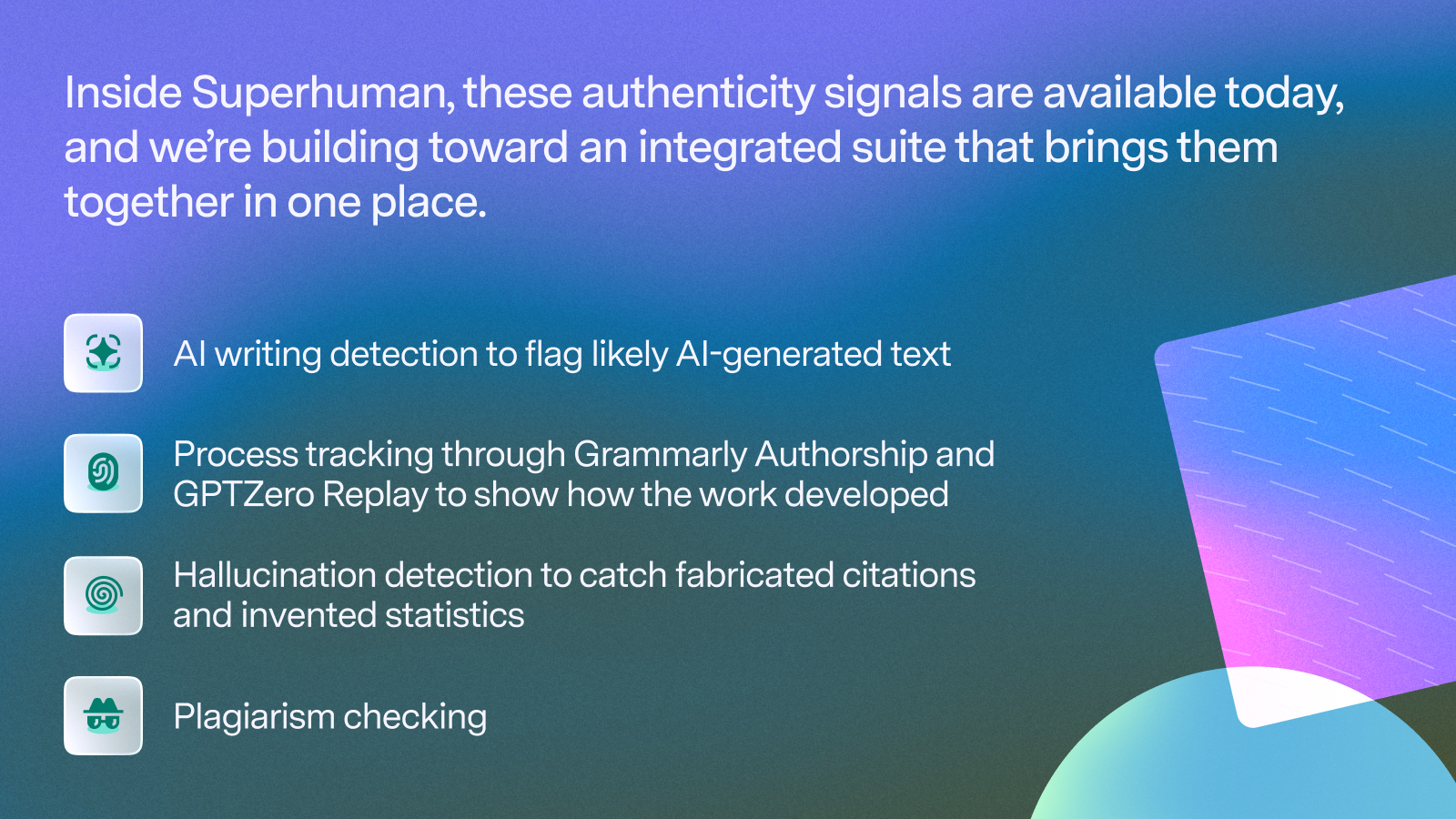
Used together, they form an authenticity suite, giving students and instructors the same high-quality signals of authentic work. One signal gives you a blurry picture. Several, read together, bring it into focus.
Each signal answers a different question:
- AI detection: How likely is it that AI wrote this?
- Process tracking: What went into the writing process?
- Hallucination checking: Are the sources real or AI-generated?
- Human pattern recognition: Does the typing follow normal human patterns?
Read together, they give an instructor something sturdier than a hunch and give a student a real chance to show their work. And these signals are interpretable. GPTZero doesn’t just return a score; it shows which AI writing patterns it flagged and explains, in plain language, why a passage read as AI-generated. That gives an instructor something they can talk through with a student, and it’s what makes a signal a starting point for a conversation rather than a verdict.
A signal, not a verdict
This is a philosophy GPTZero and Superhuman have long shared. GPTZero has always framed its mission as preserving learning, not just catching cheating, which is why our fit is a natural one.
Authenticity tools work best as an input to a conversation between a student and an instructor. They work best, too, with information parity, where the same signals are visible to both sides, so there are no gotchas and no black boxes. The goal is to protect the space where real learning happens and to give honest students a way to stand behind their work with confidence.
It reflects a shift in how the whole field is coming to understand authentic learning: through the process, not just the finished product. Two students can reach the same conclusion by very different paths. The signals that matter are the ones that show the journey.
What makes those signals trustworthy is parity: students see the same authenticity signals their instructors do. Nothing happens behind their back, so they become a participant in the process rather than a subject of it.
What’s next
Superhuman and GPTZero will continue to build for students and educators as AI becomes increasingly embedded in how people think, write, and learn. The goal is to meet institutions where they are today, with the authenticity signals they already trust, and help them grow into a fuller, holistic view of authentic work in the age of AI.
“AI is already part of how students write and learn. What matters now is helping educators see how work comes together, with signals they can trust. Bringing GPTZero and Grammarly’s tools into one place gives them that clarity, and gives students a fair shot to show their thinking.”
— Jenny Maxwell, Head of Superhuman for Education
Learn more
Join us on Thursday, October 15 at 11 a.m. PT / 2 p.m. ET for a live session on giving your institution a fuller, fairer picture of authentic student work.
About Superhuman
Superhuman is the AI productivity platform that brings AI wherever people work, integrating with over 1 million applications and websites. Grammarly is now part of Superhuman, alongside Superhuman Docs’ collaborative workspaces, Mail’s inbox management, and Go, the proactive AI assistant that understands context and delivers help automatically. Founded in 2009, Superhuman supports over 40 million people, 50,000 organizations, and 3,000 educational institutions worldwide.
About GPTZero
GPTZero is an AI detection platform that helps teachers, students, institutions, and professionals identify content generated by large language models. The first purpose-built AI detector, it’s trusted by millions of users and recognized as a leader in detection accuracy. Beyond detection, GPTZero has grown into a broader platform for trust and transparency online, spanning real-time AI content detection (AI Vision), source and authorship analysis, hallucination detection, and a developer API.
¹ OpenAI, “Introducing ChatGPT,” OpenAI, November 30, 2022, https://openai.com/index/chatgpt/.
² Rachel Hale, “College Students Face AI Allegations and Mental Health Toll,” USA Today, January 22, 2025, https://www.usatoday.com/story/life/health-wellness/2025/01/22/college-students-ai-allegations-mental-health/77723194007/.