
Key takeaways
- Build a decision system using the 2-minute rule: handle quick emails immediately, schedule longer tasks, delegate with clear protocols, and archive everything else
- Protect deep work with time-blocking: limit email checks to 2-3 times daily and guard 3-4 hour blocks for strategic work
- Master keyboard shortcuts to cut processing time from 2-3 hours to 45-60 minutes daily
- Layer in AI tools only after establishing clear processes; without process redesign, technology rarely delivers ROI
- Team collaboration features create visibility and prevent duplicate work without micromanagement
Your inbox is out of control. You're processing 200-300 emails daily, spending hours upon hours every week just managing messages. Important emails still slip through, and your team's waiting on responses that impact revenue.
But you don't have an email problem. You've got a systems problem.
Leaders who manage high email volumes don't work harder. They use three frameworks that cut processing time, protect their thinking time, and keep them responsive without sacrificing nights and weekends. Here's how to transform your inbox from a productivity drain into a tool that works for you.
What is high volume email management?
High volume email management is the systematic practice of processing, organizing, and responding to large quantities of email using structured frameworks, time-based strategies, and purpose-built tools. Professionals handling 100 or more messages daily need intentional systems rather than reactive checking.
Effective high volume email management rests on three pillars: decision frameworks that eliminate ambiguity, protected time blocks that batch processing into focused sessions, and email productivity apps that automate low-value tasks.
The goal is reclaiming mental bandwidth for strategic work. Professionals who adopt structured email sorting and processing systems report lower stress, faster response times, and more time for deep work.
The hidden cost of email overload
Your inbox steals more than time. It fragments your attention in ways that compound throughout the day.
Here's the math: you toggle between applications over 1,200 times daily. Each switch costs you. Your brain needs 23 minutes to recover from a single distraction. The total damage? You're losing 4 hours of productive time every week.
The average professional spends 28% of the workday on email, receiving around 120 messages daily. Global email traffic reached 361.6 billion daily in 2024 and is projected to grow to 424.2 billion by 2028. The volume will only increase.
The most counterintuitive finding: 60% of professionals cite lack of time as the primary barrier to implementing better email management. The problem prevents its own solution. Breaking this cycle requires frameworks that deliver immediate results without extensive setup time.
1. Build a decision system, not a filing system
The Getting Things Done methodology transforms inbox clearing from an overwhelming task into a systematic workflow.
The core principle: your inbox is a processing station, not storage. Every email should be processed through a clear decision framework (delete, delegate, defer, or do), with only very quick items requiring immediate action. Delegate to someone else, defer the task to a time block, handle it immediately if it takes less than 2 minutes, or move it to an external system to free mental capacity.
- If it takes less than 2 minutes, handle it now. In GTD, this "2-minute rule" appears within the Clarify step of the processing workflow, not as the first rule in a five-step decision process. If an email requires less than 2 minutes to handle, execute it immediately rather than deferring it. For emails requiring more than 2 minutes, schedule dedicated processing time.
- If it requires more than 2 minutes, schedule it. Block time in your calendar for execution. The email moves to an @Action folder that serves as your task list.
- If someone else should handle it, delegate with clear protocols. Include the goal, step-by-step process, and expected timeline. Track delegated items in an @Waiting For folder to ensure follow-through without micromanaging.
- If it's purely informational, archive it. Trust your search function. Creating elaborate folder hierarchies wastes more time than searching when needed.
Email protocol systems transform reactive email into structured project management by reducing total message volume. Include goal statements and step-by-step processes in outgoing messages, frontload process design to eliminate clarification exchanges, and create protocols for recurring request types.
Instead of writing "Can we discuss the Q2 budget?", write: "I need approval for Q2 budget Option B (attached). This increases marketing spend 15% to support the product launch. Please reply 'approved' or flag line items for revision by Friday at 3 pm. If no response by then, I'll assume approval to proceed."
This approach reduces back-and-forth exchanges through frontloaded process design.
2. Protect deep work with time-blocking
Processing email strategically matters far more than simply processing it efficiently. The difference lies in timing: when and how frequently you check email versus when you dedicate deep work blocks to processing it.
The three-tier time management system creates protected blocks for strategic work.
- Weekly planning identifies your most important initiatives. Block 3-4 hour periods on your calendar for these priorities as email-free deep work periods.
- Daily time-blocking assigns every minute intentionally based on current priorities, with dedicated email-free blocks protecting 3-4 hours for strategic work.
- Email-free deep work blocks protect your attention. About four hours of truly focused, uninterrupted work is the upper limit most people can sustain in a day, and this concentrated time produces significantly more value than an entire day of fragmented, distracted effort.
Limiting email checks to two or three times daily reduces stress compared to unlimited checking. A controlled academic study found significant stress reduction when participants limited checking frequency.
Here's your daily email rhythm:
- Morning (15 min): Scan for urgent items only. Flag without processing.
- Mid-morning (3-4 hours): Email completely closed. Deep work only.
- Afternoon (60-90 min): Process everything. Apply the 2-minute rule. Batch similar emails.
- End of day (15 min): Quick urgent scan. Review tomorrow's blocks.
The key: batch processing 2-3 times daily instead of continuous checking. This reduces stress and protects focus time for strategic work.
This isn't about delayed responses. It's about protecting the mental capacity required for strategic decisions that only you can make.
3. Master keyboard shortcuts for speed
The math demonstrates the power of keyboard efficiency. Mouse-based actions take 2-3 seconds each, while keyboard shortcuts take 0.5-1 second. For professionals processing 100+ emails daily, mastering keyboard shortcuts delivers dramatic time savings. Traditional processing requires 2-3 hours, while keyboard-driven processing reduces this to 45-60 minutes.
The time savings compound with cognitive benefits. Your hands stay on the keyboard, maintaining flow state instead of breaking focus with mouse movements.
Gmail and Outlook both offer comprehensive shortcuts that cover 80% of email actions. Enable them in your settings and master the 10-15 most common commands.
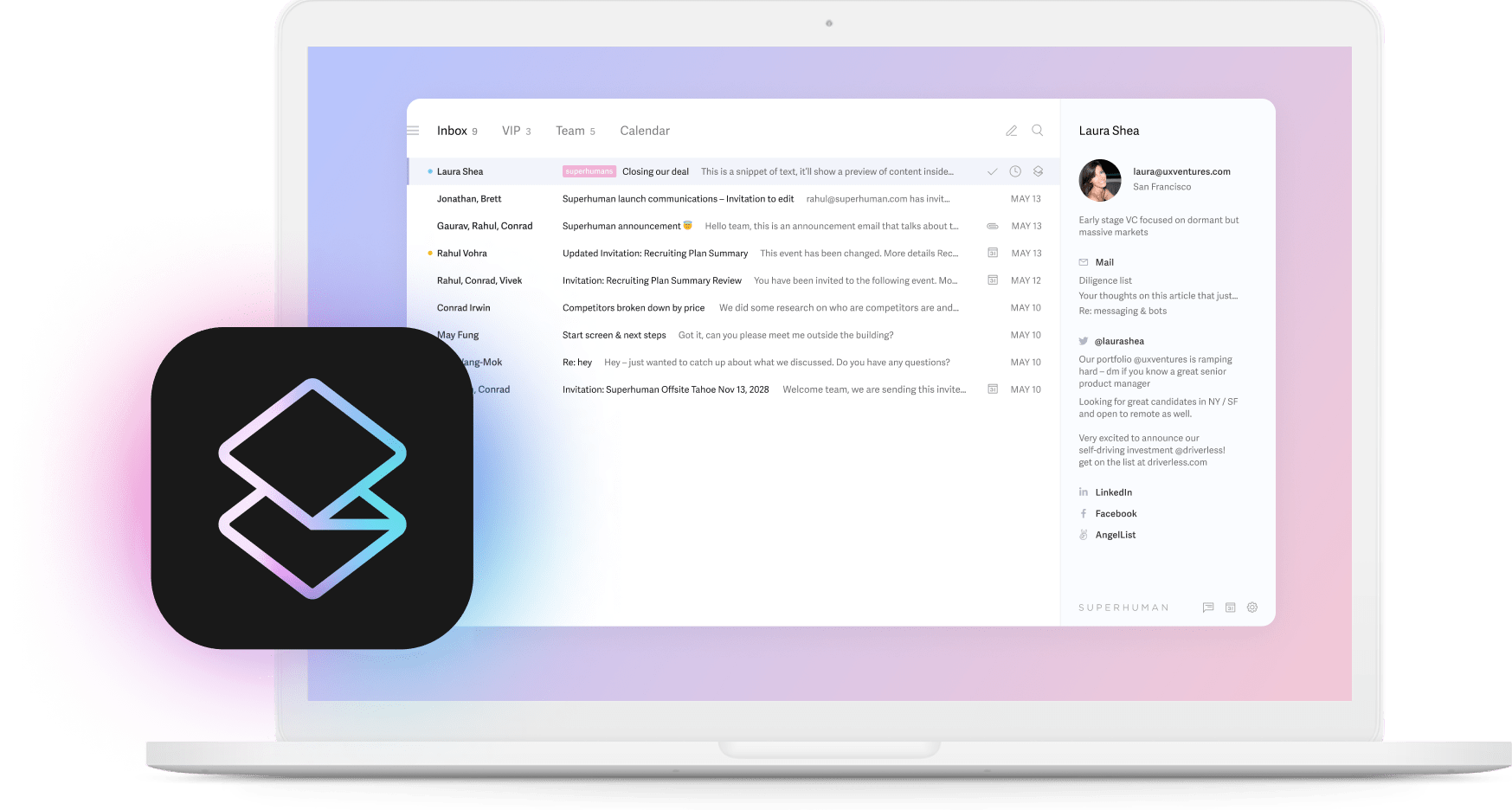
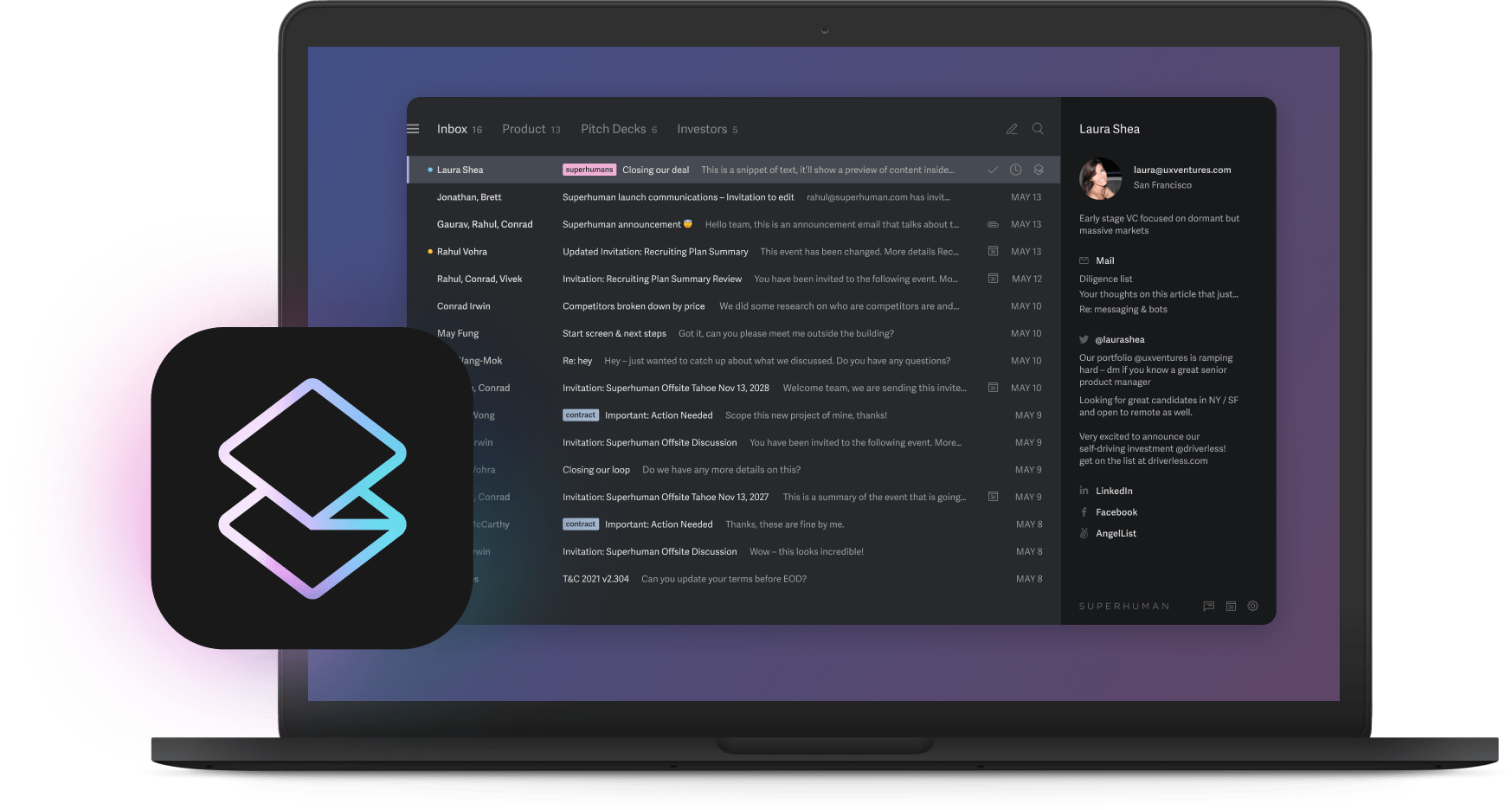
Superhuman Mail's approach optimizes high-volume email management through an integrated multi-feature system. The Cmd+K (Mac) or Ctrl+K (Windows) command gives instant access to every action, with the interface displaying each action's shortcut as you use it, creating natural learning without memorizing lists.
Beyond keyboard optimization, Superhuman Mail combines Split Inbox for AI-native automatic categorization, Write with AI for drafting emails with voice matching to your tone, Instant Reply for pre-generated draft responses, and team-level Read Statuses that show when colleagues have seen important messages. Superhuman Mail delivers documented productivity gains.
Mobile shortcuts include two-finger tap or L-shape swipe gestures that replicate keyboard speed on phones.
The barrier isn't complexity. It's the initial investment in learning. Mastering 10-15 core commands saves 20-40 minutes daily for high-volume customers.
Use AI tools that match your workflow
AI tools amplify your existing workflow. Without clear email processes and protocols, AI implementations often fail to deliver measurable returns. Well-designed systems combined with AI, however, create exponential efficiency gains.
Customers using generative AI saved 5.4% of work hours in recent research. More focused studies show that AI assistance can improve knowledge worker performance by nearly 40% compared to workers without AI support.
Gmail's Gemini integration now offers AI-native features to consumer accounts. The side panel helps write emails and summarize conversations without leaving your inbox. Help Me Write generates contextual drafts based on brief prompts and is now free for all consumer accounts.
Microsoft Outlook's Copilot provides similar AI capabilities through conversational interfaces. Draft email messages with AI assistance, receive email coaching to improve communication quality, or use Quick Polish for inline editing.
Superhuman Mail takes a different approach, focused on speed and voice matching. The platform uses AI capabilities, including voice matching that analyzes messages you've sent to specific recipients and matches your tone automatically, plus advanced agentic writing that can use multiple tools and resolve ambiguities. This isn't generic AI writing. It's your voice applied consistently across all communications.
- Split Inbox uses AI-native categorization to automatically separate marketing, cold pitches, and social network updates from important messages.
- Create custom Auto Labels with short prompts like "job applications" or "requests to review work."
- Instant Reply generates draft responses for every email. With Instant Reply, customers write emails in half the time with minimal editing required. Wake up to an inbox where replies are already drafted and waiting for your review.
- Auto Summarize provides one-line summaries above every conversation that update instantly as new messages arrive. Combined with keyboard shortcuts and AI features, customers can process email roughly twice as fast.
- Ask AI enables natural language search across your inbox and other connected workspace data (like calendars and CRM records), but not the external web simultaneously. Questions like "where's the offsite" or "what did Sarah say about the budget" return instant answers without needing to remember specific senders or keywords.
The privacy framework matters for executives. Superhuman Mail maintains Zero Day Data Retention with LLM providers and doesn't train models on your data.
Enable team collaboration without bottlenecks
Email management becomes exponentially more complex when your inbox serves as a coordination hub for multiple team members. High-volume email management at the team level requires tools that create visibility without creating bottlenecks.
- Shared conversations and visible team activity solve the visibility problem. Team members see the same email conversations and track who's viewed messages, preventing embarrassing duplicate responses to customers and partners. Internal comments let teams discuss strategy privately before responding externally.
- Read Statuses help you time your follow-ups more effectively by showing when people read your emails, reducing guesswork around messages like "Did you see my email?" For teams, Read Status notifications share across conversations, providing visibility into message engagement without requiring constant check-ins.
- Snippets are reusable email templates that ensure everyone communicates with consistent messaging, tone, and brand voice. Build libraries of proven responses for common scenarios, capturing institutional knowledge that typically lives only in senior team members' inboxes.
- Remind Me prevents important messages from being forgotten. Automatically bring emails back to your inbox at the perfect time so you never drop the ball on follow-ups.
Workflow automation routes emails to the right person based on expertise, workload, or availability, creating clear accountability and preventing duplicate work. Every email receives intelligent routing with designated ownership.
Make email feel good again
High-volume email management isn't about processing messages faster. It's about reclaiming time for strategic work that only you can do.
The path forward: establish decision frameworks using the 2-minute rule and email triage principles. Protect 3-4 hour deep work blocks where email stays closed. Master keyboard shortcuts to save 20-40 minutes daily. Then layer in AI-native tools that match your tone and draft contextual responses. Finally, enable team collaboration features that create visibility without micromanagement.
Superhuman Mail delivers documented time savings of 4 hours per person every week through speed optimization, AI-native features, and keyboard-first design. Your inbox is waiting for an upgrade. Try Superhuman Mail today!
FAQs
How many times a day should I check email?
Research shows that limiting email checks to 2-3 times daily significantly reduces stress compared to continuous checking. A morning scan (15 minutes), an afternoon processing block (60-90 minutes), and an end-of-day review (15 minutes) provides responsiveness while protecting deep work time.
What is the 2-minute rule for email?
The 2-minute rule comes from the Getting Things Done methodology: if an email takes less than 2 minutes to handle, do it immediately rather than deferring it. For emails requiring more time, schedule a dedicated block on your calendar and move the message to an @Action folder.
How do I manage 200+ emails a day?
High volume email management requires three systems working together: a decision framework (delete, delegate, defer, or do), protected time blocks for processing, and keyboard shortcuts for speed. Leaders who implement all three cut processing time by 50-70% while staying responsive.
Should I use folders or labels to organize email?
Trust your search function instead of creating elaborate folder hierarchies. Most modern email clients have powerful search capabilities that make complex folder structures unnecessary. Archive informational emails and use a simple @Action folder for items requiring follow-up.
How can AI help with email management?
AI tools like Superhuman Mail's Instant Reply can draft contextual responses, summarize long threads, and categorize incoming messages automatically. However, AI works best when layered on top of established processes rather than used as a replacement for systematic email management.