How to prevent unwanted emails: 6 tips

Drowning in inbox filler? Learn how to stop unwanted emails, reduce email fatigue, and build a system that keeps your inbox calm with AI-native tools.

Your inbox contains hundreds of unread messages. Somewhere in that mess is your CEO's message about Q4 priorities. You scroll past newsletters you never read, promotional emails from that one purchase three months ago, and automated notifications from apps you barely use. Each message demands a split-second decision—delete or keep? By the time you find what matters, you've burned 20 minutes and your focus is gone.
Unlike obvious spam, inbox filler comes from legitimate sources you once consented to receive. But over time, these communications accumulate into an overwhelming digital burden that buries important messages and destroys productivity.
The solution isn't just deleting more emails. You need systematic barriers that prevent unwanted inbox filler from reaching you in the first place, while ensuring important communications get the attention they deserve.
What is "inbox filler" and why it's exhausting
Not all unwanted email is created equal. Understanding the difference between spam, important messages, and inbox filler helps you target the right solutions. Most professionals waste time treating symptoms instead of addressing the root cause—legitimate messages that no longer serve any purpose.
Three types of email
Every email in your inbox falls into one of three categories. Recognizing which type you're dealing with determines the right action—and helps you stop wasting time on messages that don't deserve it.
Spam: Unsolicited messages from unknown senders with malicious links or fraudulent offers. These bypass your consent entirely.
Important email: Messages from colleagues, clients, family, and service providers you actively engage with. These require timely responses and directly impact your objectives.
Inbox filler: The exhausting middle ground. Legitimate communications you consented to but no longer find valuable:
- Newsletters from forgotten subscriptions
- Promotional emails after a single purchase
- Automated social media and app notifications
- "FYI" emails that don't require action
- Updates from services you rarely use
Each message demands cognitive processing to determine relevance, even when you delete it unread. This mental taxation creates decision fatigue that impairs your ability to focus.
Why inbox filler kills productivity
Email fatigue manifests as psychological and physical exhaustion from processing overwhelming volumes of communications. Inbox filler creates persistent anxiety through "attention residue"—the cognitive burden of unprocessed information competing for mental resources.
When your inbox contains hundreds of unread messages, your brain maintains background awareness of this clutter. Each notification pulls attention away from important tasks, requiring an average of 23 minutes to fully regain focus. For professionals receiving 100+ emails daily, these interruptions compound into massive productivity losses.
Modern email's always-on culture means messages follow you home and interrupt personal time. Remote work blurs boundaries further. Marketing automation enables hyper-segmented campaigns at industrial scale, triggering email sequences from every online interaction.
Below, you’ll find 6 tips on how to reduce spam.
1. Audit your inbox in 10 minutes
Before implementing systematic solutions, conduct a rapid audit to understand your current inbox composition. This diagnostic reveals which types of messages consume the most space and attention.
Start by sorting your inbox by sender to identify the most prolific sources. In most email clients, you can group messages by sender domain or individual address. Look for patterns—which retailers dominate? Which newsletter subscriptions did you forget about? Have automated systems begun sending daily updates you never requested?
Next, examine your inbox by time periods. How many emails arrived in the past week? What percentage did you actually open and read? This temporal analysis often reveals shocking volumes of accumulated messages that provide no ongoing value despite consuming mental bandwidth.
Classify emails into three categories:
- Delete immediately: Marketing from companies you've never purchased from, social media notifications, automated updates you don't monitor, expired event invitations, newsletters you haven't opened in three months
- Unsubscribe and delete: Legitimate communications you once wanted but no longer need—industry newsletters that became irrelevant, retail marketing from one-time purchases, updates from abandoned tools
- Keep and filter: Important communications that don't require immediate attention—professional development resources reviewed monthly, financial statements, community updates read on weekends
This classification creates clear action paths. Messages in the first category get bulk deleted without guilt. The second category requires unsubscribe actions before deletion. The third category stays but gets routed to dedicated folders or labels where they won't compete with urgent communications.
2. Stop junk at the source
The fastest way to reduce inbox filler is to prevent it from arriving in the first place. A few minutes spent unsubscribing and blocking senders now saves hours of processing time later. Start with the biggest offenders and work your way down.
Unsubscribe strategically
Unsubscribing from unwanted emails delivers immediate and lasting improvements. Focus on high-volume senders first—if a retailer sends daily emails you never open, that's 365 messages per year from a single source.
Click the unsubscribe link (typically in small text at the bottom) and complete the removal immediately. For stubborn senders who continue messaging after unsubscribe requests, mark messages as spam.
Superhuman Mail streamlines unsubscription through keyboard shortcuts. Press Cmd+U or Ctrl+U to unsubscribe from any sender, then mark all related messages as done or trash them simultaneously. What typically requires multiple clicks happens in seconds.
Block persistent senders
Some senders ignore unsubscribe requests or use multiple email addresses to circumvent blocks. For these persistent sources, implement sender blocks that automatically delete all messages from specific addresses or entire domains.
In Gmail, click the three-dot menu and select "Block [sender]." This automatically routes all future messages from that address directly to trash. Outlook offers similar functionality through its junk email settings.
Domain-level blocking becomes valuable when companies use multiple sending addresses. Rather than blocking individual addresses like [email protected] and [email protected], block the entire domain so all variations get automatically filtered.
Superhuman Mail's blocking capabilities extend beyond single addresses to include entire domains with bulk actions on existing messages. When you block a sender, you can simultaneously trash all historical messages from that source—clearing months of accumulated clutter in seconds.
Consider creating a whitelist approach for critical communications. Some email clients allow configuration where only approved senders reach your primary inbox while everything else routes to a separate folder for periodic review. This works particularly well for executives who need to ensure VIP communications never get missed.
Reduce optional work communication
Professional communications generate unnecessary volume through habits that perpetuate overload:
- Reply-all abuse: Verify that every person genuinely needs your information before hitting reply-all
- CC proliferation: Stop copying colleagues "just to keep them in the loop" when they don't need attention or action
- FYI emails: These well-intentioned updates create expectation pressure without benefit. Platforms like Coda provide better alternatives where stakeholders access information when needed
- Calendar invite overuse: Every meeting generates multiple notifications—evaluate whether every attendee truly needs to be present
Establish team norms around essential communication only.
3. Set up smart systems
Once you've stopped junk at the source, you need systems that automatically organize what remains. The right setup routes important messages to the front while keeping routine communications out of your way. Build these systems once, then let them run on autopilot.
Use Split Inbox for automatic triage
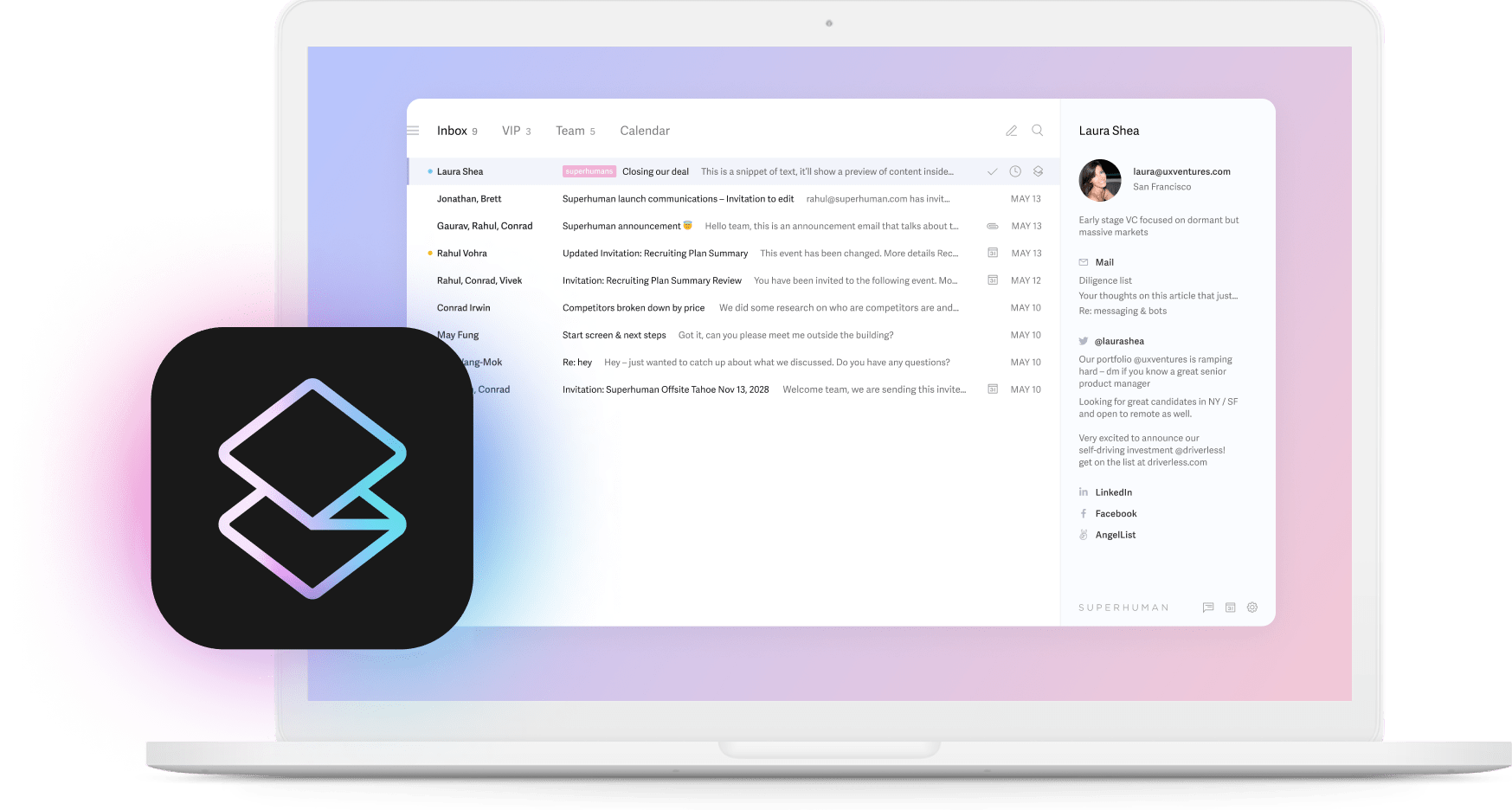
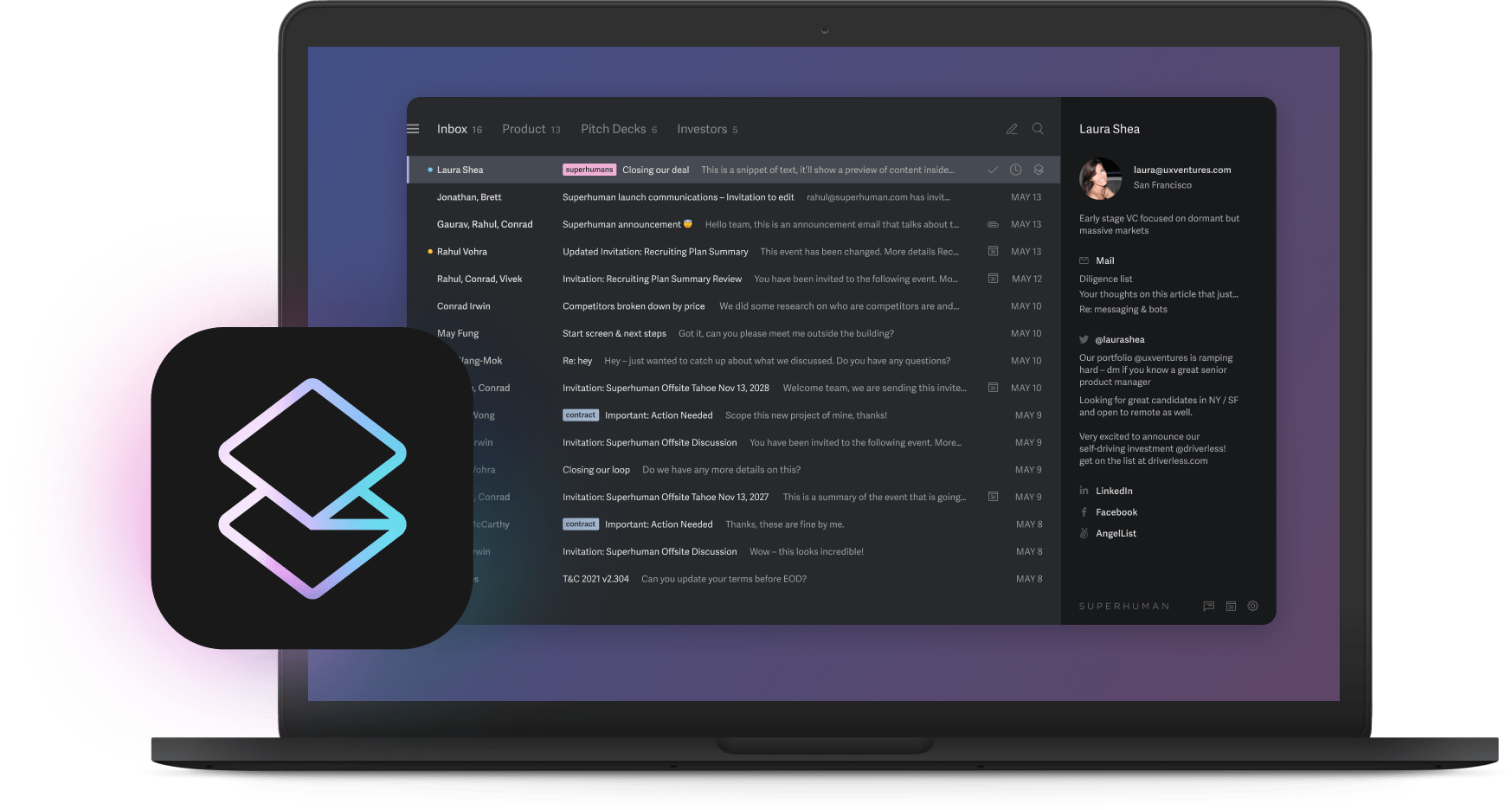
Split Inbox in Superhuman Mail automatically categorizes messages into distinct streams based on sender relationships and content type. This intelligent segmentation ensures important communications receive immediate attention while routine messages get batch processing.
The system creates separate inbox views for colleagues, VIP contacts, tools and notifications, and other categories. You can customize these splits to match your specific workflow needs—creating dedicated streams for key clients, specific projects, or leadership communications.
This approach eliminates the cognitive load of manually sorting mixed messages. Rather than processing every email sequentially as it arrives, you review your colleague split when you're ready to handle internal communications, your VIP split when you're prepared for external stakeholder messages, and your tools split when you're batch-processing automated notifications.
The AI learns from your behavior patterns—who you respond to quickly, which senders you prioritize, which messages you typically archive—and continuously refines its categorization logic. For professionals managing hundreds of daily emails, this categorization creates dramatic efficiency gains.
Instead of scanning hundreds of mixed messages to identify priorities, you focus first on your most important splits and address lower-priority categories during dedicated processing time.
Build filtered workflows
Gmail and Outlook offer powerful filtering systems that automatically route incoming messages based on sender, subject keywords, or content patterns.
Useful filter patterns:
- Route all messages from your manager to a priority label
- Automatically archive notifications from collaboration tools like Slack or Asana
- Send newsletters to a dedicated folder for weekend reading
- Forward receipt emails to financial tracking systems
Start with broad filters that handle high-volume senders, then create nuanced rules as you identify patterns. Review filters quarterly to remove obsolete rules.
Establish processing routines
Time-box your email sessions to prevent constant context switching. Designate specific windows for email processing—morning review for urgent communications, midday processing for coordination, end-of-day closeout.
During dedicated sessions, focus exclusively on email. Batch similar tasks: process all quick replies consecutively, then handle emails requiring research, then manage messages needing delegation.
The discipline of limited email windows forces more efficient processing while ensuring email doesn't expand to fill all available time.
4. Build better email habits
Systems handle incoming email, but your own habits determine how much email you create. Every message you send potentially generates responses that add to your inbox load. Small changes to how you communicate create compound effects on your overall email volume.
Reduce email you create
Every email you send potentially generates additional responses, creating a self-perpetuating cycle of increased inbox volume. Examining your own sending patterns reveals opportunities to reduce overall email load while improving communication effectiveness.
Before composing an email, consider whether the communication warrants asynchronous messaging or would be more effectively handled through synchronous channels. Brief questions often resolve faster through instant messaging or quick phone calls than through email exchanges requiring multiple rounds.
When email is appropriate, craft messages that minimize back-and-forth:
- Provide complete context and anticipate likely questions in initial sends
- Be specific about action items and deadlines—avoid vague requests like "let me know your thoughts when you get a chance"
- Copy only recipients who genuinely need the information or when their input is essential
- Use tools like Grammarly to ensure messages are clear and professional before sending
Consider whether you're the right person to send this email. Often, information can be shared through team channels or documentation rather than individual messages that multiply across your organization.
Make decisions faster
The two-minute rule provides simple logic: if an email requires less than two minutes to process, handle it during your initial review. Quick replies, simple approvals, straightforward information sharing—these take less time to complete immediately than to defer and revisit.
For emails requiring extended consideration, create specific next steps rather than leaving them in your inbox. Calendar a block for analysis, add the email to your task system with a clear deadline, or delegate to team members. Tools like Coda help track these action items without letting emails pile up as makeshift to-do lists.
Practice inbox discipline
Inbox Zero treats your inbox as a temporary holding space rather than permanent storage. Every message should move toward resolution rather than accumulating indefinitely.
After reading each email, take immediate action:
- Respond if it requires a quick reply
- Archive if no action is needed
- Delegate if someone else should handle it
- Schedule if it needs future attention
- Delete if it's not worth keeping
Archiving generates anxiety for many professionals who fear losing access to important information. Modern email search makes archived messages easily retrievable through keyword searches, sender filters, or date ranges. The key is recognizing that archived messages remain accessible—they're simply removed from your active processing queue.
Superhuman Mail's keyboard shortcuts make processing effortless: E to archive, R to reply, H to schedule reminders, Del to trash. These shortcuts eliminate mouse navigation and reduce processing time per message from seconds to milliseconds.
The psychological benefits of a clean inbox extend beyond mere organization. Visual inbox clarity creates mental calm and reduces background stress. When you open your email client and see zero or single-digit unread messages, you experience a sense of control rather than overwhelm.
5. Use AI-native tools strategically
Manual email management hits a ceiling when volume exceeds 50-100 messages daily. AI-native tools analyze patterns, prioritize automatically, and handle routine tasks so you can focus on communications that actually require your attention. The right tools learn from your behavior and get smarter over time.
Let AI handle triage automatically
AI-native email tools analyze message content, sender relationships, and behavioral patterns to automatically prioritize communications requiring immediate attention.
Superhuman Mail's AI learns from your behavior. When you consistently respond quickly to specific senders, the AI prioritizes future communications from those contacts. When you routinely archive messages from certain sources, the AI deprioritizes similar messages.
Key AI features:
- Auto Summarize: One-line summaries of complex conversations
- Instant Reply: Contextually appropriate response drafts in your voice
- Auto Labels: Automatic categorization of marketing emails, social notifications, and tool updates
Speed up with keyboard shortcuts
Superhuman Mail's keyboard-first interface eliminates mouse navigation. Hit Cmd+K or Ctrl+K to open the command palette for searchable access to every function.
Common shortcuts:
- E to archive (mark done)
- R to reply
- H to schedule reminders
- L to add labels
- Del to delete
- Cmd+Enter or Ctrl+Enter to send
Navigation shortcuts: J (next message), K (previous), O (open conversation). When you process 100+ emails daily, eliminating two seconds per message saves over three minutes daily—more than 13 hours annually.
6. Protect your email address
A compromised email account floods your inbox with spam and exposes sensitive information. Securing your account and using smart addressing strategies prevents future problems before they start. These protections take minutes to set up but deliver lasting benefits.
Secure your accounts
Email account security provides the foundation for all inbox management efforts. Compromised accounts flood inboxes with spam, expose sensitive information, and create cascading security problems across connected services.
Essential security measures:
- Multi-factor authentication: Time-based one-time passwords through authenticator apps like Microsoft Authenticator create six-digit codes that change every 30 seconds, making stolen passwords insufficient for account access
- Strong, unique passwords: Email passwords should differ from other services, preventing credential reuse attacks. Password managers eliminate the burden of remembering complex passwords
- Recovery contacts: Backup email addresses and phone numbers enable account recovery if primary authentication becomes unavailable. Keep these secured independently
- Login monitoring: Check activity logs for unusual location patterns, unfamiliar devices, or suspicious timing that might indicate unauthorized access attempts
Most email providers offer activity logs showing recent account access with timestamps and geographic locations that enable early detection of potential compromise.
Use aliases strategically
Email aliases provide compartmentalization that limits exposure risk while identifying subscription sources.
Plus-addressing: Gmail's yourname+category@gmail.com creates unlimited variations routing to your primary inbox. Use yourname+shopping@gmail.com for purchases to enable automatic filtering and identify which retailers share your address.
Custom aliases: Professional-appearing addresses for different purposes. When aliases receive unexpected email, identify which service compromised your information.
Disposable services: Temporary addresses for one-time use—software downloads, contest entries, website registrations.
Reduce spam in your inbox to improve productivity
Effective inbox filler elimination requires systematic implementation: source reduction through strategic unsubscribing, automated routing through intelligent filters, behavioral changes to prevent new filler, and technical tools to streamline legitimate communications.
The most successful professionals combine aggressive filler reduction with productivity-enhancing email clients. This dual approach of reducing noise while amplifying signal creates compound benefits where less total email results in dramatically better outcomes.
Transform your next email session from reactive browsing into intentional management. Start with your Split Inbox or priority view, handling urgent communications first. Use keyboard shortcuts and AI assistance to accelerate processing. End with inbox zero by processing every message through deletion, archiving, response, or task conversion.
Inbox filler shouldn't control your day. Your most important work happens when you're focused, not when you're buried in newsletters and promotional emails. With the right system—strategic unsubscribing, smart automation, and AI-native tools—you can eliminate the noise and protect your attention for work that actually matters.
Superhuman Mail makes email work at the speed of thought. Split Inbox surfaces what's urgent. Auto Archive clears the clutter. Instant Reply drafts messages in your voice. Your inbox feels lighter, your team responds faster, and you save hours every week.
Ready to stop unwanted inbox filler for good? Try Superhuman Mail and experience email that works as fast as you think.