Redesigning a College Around Generative AI
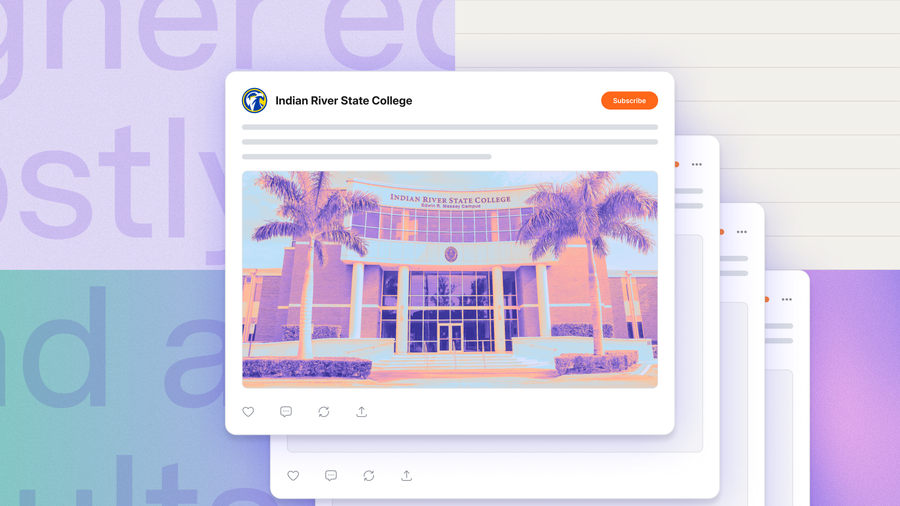
How one college is redesigning around generative AI in higher education, and what building on Superhuman Go looks like for a peer institution.

Higher education mostly gets to read about AI results once the hard part is over: a finished case study, a clean set of results, a lesson wrapped in a bow. Indian River State College—a multi-campus state college in Florida with a low-cost, high-quality mission—is doing something rarer. It’s documenting its AI transformation in real time, in a public Substack, while the work is still underway.
The series is spearheaded by Dr. Bruce Fraser, the college’s executive director of AI initiatives, and it’s refreshingly candid. Fraser writes plainly that there are “more things we don’t know than things we do.” For a technical or academic leader trying to work out what institution-wide AI actually takes, it’s a rare look at a peer showing the work. We’re partnering with Indian River State College to help share it, so here’s an introduction to the series and to what building on Superhuman Go looks like for them.
A college’s wager on generative AI in higher education
The Substack opens with a piece Fraser calls “Indian River’s Wager.” The bet is that the traditional model of higher education, built for a world in which information was scarce and expertise was the point, no longer fits a world of information superabundance. The college’s response is to shift its emphasis from expertise to agency, teaching students to work with AI as an intellectual partner rather than treating it as a threat to learning.
This is a philosophical commitment, and it shapes everything that follows. In partnership with Superhuman, the college is restructuring operations around generative AI, from recruitment through curriculum to evaluation. Because Grammarly, now part of Superhuman, was already familiar on campus, the work had a foundation to build on.
What building on Superhuman looks like
The best way to see an institution’s AI strategy is to look at what it builds. Indian River State College is building its own agents, each aimed at a problem it defined for itself.
Iris is the college’s answer to its hardest adoption problem
Fraser draws a useful line between vertical AI integration (i.e., standing up new AI degree programs), which higher education already does well, and horizontal AI integration (i.e., making an entire workforce genuinely fluent with AI). The second is the hard one, and it’s a change-management problem as much as a technical one.
Iris, short for Intelligent Resource for Instructional Support, is an agent built on Superhuman Go and grounded in a knowledge base the college authored itself. It does several things at once:
- Makes the case for why AI belongs in teaching
- Coaches faculty on best practices, such as redesigning an assignment or handling deepfakes
- In areas of genuine inquiry, guides users with a Socratic style rather than handing over answers
- Holds people to the college’s own AI policies
Because it lives in Go, it’s present wherever employees already work.
River Guide is the college’s front door for common questions
River Guide is a public-facing agent on the college’s website that answers common questions in real time and takes pressure off the call center, advisors, and faculty. It isn’t behind a login, so you can try it yourself.
Together, Iris and River Guide hint at what Indian River State College calls an “agentic bench,” a set of agents that carry institutional knowledge consistently across a multi-campus system. These agents run on knowledge the college created, stay within policies the college set, and show up where work already happens.
What institution-wide AI adoption actually takes
The agents are the visible part. Beneath them is the groundwork that makes them last: the policy, security, and cultural work the college has built its rollout around.
Readiness is infrastructure
For Indian River, readiness is infrastructure. Capability without policy, security, governance, and clean data is fragile. The same policies and knowledge base that power Iris also power River Guide, so getting the foundation right once pays off with every agent the college builds next.
Transformation is cultural
Other posts, including a leadership conversation between President Moore and Jenny Maxwell, head of Superhuman for Education, and a piece on the communication challenge of adoption, keep returning to one idea: You can’t buy your way to AI-forward. Reaching a whole organization runs on trust, faculty expertise, and taking resistance seriously. As the series puts it, humanism is not a garnish on the strategy—it is the strategy.
Safety comes first
The college’s approach also runs against the instinct to move fast. Getting responsible AI use right early on is what frees a campus to build, and when people trust the guardrails, they’re willing to experiment.
Take what’s useful
Indian River State College is not claiming to have it all figured out, which is exactly what makes the series worth reading. It’s a working record of a college rebuilding around AI without losing what makes education human, published while the outcome is still uncertain. Fraser’s first post captures this spirit: Take what’s useful.
Follow the Indian River State College series
Read the college’s own account of what institution-wide AI really takes as it unfolds.