Technical Teams Have the Access and the Skill. So Why Isn’t AI Value Adding Up?


Technical teams were supposed to feel the benefits of AI first. They live inside the systems where it runs, and many of them are the ones building it. Access isn’t the barrier: Nearly every technical worker already has AI writing, coding, summarization, and copilot tools at their fingertips, and according to our latest survey data, 90% say those tools help them feel more accomplished at the end of the day.
So why does it still feel like AI isn’t living up to the expectations of technical leaders?
The answer comes down to two conditions: how well workers are set up to use the tools they have, and how much friction they absorb just to keep work moving across those tools. Together, these conditions sort every technical organization into one of four quadrants, and most are stuck in the same one.
What actually determines AI value for technical teams?
Two factors determine which quadrant a technical organization falls into. It has less to do with the AI tools themselves and everything to do with the conditions surrounding them.
The first condition is enablement: how well people are set up to use the tools they have access to. The reality is, most companies simply aren’t investing in tool enablement. Just 20% of technical workers say they use all the features available to them; 22% don’t know why certain tools exist, 26% don’t know when to use which tool, and 27% say they never received training at all. Access without enablement leaves capability sitting unused and value sitting on the table.
The second condition is friction, the amount of mental effort required to keep work moving across tools. Technical work inherently involves multiple systems: 65% of technical workers use six or more tools in a typical week, switching between two or three just to complete a single task. What workers need is for those tools to work together, carrying context forward as work moves between them. However, nearly two-thirds say their tools feel fragmented rather than part of one unified system.
Plot every technical organization against these dimensions, and four distinct quadrants emerge. The goal is simple to state but hard to achieve: high enablement, low friction.
What are the four AI value quadrants?
Enablement and friction determine whether AI value compounds or stalls, and together they form a grid. Enablement runs along one axis, low to high, where higher is better. Friction runs along the other, but with friction, lower is better. Plot any organization on both, and it lands in one of four quadrants:
- Stalled (low enablement, high friction): This is where the gap between AI investment and return is widest. People spend their workdays navigating a system that adds effort instead of removing it, and they haven’t been equipped to do anything but work around it.
- Constrained (high enablement, high friction): People know how to use their tools well, but the tools don’t work well together. Individual fluency shows up in pockets, but friction absorbs the gains before they can spread, so the return stays capped.
- Unrealized (low enablement, low friction): The environment is ready, but the people aren’t. The tools are connected, but without training or context, workers never get full value from them.
- Compounding (high enablement, low friction): Tools are connected, context carries forward, and workers are fluent enough to make the most of it. This is the only quadrant where AI value compounds across a team.
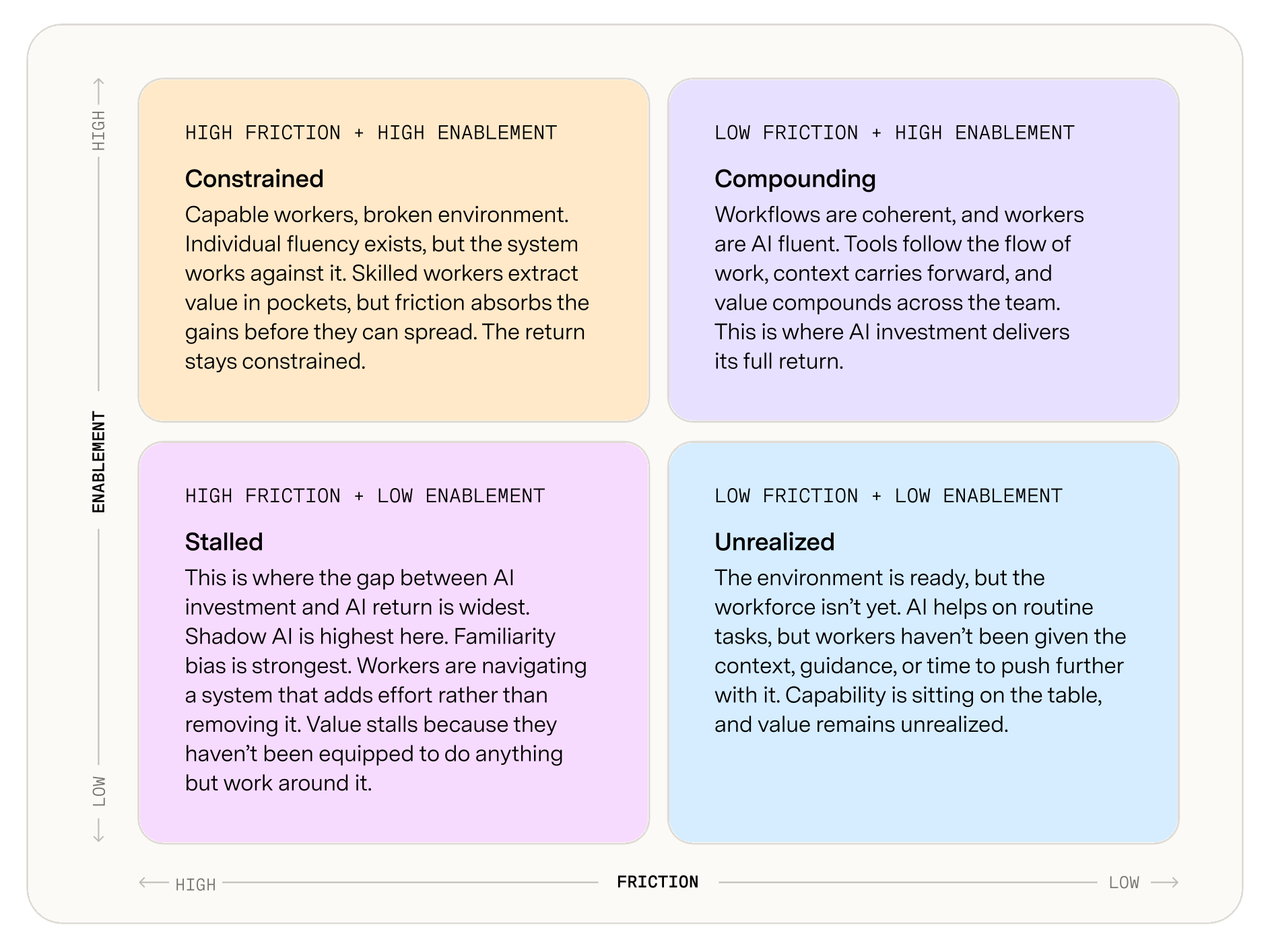
There’s no shortcut that can fix just one condition. Reduce friction without investing in enablement, and the value of AI sits on the table unrealized. Train people well without fixing the friction around the tools, and value stays constrained. Value can be realized only when both conditions move at once.
What technical leaders can do now
Technical leaders need to take an honest look at which quadrant they’re actually in, and then commit to fixing both conditions. That starts with naming where friction lives and where enablement is missing, then working on both problems simultaneously rather than picking whichever one feels easier to fund this quarter.
Your team has the access and the skill to get value from AI. Whether they succeed or not is based on the conditions you create.