Scaling AI Responsibly: How Three Institutions Turned Adoption Into Impact

Real examples of AI in higher education. How three institutions built agents on Superhuman Go and made adoption stick.

On most campuses, students started using AI well before leadership had a plan for guiding its use. Nearly 6 in 10 students use AI in their coursework every week.¹ The tools are everywhere. But the strategy between student use and an institution’s guidance is still catching up.
In our survey of over 150 higher education executives, only about 1 in 5 say their institution has built AI into its strategy. Faced with that reality, institutions tend to reach for one of two approaches:
- Grassroots: This approach invites adoption but leaves leaders with little visibility into where or how AI is being used across the institution.
- Centralized: This approach delivers campus-wide visibility into usage but often struggles to earn widespread buy-in and adoption.
On their own, neither approach gives campuses AI they can measure, understand, and scale.
The institutions turning AI into real impact are pairing grassroots adoption with real governance, so AI gets used and can still be measured and scaled. That pairing—adoption plus governance—is what the three in this post have each pulled off, in very different ways, while building on Superhuman Go. Their paths look nothing alike, but the through line is the same.
Three institutions, three paths to impact
Indian River State College, New Mexico State University, and St. John’s University arrived at agentic AI from three different starting points. What they share is a set of goals: consistency, transparency, scalability, and a belief that adoption is, at its core, a human challenge rather than a technical one.
St. John’s University: Becoming an AI-enabled university
Eric Alvarado, associate vice president of digital strategy and deputy CIO at St. John’s University, saw what agentic AI could do on campus during a conversation at our EDUCAUSE booth. Less than one year later, their AI agents were live.
The institution’s goal was twofold: prepare students for an AI-enabled world, and be known for it. But St. John’s shared a common challenge for many. They already paid for AI tools nobody used, while shadow AI spread quietly. Rather than hand faculty a new large language model (LLM) and hope for the best, the university sought something that fit into the work people were already doing.
The rollout started where the teaching happens. A handful of courses use Go today—with more coming this fall—to check writing, build AI literacy, and update rubrics. Superhuman helps stand up the framework underneath.
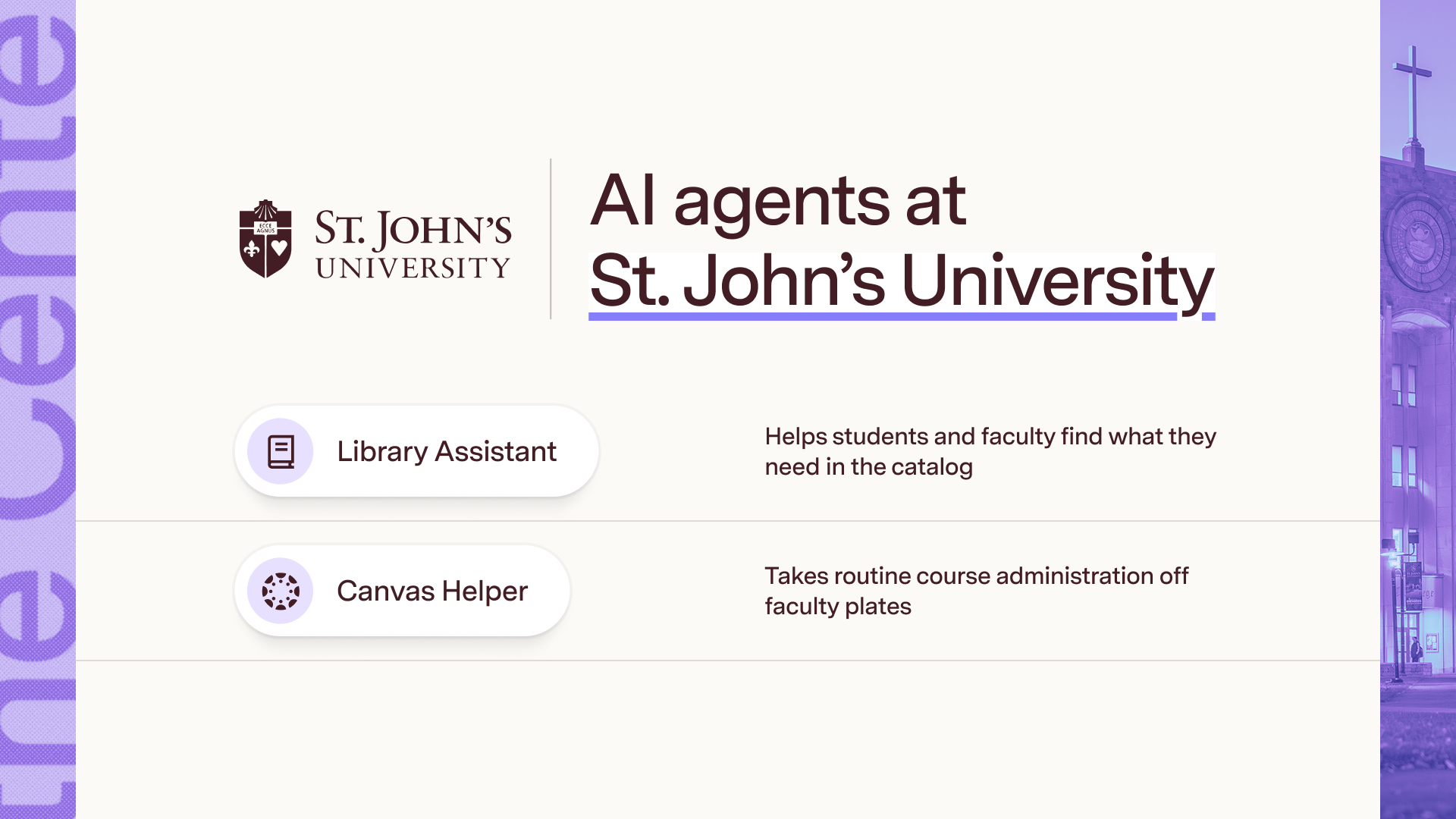
Staff started finding their own uses too, from digging up files across SharePoint to summarizing long documents. The faculty who pushed back weren’t steamrolled. St. John’s approach is to meet them where they are, customize how they engage, and keep listening, without letting skeptics stall momentum.
“Being a partner school with Superhuman let us shape AI on our campus to our vision.”
— Eric Alvarado, Associate Vice President of Digital Strategy and Deputy CIO at St. John’s University
Indian River State College: An agentic bench for institutional knowledge
Bruce Fraser, executive director of AI initiatives at Indian River State College, faced a different challenge. At a multi-campus college, institutional knowledge lives in scattered documents, buried processes, and people’s heads, and rarely reaches the person who needs it. His solution was an “agentic bench”: a set of agents that put that knowledge within reach across the whole system.
Before building anything, Indian River prioritized safety first. Getting responsible AI use right was the mandatory first step, and answering it well gave people across campus the confidence to start building. That took real work. Prompt-injection risk led to a close partnership with Superhuman’s technical team to rewrite the college’s policies and add an HR attestation (a short AI security program faculty complete before they touch Go).
With that foundation in place, the bench took shape.

“The work is in the process. I don’t need a magic wand; I need a thoughtful process.”
— Bruce Fraser, Executive Director of AI Initiatives at Indian River State College
New Mexico State University: An operational backbone for a whole system
Andrew Sedillo, executive director of strategic initiatives and partnerships at New Mexico State University (NMSU), started with one specific goal: streamline marketing costs. As his team discovered more of Go’s capabilities, one goal led to another, and today, Go offers a shared operational backbone for all public universities across New Mexico.
Sedillo runs Go through the New Mexico Online Hub, a shared-services model built for exactly the kind of campuses that tend to get left behind (i.e., smaller, under-funded institutions). The hub gives them tools and expertise they’d never have alone, and a way to speak the same language, share what works, and stop each team from solving the same problem by itself. With Go, NMSU built agents for the work every campus shares, from marketing to course design to operations.

Their plan was always deliberate: Prove the model at the hub, then scale it to every institution, with a full statewide student rollout next and a clear success story for the legislature along the way.
“This wouldn’t have been possible with off-the-shelf tools.”
— Andrew Sedillo, Executive Director of Strategic Initiatives and Partnerships at New Mexico State University
How they’re measuring outcomes
The point of pairing adoption with governance is that you gain visibility into whether it’s working.
Each of these institutions is building that into its process. St. John’s is preparing to measure AI proficiency and have students reflect on how they’ve grown as AI users. Indian River can already see which questions River Guide resolves. And New Mexico State is assembling the evidence it needs to make its case to the state legislature for continued funding.
Only 13% of institutions can measure whether their AI is working; these three are building toward being among them.²
What it takes to make adoption stick
Across three very different paths, the same three lessons surfaced.
1. Start somewhere, and start on purpose
AI can feel overwhelming precisely because it could do just about anything. Each institution picked a focused first problem: marketing for New Mexico State, safe and responsible use for Indian River State College, the academic experience for St. John’s. Then they built out from there.
There’s no wrong way to start, as long as you know your why and what you’re measuring. Starting small doesn’t mean ending small.
2. Safety unlocks innovation
For Indian River, getting responsible AI use right came first, on purpose. Tackling safety early gave people across campus the confidence to start building.
3. Buy-in is the work itself
All three treated adoption as change management: leading with humility, starting with strategy, security, and privacy, then moving to phased rollouts, academic guardrails, and staff training before opening the tool up to students.
Built with institutions, not just for them
None of these paths looked like a standard vendor rollout. In each case, Superhuman worked as an extension of the institution’s team, helping shape the strategy, co-designing around campus priorities, and building alongside partners. That co-building is the point.
There are no experts in this space yet, so institutions and Superhuman are working it out together, in real time. Institutions know their people and their goals better than anyone, which means the best AI for your institution is the one your campus helps build.
“Speed is cultural. It’s not a switch you can just flip.”
—Jenny Maxwell, Head of Superhuman for Education
See how three campuses scaled AI responsibly
Hear each institution’s path, in their own words, and their thoughts on how agentic AI can support higher education.
¹ Lumina Foundation and Gallup, “State of Higher Education,” Gallup, https://www.gallup.com/analytics/644939/state-of-higher-education.aspx.
² Jenay Robert, “The Impact of AI on Work in Higher Education,” EDUCAUSE, January 2026, https://www.educause.edu/research/2026/the-impact-of-ai-on-work-in-higher-education.