Superhuman Launches Superhuman Docs, a Collaboration Surface for Teams to Write, Track, and Build With AI

- New capabilities move AI beyond the chat window and into the documents teams rely on, enabling them to build with AI together and create custom tools connected to their data
- Superhuman Databases launches in beta as a dedicated home for enterprise-scale data management
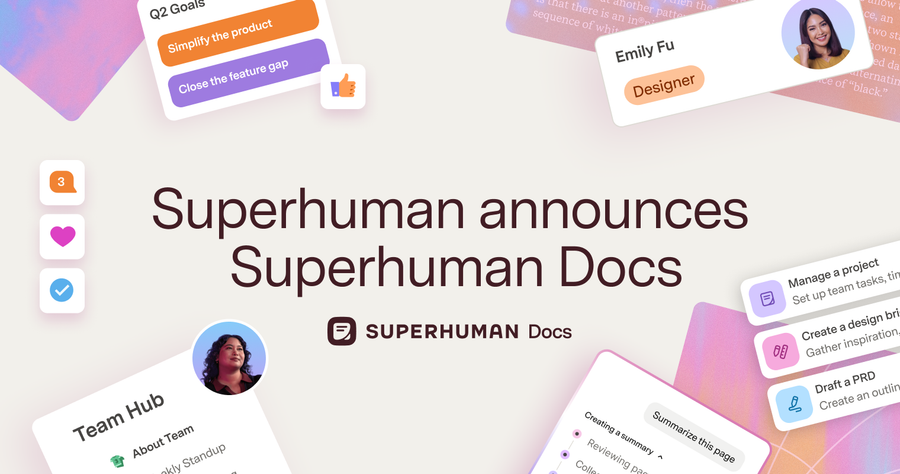
SAN FRANCISCO — July 8, 2026 — Superhuman, the productivity platform bringing AI to wherever people work, today announced the launch of Superhuman Docs, marking the evolution of Coda into an AI-native product within the Superhuman suite. Docs pairs a flexible document surface with a new generation of AI capabilities that turn simple prompts into drafted content, structured tables, and custom, interactive views, so teams can bring AI into how they already work together.
What’s new:
- Docs AI: A completely rebuilt AI assistant that can read, plan, write, track, and build inside any doc. Unlike traditional documents, Superhuman Docs are interactive, with building blocks like tables, formulas, automations, and live connections that power the way teams work, from project trackers and content calendars to product roadmaps and team hubs. With Docs AI, users describe what they need in plain language, and it produces content, builds formatted tables, resolves comments, and pulls information across documents. Docs AI can also leave inline comments with feedback, pull in information from the web, and suggest what to build next based on the doc.
- AI views (private beta): Describe a custom interface, app, or tool, and AI builds it on top of a table’s data, no developer experience needed. AI views run on live data, with drag-and-drop interactivity and AI-powered actions, and automatically update as the underlying data changes. Users can also build AI views from data pulled from connected tools like Jira or Salesforce.
- AI blocks and columns: Describe what a column should do, and AI columns auto-populate results across every row. AI blocks generate live summaries, actions, and key insights that refresh as data changes.
- Superhuman Databases (private beta): A new product for managing structured data at enterprise scale, with support for up to 1 million rows per database. Teams can centralize shared datasets, build trackers and operational systems that scale with their work, and connect that data directly to Docs so the same information is available across surfaces.
- MCP: Connect ChatGPT, Claude, Cursor, and other AI clients to Superhuman Docs with one click, allowing those tools to read and write to docs and tables in real time.
- New desktop and mobile apps: A new native macOS app with tab navigation and native notifications, and redesigned iOS and Android apps that are more responsive and simpler to use.
- Table pages: A fullscreen page type built for structured data, giving teams room to work on project trackers, data workflows, and bulk editing.
AI built for team collaboration
Despite the rapid growth of AI tools today, the impact has been personal, not collective: 65% of workers who use AI say it has had a positive impact on their individual productivity, but only 12% agree it has transformed how their team works. Most AI tools require careful prompting and produce results that need to be manually moved back into documents or trackers. The work that AI helps create stays with the person who prompted it, while the rest of the team is left to rebuild the context around it.
Superhuman Docs closes that gap. Users describe what they need in plain language, whether that’s a project tracker, a brief, or a weekly status update from meeting notes, and AI builds it directly in the doc. From there, teammates can edit and build on the work together, leave comments for the AI to address alongside their own, or ask Docs AI to research a topic, draft feedback, or extend the work further.
“We’ve spent over 10 years making Coda the most flexible surface for teams to write, track, and build together,” said Lane Shackleton, Head of Superhuman Docs. “Superhuman Docs is the next chapter. When AI lives inside the same surface where teams already collaborate, it stops being a private tool one person uses in a side window and becomes a true team multiplier. Anyone can describe what they need, our AI uses context from the doc and builds it immediately, and the whole team can edit, refine, and improve on it together.”
“What Superhuman Docs does for an organization is make things simpler for the team,” said Pam Larson, an education technology Professional Learning and Development Leader. “It helps overcome the frustration of working in several different programs, makes teams more efficient, and adds to the professionalism of what they’re creating. I’m excited to have AI sitting inside the tools we use every day.”
Superhuman Docs in action
Superhuman Docs supports teams, from planning to execution. It can draft documents from a single prompt, surface answers across a team’s docs, build tables and charts from your data, and write formula logic, with all context already built in rather than pasted into a separate AI window.A few examples of what teams can do with Docs:
- Marketing teams run campaigns from a single connected hub. A campaign manager prompts Docs AI with “build a product launch hub with sections for project vision, team tasks, launch status, and exec summary with charts,” and AI builds it directly in the doc, drawing on the team’s existing messaging and recent campaign data. A teammate jumps in to refine the messaging section, then asks Docs AI to research positioning for comparable launches and pull the findings back into the doc. A follow-up like “create a content calendar with columns for channel, format, status, and owner” produces a structured tracker with formulas that auto-calculate publish dates. Docs can also pull and push live data from tools like Jira, Salesforce, and Asana, so the hub is accurate without anyone copying data between tools.
- Sales teams build account plans that stay current as deals evolve. Preparing for a quarterly business review, a sales lead connects a live view of the team's Salesforce pipeline into the doc, then prompts Docs AI with, “draft a QBR narrative with the top five at-risk accounts and recommended actions.” It produces a structured first draft with charts that update as the pipeline does, so leadership reads the story and the data side by side with no stale numbers or tabs to switch between.
- Product teams plan together in one place. After a planning sprint, a product manager prompts Docs AI with “design a project dashboard pulling from my active tracker that shows progress, risks, and owners.” AI builds it directly in the doc, reading from the tracker the team already maintains. When a designer and an engineer need different views of the same data, Docs AI generates a roadmap for one and a Kanban board for the other, both pulling from the same source.
- Executive teams turn an event guest list into a draggable floor plan of the venue. Ahead of a board dinner, a chief of staff keeps the guest list in a table with each person’s name, role, and a note on which teammate is the best fit to sit beside them, then prompts Docs AI with “lay this out on the venue’s floor plan and use the notes to seat everyone in the optimal seat.” AI builds an interactive map that mirrors the real room, drops each guest into a chair based on the notes, and lets the team drag people between seats, with every move updating the table underneath.
- Use Superhuman Docs from AI clients with the new Superhuman Docs MCP. Teams can use AI tools like ChatGPT, Claude, or Cursor to create docs and tables, turn rough notes into a polished write-up, or gather information from other connected tools, all without leaving their chat conversation. The Docs MCP is also available today in Anthropic’s Connectors Directory and the OpenAI App Directory.
Learn more:
- Access to Superhuman Docs will start rolling out today for all existing Coda customers and new Superhuman suite customers. Existing Coda customers will see their docs automatically become Superhuman Docs, with access to Docs AI and the updated capabilities.
- Read our blog post: Coda is now Superhuman Docs — the best place for teams and AI to work together
- Learn more about Superhuman Databases in beta and request access here.
- AI views is in private beta, with early access available through a waitlist.
About Superhuman
Superhuman (formerly Grammarly) is the AI productivity platform on a mission to unlock the superhuman potential in everyone. The Superhuman suite of apps and agents brings AI wherever people work, integrating with over 1 million applications and websites. The company’s products include Grammarly’s writing assistance, Docs’ connected surface for teams, Mail’s inbox management, and Go, the proactive AI assistant that understands context and delivers help automatically. Founded in 2009, Superhuman empowers over 40 million people, 50,000 organizations, and 3,000 educational institutions worldwide to eliminate busywork and focus on what matters. Learn more at superhuman.com.