Taking Ownership: A Q&A With Superhuman’s First-Ever Product Design Interns
Superhuman launched a brand-new product design internship. Here’s how the interns made the experience their own.
This year, we invited 22 interns across three hubs to join Superhuman’s annual summer internship program. For the first time, we expanded beyond our existing engineering and business interns and also welcomed product design interns to join us in San Francisco. Over the past several years, our design team has been taking on increasingly complex challenges, such as building entirely new products from scratch. It felt important to ensure that we were preparing Superhuman’s next generation of designers to meet these challenges head-on.
From day one, our product design interns were trusted with meaningful ownership: tackling real product challenges, improving core user experience flows, and finding ways to contribute to Superhuman’s mission. As they made the experience their own, they also helped shape the product design internship for future cohorts.
We recently caught up with four product design interns to hear about their projects, discuss what they learned along the way, and get their advice for future interns. In this post, we’ll share highlights from each conversation.
Jennie Wei
University: Carnegie Mellon University, Design
Team: Superhuman Docs
To kick us off, tell us what drew you to product design and to Superhuman specifically?
Although I study graphic design, I love the human-centered problem-solving at the core of the product design process. I was drawn to Superhuman specifically because of the people and the excitement for the product that I felt from everyone I spoke to during my interview process. It is also the perfect size: You’re surrounded by talented people without losing the benefits of working on a small team. I personally love working on smaller teams, as you naturally get closer to everyone and get to have more impact as a designer, even as an intern.
Tell us about your internship project at Superhuman.
I actually had two projects. My first was an exploratory project imagining what widgets could look like in Superhuman Docs, which is currently in development. Widgets expand Docs with app-like capabilities that can truly solve user needs. For example, collaborative widgets, such as a live poll or a widget providing an overview of open comments on a document, enable teams to work together more effectively.
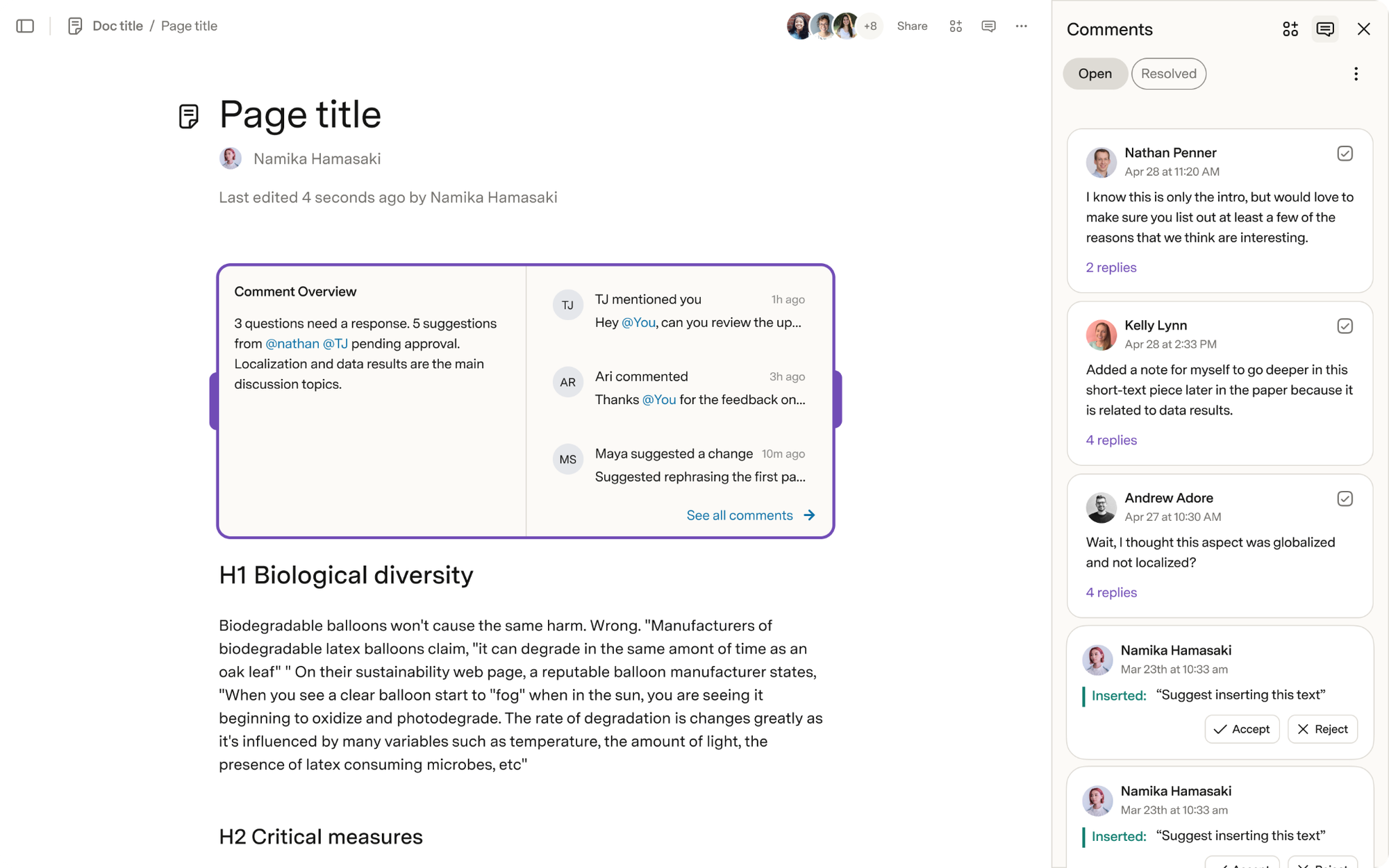
My second was focused on Grammarly Docs, our web-based document editor. It was a project that I identified and helped scope. I noticed that while Grammarly Docs has many powerful tools and agents to help refine existing writing (e.g., proofreading, AI-text detection), it doesn’t provide sufficient support to help users start writing; if users don’t have any text to add to the editor, then they won’t get to see Grammarly’s value and may potentially drop off. I thought about ways to use tools like Grammarly’s AI Chat or uploading existing writing into Grammarly to make this process easier. This work has been launched, and we are tracking its performance with users.
Was there advice from a mentor or teammate that changed how you approached your work?
A designer whom I’d met during the interview process was kind enough to check in on me throughout my internship. At one point, I was in a bit of a rut because I was blocked on most of my scoped work. He told me to “be unbounded, find things that annoy you, and prototype.” From that point on, I stopped limiting myself to what I was “supposed to do” and began expanding into areas that interested me. For example, I started prototyping features I had designed on a local branch of Superhuman Docs in order to share my ideas more effectively. By doing so, I unlocked opportunities to join new projects and even helped other designers start to experiment with building in this way.
You were part of Superhuman’s first-ever product design intern cohort. What advice would you give to next year’s interns?
Internships can often be very structured and limiting, especially at bigger companies with strict hierarchy and processes. But at Superhuman, the teams are very flat, and you can really advocate for the work you want to do. For example, I got to work on Grammarly Docs after identifying a real problem, and the team allowed me to take ownership of finding a solution. So my biggest piece of advice is to trust that you were hired because you bring something unique to the table and don’t be afraid to speak up.
Fun question: What was your favorite intern event?
I enjoyed our intern fun event at Sandbox VR, an immersive virtual reality experience where we all could get to know each other better by exploring virtual worlds together.
Hao Liu

University: University of Michigan, Master of Science in Information
Team: Superhuman Go
Tell us what drew you to product design and to Superhuman specifically?
I have always been drawn to environments where design plays an important role in solving meaningful business problems. Superhuman is an especially exciting place to explore this intersection, as the company navigates challenges such as building a unified brand, creating value across a growing product suite, and helping new users discover that value. I was also excited to be part of Superhuman’s first product design intern cohort. Because there was no established playbook, I had room to be proactive, take on meaningful responsibilities, and explore where I could add the most value.
Tell us about your internship project at Superhuman.
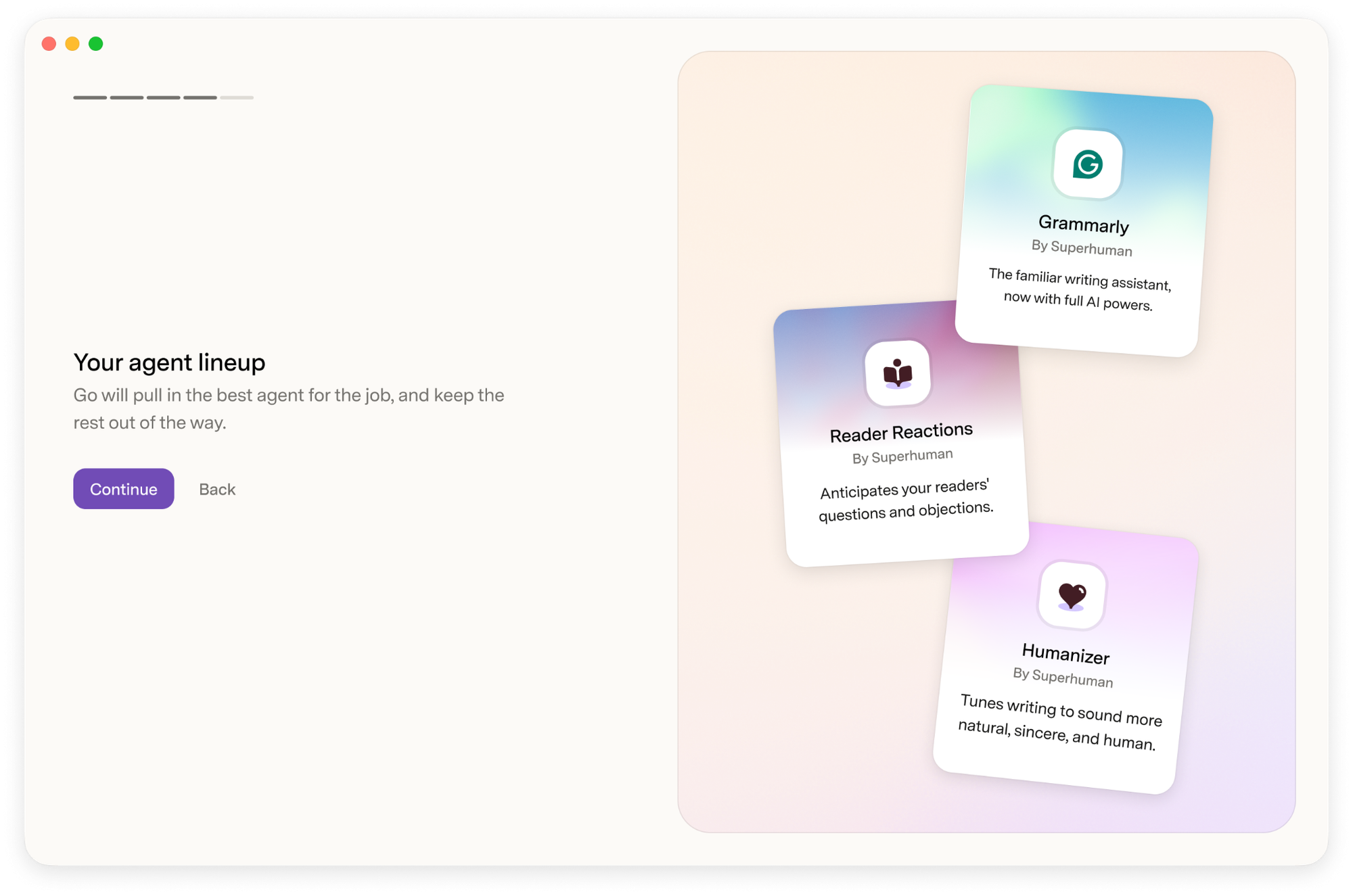
My project focused on improving onboarding and early activation for Superhuman Go, an AI assistant that works across apps and browser tabs. The core challenge was helping new users quickly understand a new agent-based product, complete setup without friction, and reach a meaningful first action without feeling overwhelmed or dropping out of the flow. I approached this by narrowing onboarding to a single page that introduced the highest-performing free agents, so new users could see exactly what they had access to and reach a meaningful first action quickly. This solution is now shipped and in production for users!
Was there advice from a mentor or teammate that changed how you approached your work?
One of the most important lessons I learned from my mentor was that moving quickly does not mean skipping the divergence stage of the design process, the problem-solving phase where you explore a wide range of ideas. In fact, I learned it is best to be intentional about what I explore deeply and to do so in a way that makes specific trade-offs easier to flag and discuss (e.g., exploring more ambitious versus lightweight solutions).
For example, for my project, I decided to spend more time finessing the animation for the onboarding flow because I was interested in ways to introduce more delight into the first-time user experience. To buy time for this exploration, I provided our Engineering team with the basic logic so they would not be blocked, while I worked closely with a motion designer to develop different options with varying degrees of expressiveness. This allowed us to consider the full range of potential solutions and make an intentional choice, rather than just moving forward with the first option we came up with. In our case, we decided to ship a restrained version for the minimum viable product and prioritized the richer animation proposal as a follow-up iteration.
Zooming out, what did you learn about product design from working at Superhuman?
I used to think of a designer’s role as simply taking a defined problem and translating it into thoughtful, beautiful screens, but it’s so much more than that. Every member of the team brings a different perspective to the conversation, whether it’s user needs, business goals, or technical constraints, and designers are uniquely positioned to drive alignment. We can help identify the most important questions and use concrete proposals to help the team make trade-offs and intentionally align on a path forward.
Fun question: What is your favorite Superhuman feature?
My favorite Superhuman feature is the AI companion in Superhuman Go. I was really annoyed with opening multiple tabs just to find a quick answer, refine grammar and tone, or repeatedly explain context to an AI tool. Go helps me do all of that without constantly switching between applications.
Kyrene Tam
University: University of California, Berkeley, BA in Architecture
Team: Superhuman Mail
Tell us what drew you to product design and to Superhuman specifically?
I shifted my career from architecture to product design because it better captures the intersection of my interests: connecting with people through problem-solving, innovation, and a holistic understanding of their needs. I was drawn to Superhuman because, during my interview, I sensed a genuine care for one another and for the product itself from the team. That warmth made it feel like a place I’d actually want to work.
Tell us about your internship project at Superhuman.
My internship project focused on improving team scheduling within Superhuman Mail. Currently, scheduling across multiple teammates in Superhuman Mail can be challenging to navigate and can sometimes feel disconnected from the rest of a user’s workflow. My work focused on making availability across team members’ calendars viewable at a glance, making scheduling more delightful, and letting users shape the calendar to how they work. The project is in development and is expected to launch soon.
While working on this project, did a teammate offer advice that changed how you approached your work?
Throughout my summer, when I hit blocks, I often turned to my mentor, Gloria, for advice. Instead of giving me the answer, she would often ask me questions. For example, she often asked me questions about research I’d done, and answering them helped me figure out what to do next. Over time, I realized that asking the right questions almost always leads to new ideas or creates a path forward.
In fact, during an intern event, Shishir Mehrotra, Superhuman CEO, mentioned a similar concept. He discussed asking the right questions, a concept he calls eigenquestions, to identify what actually matters. This idea really clicked for me during my internship.
You were part of Superhuman’s first-ever product design intern cohort. What advice would you give to next year’s interns?
I’d encourage them to trust their instincts and not be afraid to share their ideas. In the first half of my internship, I was afraid of showing designs that weren’t fully developed yet. But after receiving feedback, I realized that no matter how early stage your designs are, it can help you identify where your ideas are already resonating and where there are opportunities to strengthen them.
Fun question: What is your favorite Superhuman office snack?
Dried mangoes!
Echo Cho
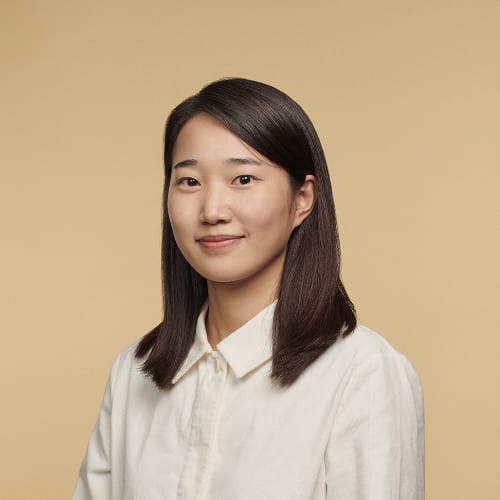
University: Georgia Institute of Technology, MS in Human-Computer Interaction
Team: Growth
Tell us what drew you to product design and to Superhuman specifically?
When I was growing up, my grandmother would tell me stories about guardians who live inside objects, protecting us. That idea has always shaped how I want to design. I don’t think of the things I design as simply tools people use, but instead as companions that care for people and help support their everyday lives. That belief has guided my path ever since, and it’s what drew me to Superhuman, where I believe I can build products that genuinely support and help people.
Tell us about your internship project at Superhuman.
My main project focused on helping longtime Grammarly users discover Superhuman Go at natural moments in their workflow. To do this, I identified moments where Go could complement existing workflows—for example, by helping users identify AI-generated text in content they were already reviewing with Grammarly. This work is currently in development and will be shipped to users soon.
Was there advice from a mentor or teammate that changed how you approached your work?
I was encouraged to test and fail fast. Initially, I found it challenging not to overinvest in polishing design details. But when you are designing something new, it is useful to design experiments that can be built and tested quickly. I realized that designing something to be easy to evaluate is a design decision, and enabling your team to quickly evaluate and ship an idea is a win in itself.
You were part of Superhuman’s first-ever product design intern cohort. What advice would you give to next year’s interns?
I’d encourage next year’s interns to trust and advocate for their point of view. Being fresh out of school and unfamiliar with the product can actually be a real advantage for the team. You notice things longtime team members and users have stopped questioning, and you bring a fresh perspective that can spark new ideas.
For example, as a former Grammarly user, I felt nervous the first time I used Superhuman Go. I brought this to the team, and we realized we needed more education to explain this transition to users, along with safeguards for Grammarly users to ensure they understood they weren’t losing any features they valued. I’m proud I brought this up because I feel it has created a better experience for all customers—the team is genuinely open to all voices, and your contribution matters!
One fun question: What is your favorite Superhuman office snack
Gummy bears!
Looking forward
In just three months, our first cohort of product design interns has helped meaningfully shape the Superhuman product experience—whether it’s redesigning an onboarding flow or helping to better integrate various products—by bringing fresh perspectives, thoughtful questions, and real ownership. We’re incredibly proud of what our interns have accomplished and wish them the best of luck as they finish up their studies.
Interested in next year’s internship program? Stay tuned for updates on our career page.