Coda is now Superhuman Docs — the best place for teams and AI to work together

TL;DR
- Coda is now Superhuman Docs: All the same features you rely on, now with a new name and visual identity that bring us closer to a unified suite with Mail, Go, Grammarly, and more.
- A new AI assistant, rebuilt from the ground up: Docs AI goes beyond a basic chat experience. It lives inside your doc and can build with you, so you can ask it to summarize a brainstorm, create a project tracker, or build a request intake workflow without ever leaving the page.
- The MCP is here for everyone: Connect Docs to Claude, ChatGPT, Cursor, or whatever AI tool your team already uses, and your doc stays the single source of truth.
- AI Views (closed beta) let you build anything just by describing it: You’re not constrained to standard building blocks. Describe what you need, and Docs builds it live on top of your data.
- Your data can scale to new limits: Full-page tables give structured data room to breathe, and Superhuman Databases (closed beta) handles up to 1,000,000 rows without slowing down.
The journey from Coda to Superhuman Docs
We built Coda with the simple belief that a doc could be more than just a place to write. It could be a familiar surface where teams get work done, with all the information, decisions, workflows, and people in one place. That belief shaped everything we built. Tables that keep everyone organized around the same data. Buttons that help you take action. Formulas that keep things up to date automatically. Integrations that connect to other tools your team uses. And most importantly, a community of makers who pushed every one of those building blocks further than we imagined.
Over the past couple of years, our work has evolved in exciting and unexpected ways. Individuals are more productive than they've ever been with the help of AI, but teams are more fragmented and siloed. Everyone is now spending more time in separate tools and private chat windows, off to the side of where the team actually comes together. But the best work never happens alone; it happens when a team can see it, question it, build on it, and with the help of AI, make it better together.
Creating the best surface for teamwork has been our passion for ten years. Every table, every formula, every shared view turned the doc into a place for teams to solve problems together. That collaborative surface is exactly what's missing from how most people use AI today. Many AI products deliver a magical single-player experience. We bring AI directly to your team, on a surface built for collaboration from the start.
The team has been heads-down and focused on delivering what we’re shipping today. We redesigned our entire AI backend and wove it into the surface itself, so it works with your whole team's context instead of one person's chat window. We rebuilt the data foundation, so your team's critical information can grow to new heights without slowing down. And we made it possible to go beyond Coda’s building blocks to create new views without constraints. The result is a surface where a whole team and their AI work as one, and where people are more capable together than they could ever be alone.
So, we gave the product a new name to match this new experience and to set a new foundation for integration into the Superhuman suite. Coda is now Superhuman Docs, the best place for teams and AI to work together. For those of you who’ve been building with us for a decade, consider this the Coda 5.0 you’ve been waiting for. For everyone here for the first time, Docs is the collaborative surface designed for how your team works, so AI output is never stuck with one person. It's shared, editable, and built on by everyone.
A new name, and a new look
We don't take renaming Coda lightly. "A doc, backward" has been our identity for years, and we loved it.
But we also wanted a name that matched where we're going, not where we've been. We're building something bigger: a Superhuman suite that includes Go, Mail, Calendar, Docs, Grammarly, and more on the way. Superhuman Docs, or as our beta users have affectionately called it, SuperDocs, isn't Coda's ending. It's our next chapter, one built so you and your team get the full benefit of everything we're building together.
What doesn't change is everything you've built. All existing Coda docs automatically become Superhuman Docs from day one. The makers who pushed every building block to its limit, the teams who ran their most complex operations in it, the community that showed up to early Block Parties and left incredibly thoughtful feedback in the forums — that’s what made Coda the right foundation for this moment. All of that comes with you now. And there is one more thing worth saying directly: your pricing isn’t changing. Everything we are launching today is included in your plan, and Maker Billing remains.
The most visible change you’ll notice is a refreshed look and feel. We’ve updated to a beautifully designed custom typeface called Super Sans. It’s designed so that reading and writing in Docs feels great out of the box without any formatting work. New icons, new illustrations, and new borders give the canvas a subtle hint of paper on a desk. Your work sits above everything else, so you can focus.
Our amazingly talented design team wrote about their process and the thinking behind the updates here.
A new approach to AI
One of our design principles at Coda has always been to create a product with a “low floor and high ceiling.” That’s part of why we started in a familiar doc and not an app builder. With powerful building blocks like tables, formulas, automations, buttons, and forms, you’d never run out of room to build. But a lot of the building required skills that took time to learn.
AI lowers that floor so that more people have access to the power of building.
Docs AI: AI that works like a teammate
In Docs, AI is built into the surface itself, instead of a separate application you prompt and paste from. Docs AI works with you the way a teammate would, with full context of everything your team has built: your data, your briefs, your roadmaps, your connected tools. You get the familiar back-and-forth of AI chat, but grounded in what's actually happening across your team's work.
We’ve heard from customers with early access to Docs AI that ‘it just works’ in the most delightful way. Ask it to summarize your current sprint. Ask it to compare your pricing against a competitor and create a page with the analysis. Ask it to draft a decision record from your meeting notes. Ask it to recommend improvements to a ritual you’ve created or help someone understand what they’re looking at when they open a doc for the first time. Writing work, data work, synthesis work on the same surface, with the same AI, without context switching.
Today’s launch builds on a foundation we’ve been developing along the way. Earlier this year, we upgraded AI columns so that they're faster, more consistent, and no longer require @ references to work. Just describe what you want the column to do, and AI will figure out the context and changes to apply.
We also updated AI blocks, so you can summarize any page or table, surface action items automatically, find themes across large sets of content, all at scale. Both of these are live today and meaningfully better than they were six months ago.
Docs MCP: Connecting Docs to your AI stack
I've always believed the tools we love should connect, not compete. We moved in this direction years ago when we opened our Packs platform so makers could extend Coda with the tools they already used. Earlier this year, we made another step with the beta launch of the Coda MCP, which brings the full context of your docs into whatever AI tool your team reaches for.
Your team is probably already using Claude, ChatGPT, Cursor, and other tools, then manually figuring out how all of it connects back to where your team actually works. We're not going to pretend otherwise, and we're not going to build walls around your data to force a choice between the AI your team loves and the doc where your work lives.
These tools exploded in popularity as single-player tools. Collaboration isn’t their focus, and the work they produce is evidence of this, requiring users to move outputs between tools to collaborate effectively. Docs is built to be their companion, a multiplayer surface where everything those tools produce stays connected and moves forward with your team.
Even while in beta, the MCP has become the fastest-growing feature we’ve ever launched. In just eight weeks, we’ve shipped 40+ improvements and feature enhancements shaped directly by those using it. People keep telling us that the MCP is changing how they work with AI entirely.
Today, we’re launching the Docs MCP for everyone. You can ask questions, request updates, and build docs right from your preferred AI tool, and everything is reflected back in Docs in real time. And your single source of truth stays current no matter where the work is happening.
We’ve already launched official connectors with OpenAI and Anthropic, and you can read more about them here. Want to bring Docs context into your own AI platform? Reach out to our partner team.
AI views (closed beta): Build anything just by describing it
Docs AI lowers the floor for what anyone can build in a doc. AI views go a step further by removing the constraint of building blocks entirely.
Until now, you were working with a powerful but limited set of building blocks. You had powerful views, like cards, calendars, charts, and forms. But if what you needed wasn’t on that list, you were stuck.
AI views changes that. Now anyone on the team can build what our standard views never could. Just describe what you need. Docs builds it on top of your live data, right inside the doc your team is already working in. When something is updated in an AI view, that change flows through to every other view in your doc.
This isn’t a template. It’s something that didn’t exist until you asked.
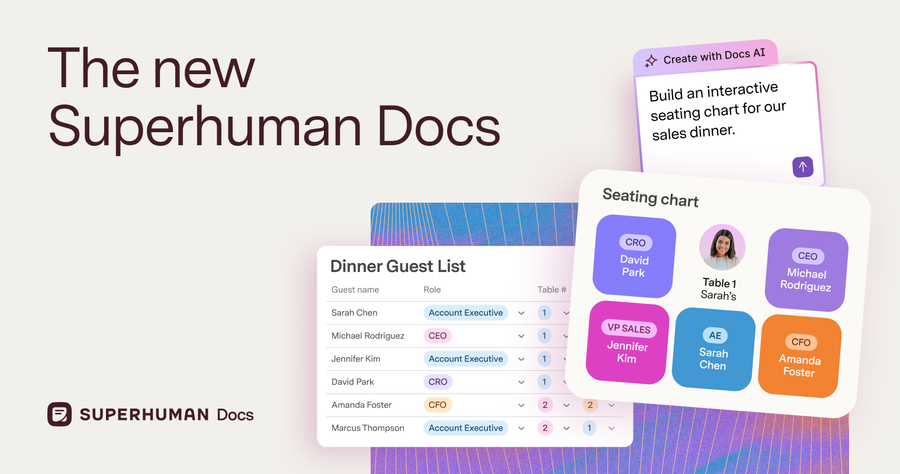
While we were testing AI views internally, I was surprised at how creatively people used it. A sales team turned their VIP dinner registration list into a live seating chart. Engineers built a cost dashboard with sliders and heatmaps to model LLM spend. A team built a weekly standup tracker-turned-leaderboard, including who’s shipping and who’s blocked. All of it from a prompt, all of it built on live data, all of it collaborative by default.
These aren’t static widgets. They are AI-created and incredibly dynamic. Just like other building blocks, data always stays in sync across views. So the seating chart doesn’t just arrange dinner guests, it reasons about where to seat people based on what’s in your table. And the cost dashboard doesn’t just display numbers, it shows you what’s changed and why.
AI views is the latest example of how Superhuman Docs makes it easier than ever to build and collaborate on whatever your team needs to get work done.
Sign up for the AI views closed beta here. And if you want to read more, check out this deep dive from the team behind the feature!
A new approach to data
Hundreds of teams have been using Coda as the central database for their projects, goals, and team operations for years. As the teams grew, so did their data. To keep up with the massive influx of mission-critical data, we rebuilt our data layer from the ground up. So these teams can scale. And so we can build toward a surface where people and agents work together on the same source of truth.
Table pages: Data that lives where your team works
Most data work in a doc happens in the middle of a page, surrounded by text and context that's useful for writing but gets in the way when you're doing serious data work.
Table pages are a new type of page that gives your data a dedicated page to work from. More room to edit, track, and manage structured data without the surrounding text getting in the way. Docs AI works natively with table pages too — ask it to find patterns, flag anomalies, or summarize your data the same way it would any other part of your doc.
Superhuman Databases (closed beta): Scale to a million rows without sacrificing performance
Data is what makes AI useful. Agents need a single source of truth, and so do the people working with them. But teams have long faced an impossible choice: use a productivity tool and hit a data ceiling, or use a dedicated database and lose the collaborative workspace, with data drifting out of sync from where work actually happens.
Superhuman Databases is an entirely new product and dedicated home for your data that scales to a million rows without sacrificing performance.
One database connects to many docs, so your org-wide project tracking or product roadmap lives in one place and flows into every doc that needs it. Each doc only loads what it needs, which means the surface stays fast no matter how large your data grows. And because data permissions are managed separately from doc permissions, the right people see the right things.
If you've been managing org-wide project tracking or product roadmaps in Coda and wrestling with Cross-doc syncing for years, this is what you've been waiting for.
Sign up for the Superhuman Databases closed beta here.
Ready to try it out?
For our existing users, this launch is as much yours as it is ours. The problems you pushed us to solve, the building blocks you stretched beyond what we imagined, the feedback you left in community posts and meetups and support threads and dinner conversations, it’s shaped everything we’ve built.
We are launching Superhuman Docs today and it will be available in waves over the next 24 hours. All existing Coda docs automatically become Superhuman Docs and we put together a full FAQ to help you during this transition.
For everyone finding us for the first time, you're arriving at an exciting moment. The tool has a long history of being a single source of truth for some incredible teams across the globe. Every building block was shaped by millions of people figuring out how to make their teams work better. The AI you're getting isn't bolted onto a document, but built into the most real-world-tested collaborative surface we know how to build. We hope you will give it a try, you can sign up for free here.
And of course, we’re just getting started on this new foundation. We are building toward something much bigger: an AI-native Superhuman Suite that brings together the power of Go, Grammarly, Mail, Docs, and Databases. So you can soon build and orchestrate agents in your Docs, Databases can power their workflows, and so much more. We are humbled and grateful to have you on this journey with us.